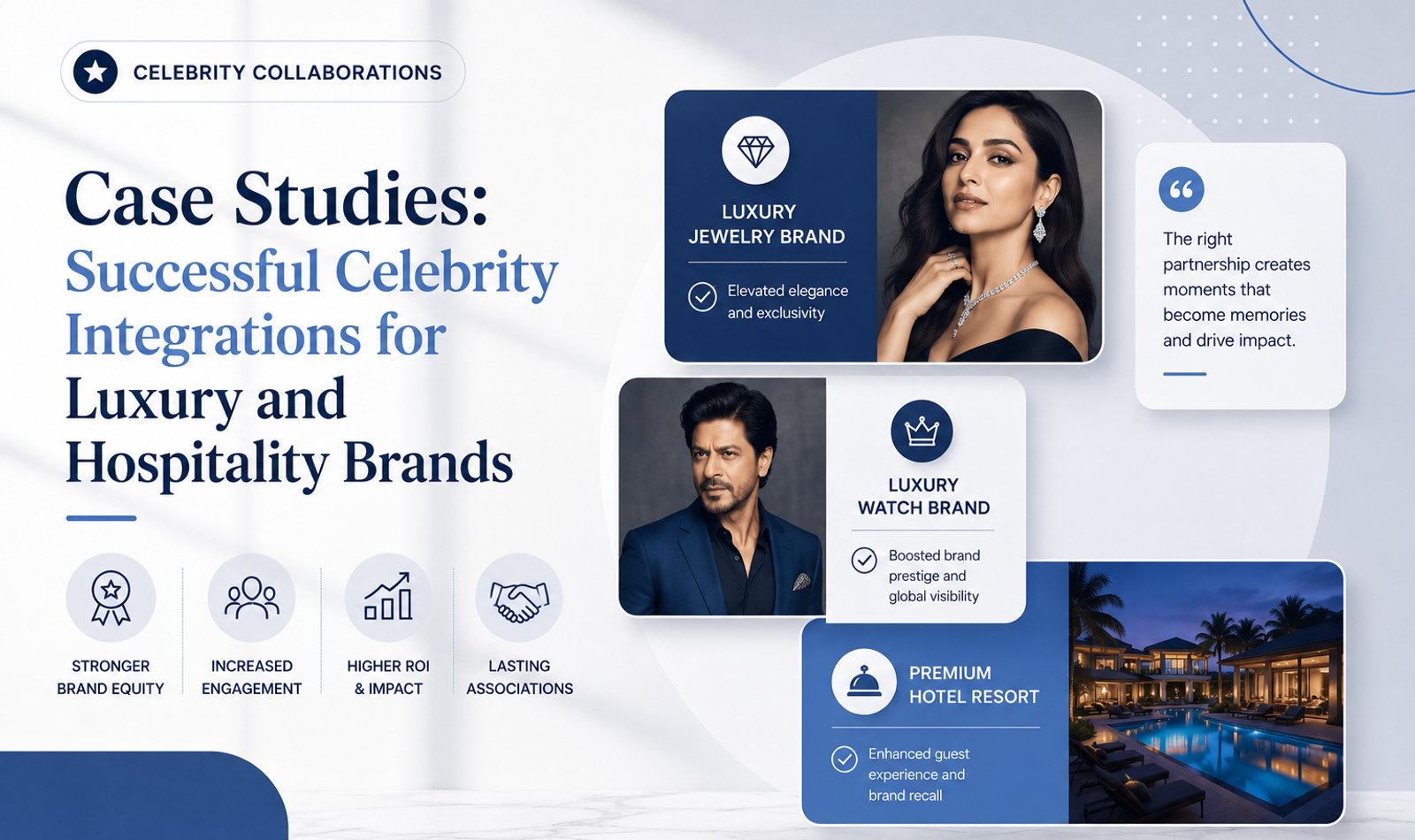
Case Studies: Successful Celebrity Integrations for Luxury and Hospitality Brands
Celebrity integration can give a luxury or hospitality brand immediate visibility, but visibility alone does not make a partnership successful.
A recognised face may attract attention to an advertisement, hotel launch, collection or event. However, the commercial value depends on what happens after that first moment of recognition.
The celebrity must fit the brand’s identity. The creative concept should connect the celebrity naturally to the product or experience. The brand must also have suitable content rights, distribution, booking pathways and measurement systems in place.
Professional celebrity management services can help brands evaluate talent fit, negotiate deliverables, coordinate appearances and manage the relationship between the celebrity, campaign and customer experience.
Successful celebrity integrations do not use fame as a substitute for strategy.
They use celebrity identity as one component within a larger brand experience.
For luxury brands, the celebrity may communicate design, aspiration, exclusivity, cultural relevance or personal achievement. For hospitality brands, the celebrity may help translate an intangible promise into a recognisable human story.
A hotel cannot be evaluated in the same way as a physical consumer product before purchase. Customers must imagine the feeling of arriving, staying, dining and being cared for.
A suitable celebrity can make this experience easier to understand.
Celebrity partnerships in luxury and hospitality can take several forms. A public figure may become a global ambassador, appear in a short campaign, host an experience, perform at a property, curate a suite, design a menu or participate in a cultural programme.
Each model produces a different type of return.
The following case studies examine several publicly documented celebrity integrations and identify the strategic lessons luxury and hospitality brands can apply to their own campaigns.
The objective is not to claim that one model works for every business. It is to understand why particular integrations become meaningful while others generate only temporary attention.
What Makes a Celebrity Integration Successful?
A successful celebrity integration begins with alignment.
The public figure’s identity, audience and cultural meaning should support the brand’s desired position.
This does not mean that the celebrity must already be a customer or expert in the category. It means that the audience should be able to understand why the partnership exists.
A defined luxury brand strategy roadmap can help the business clarify its audience, positioning, emotional territory and competitive difference before it approaches talent.
The second requirement is a strong creative role.
The celebrity should do more than stand beside a logo. Their personality, story or expertise should contribute to the campaign experience.
The third requirement is integration across channels.
A partnership creates greater value when the campaign can move through advertising, social media, editorial coverage, events, booking platforms, loyalty programmes and customer experiences.
The fourth requirement is commercial accessibility.
A customer inspired by a celebrity campaign should have a clear next action. They may be able to book the featured hotel, reserve the experience, join the loyalty programme, explore the collection or make an enquiry.
Finally, the brand should define success before launching.
Reach, bookings, qualified leads, direct revenue, earned media, brand recall and loyalty engagement are different outcomes. A campaign cannot be evaluated honestly when the objective was never defined.
Case Study One: Hilton and Deepika Padukone
The Strategic Context
Hilton’s partnership with Deepika Padukone provides a strong example of celebrity integration within a larger hospitality brand platform.
The campaign was not presented as a separate celebrity promotion disconnected from the company’s wider strategy.
It formed part of Hilton’s established “Hilton. For the Stay” platform and its “It Matters Where You Stay” communication.
This distinction is important.
Hospitality advertising often focuses heavily on destinations. Customers are shown beaches, city views, restaurants and cultural attractions. The accommodation can become secondary.
Hilton’s platform places the stay itself at the centre of the communication. It emphasises the hotel experience and the importance of being properly cared for during travel.
Deepika Padukone’s role supported this idea through a culturally relevant and highly recognisable personality for Indian and international audiences.
The partnership connected a global hospitality company with an Indian celebrity who has broad awareness, premium positioning and international recognition.
Why the Celebrity Fit Worked
Deepika Padukone’s public identity aligns with several qualities relevant to a major hospitality brand.
She is associated with global travel, cinema, fashion and premium brand partnerships. At the same time, she has strong cultural familiarity within India.
This allowed Hilton to create communication that could feel locally relevant without appearing limited to one regional audience.
The partnership also supported Hilton’s wider expansion and brand-building activity in India.
The celebrity did not need to explain the technical features of every Hilton property. Her role was to help humanise the idea that the quality of the stay changes the quality of the complete journey.
This is an important principle for hospitality marketing.
A celebrity should not be required to communicate every room category, amenity and booking condition within one campaign.
The integration should introduce a memorable emotional idea. The website, property pages and booking experience can then provide the detailed information.
The Creative Integration
The campaign used Deepika Padukone within a story about the details and service moments that make a stay meaningful.
The content was distributed through both Hilton’s and Padukone’s social presence, including collaborative platform features.
This gave the campaign access to the brand’s established audience and the celebrity’s own community.
The celebrity integration remained connected to Hilton’s global message rather than becoming a completely different India-only identity.
This balance is difficult to achieve.
A global brand needs local relevance, but it should not fragment into unrelated regional campaigns.
Using a culturally significant ambassador within an existing global platform allowed Hilton to localise the storytelling while maintaining brand consistency.
Brands planning similarly cinematic integrations can use professional AI video and video-editing services to develop campaign films, social adaptations, multilingual versions and supporting visual assets.
Reported Performance
Hilton publicly reported that the 2025 campaign generated more than 1.9 billion Instagram Reel views and 5 billion views across channels within eight weeks.
These figures demonstrate exceptional distribution and attention.
However, reach should not be the only lesson taken from the campaign.
The result came from the relationship between celebrity relevance, creative quality, platform distribution, collaboration features and an existing global brand structure.
A smaller hospitality company cannot assume that hiring a popular celebrity will automatically produce comparable numbers.
The brand must also have sufficient distribution, public interest, production quality and booking infrastructure.
What Luxury and Hospitality Brands Can Learn
The first lesson is that the celebrity should enter an established brand idea.
When the business already understands its positioning, the celebrity can amplify it.
When positioning is unclear, the campaign may become memorable only because of the celebrity.
The second lesson is the value of cultural translation.
A global brand can use a locally influential celebrity to make a universal promise feel personally relevant.
The third lesson is that social collaboration should be planned contractually and creatively.
The brand should define where the content will appear, whether collaborative posting tools will be used and how paid distribution can extend the campaign.
The fourth lesson is that attention must connect to a commercial system.
Hospitality brands should ensure that interested customers can discover relevant properties, understand the offering and move towards booking.
A connected luxury brand funnel from awareness to conversion can help turn campaign discovery into property exploration, booking intent and qualified customer action.
Case Study Two: Hilton and Paris Hilton’s “Stay Like an Infinite Icon”
Moving Beyond Traditional Endorsement
Hilton’s work with Paris Hilton illustrates a different celebrity-integration model.
Instead of limiting the relationship to advertising content, Hilton converted the celebrity’s recognisable identity into an actual stay experience.
The “Stay Like an Infinite Icon” suites at The Beverly Hilton were created to celebrate Paris Hilton’s album and personal style.
Guests could book the themed suites for a limited period, while selected Hilton Honors members and sweepstakes participants could access additional experiences.
This integration transformed celebrity association into a physical hospitality product.
Customers were not simply asked to watch Paris Hilton describe a stay. They were invited to enter an environment designed around her public identity.
Why the Partnership Had Natural Brand Relevance
The connection between Paris Hilton and Hilton carries immediate cultural recognition because of her family relationship with the hospitality name.
The collaboration therefore had a built-in narrative that audiences could understand quickly.
However, the brand did not rely only on this historical connection.
The themed suite incorporated Paris Hilton’s current music, visual identity, personal style and fan culture.
The campaign connected Hilton’s brand platform with a contemporary entertainment launch.
This made the collaboration relevant to both Hilton’s hospitality audience and Paris Hilton’s fan community.
The strongest celebrity integrations often contain this type of mutual benefit.
The brand receives cultural relevance and audience access. The celebrity receives a credible environment in which to extend their current work or identity.
Turning Attention Into a Bookable Experience
One of the most important aspects of the campaign was that the celebrity concept became commercially accessible.
The themed suites were available for booking during a defined period.
Hilton Honors members could also use points to bid for an experience, while a sweepstakes created another participation pathway.
This allowed the campaign to serve several audiences.
Premium customers could book the suite directly. Loyalty members could engage through the rewards programme. Fans could participate through the promotional competition. Social audiences could explore the content even if they did not travel.
The partnership therefore operated across direct revenue, loyalty engagement, fan participation and media storytelling.
This is more sophisticated than a traditional endorsement in which the celebrity appears in a film and the audience is sent to a general homepage.
High-value campaign pages should follow suitable conversion-optimization strategies for luxury brands so customers can move from inspiration to booking without encountering unnecessary friction.
Creating Genuine Scarcity
The limited availability of the suites created authentic scarcity.
The experience was tied to specific dates, a particular property and a cultural moment connected with the album.
This is different from artificial urgency.
The scarcity existed because the physical product could only accommodate a limited number of guests.
Luxury and hospitality brands can use this principle effectively.
A celebrity-curated suite, menu, itinerary, retreat or private event can create value precisely because it is not permanently available.
However, the brand must explain the booking period, inclusions and conditions clearly.
Scarcity builds desire when it feels real. It damages trust when availability is manipulated continuously.
Extending the Celebrity World Into Design
The suite allowed the hospitality environment to become part of the storytelling.
Colours, objects, references and amenities reflected Paris Hilton’s identity.
This created opportunities for photography, social content and guest-generated media.
The room itself functioned as a campaign asset.
Luxury hotels frequently have spaces that can be temporarily transformed around a collaborator. However, the design should remain professionally executed and consistent with the property’s service standards.
Placing a celebrity’s photographs in an ordinary room is not enough.
The experience should feel intentionally curated.
Lessons From the Integration
The first lesson is that hospitality brands can convert celebrity storytelling into inventory.
A suite, dining experience or itinerary can become the commercial expression of the collaboration.
The second lesson is the value of loyalty integration.
Celebrity campaigns can strengthen membership programmes by creating exclusive access that cannot be purchased easily through normal channels.
The third lesson is that limited experiences can generate content before, during and after the booking period.
The brand can announce the partnership, reveal the space, document celebrity visits, share guest reactions and publish a final campaign story.
The fourth lesson is that the celebrity’s identity should influence the customer experience, not merely the advertising.
Case Study Three: Hilton’s Long-Term “For the Stay” Use of Paris Hilton
Building a Recurring Celebrity Role
Paris Hilton has also appeared within Hilton’s wider “For the Stay” communication.
This demonstrates the difference between a single campaign and a recurring celebrity platform.
Repeated use can strengthen memory because the audience sees the celebrity connected with the same brand idea across different formats.
Hilton has extended this relationship through conventional advertising, themed hospitality experiences, digital activations and product-style collaborations.
For example, the relationship was expanded into virtual environments and a branded waffle collaboration for Hampton by Hilton.
This shows how a celebrity partnership can move across the parent brand and selected sub-brands while maintaining a recognisable creative thread.
The Advantage of a Flexible Celebrity Platform
A flexible platform gives the brand several ways to activate the celebrity.
The celebrity can appear in a film, support a social activation, inspire a physical experience or contribute to a limited product.
This creates more value from the relationship than one isolated piece of content.
However, flexibility requires detailed contracts.
The brand must define which properties, sub-brands, products and channels may use the celebrity’s identity.
A parent-company partnership should not automatically be assumed to cover every hotel brand and every future activation.
Each extension should fit the celebrity and the audience.
The Hilton example works because the relationship is culturally understandable and can be adapted playfully.
Brands should develop a connected content strategy for blogs, galleries and lead magnets so one celebrity partnership can produce campaign films, project stories, landing pages, galleries, media assets and lead-generation content.
The Risk of Overdependence
Long-term celebrity use also creates risk.
The brand can become too dependent on the personality. Customers may remember the celebrity but not the specific service promise.
The campaign should therefore keep the brand’s central idea visible.
In Hilton’s case, the celebrity communication repeatedly returns to the importance of the stay.
The celebrity attracts attention, but the hospitality message remains central.
This is an important distinction for luxury brands.
The celebrity should amplify the brand world, not replace it.
Case Study Four: W Hotels and the W PRESENTS Music Series
Celebrity Integration as Cultural Programming
W PRESENTS demonstrates a model based on recurring artists and live cultural experiences rather than one permanent ambassador.
W Hotels describes the programme as a global live music series featuring emerging and established artists who reflect the brand’s sonic identity.
The series has included performers such as Channel Tres, Aluna, NEIL FRANCES, Bora Uzer and Franc Moody across international locations.
This is a different type of celebrity integration.
The hotel brand does not depend on one person to communicate every message.
Instead, it builds an ongoing relationship with music culture through multiple performers.
The artists become part of the experience and reinforce the hotel’s positioning as a social and cultural destination.
Why the Model Fits W Hotels
W Hotels has long positioned itself around nightlife, music, design and energetic social experiences.
A live music platform therefore fits naturally within the brand’s identity.
The artists are not added to create temporary relevance for a conventional hotel event. They help express what the brand wants its properties to represent.
This strategic fit is essential.
A recurring music series would feel less natural for a hospitality brand positioned primarily around silence, privacy or traditional heritage unless it were adapted carefully.
Celebrity integration should emerge from the brand’s genuine character.
From Hotel Venue to Cultural Destination
The programme helps participating hotels function as destinations for local audiences as well as overnight guests.
This can create several forms of value.
The event may support food and beverage revenue, room demand, local awareness, social content and public relations.
It can also introduce the property to people who may not have considered visiting otherwise.
A hotel bar, rooftop or event space becomes associated with a wider cultural community.
This is particularly relevant for lifestyle hospitality brands that depend on local engagement.
A hotel can be commercially stronger when residents view it as part of the city’s cultural life rather than only as accommodation for travellers.
Professional event and wedding planning services can support similar programmes through venue planning, artist coordination, production, hospitality, security and guest experience.
Emerging and Established Talent
The combination of emerging and established artists allows the brand to balance recognition with discovery.
Established performers can create immediate attention. Emerging talent can make the brand feel culturally informed and forward-looking.
Luxury brands do not always need the largest celebrity available.
A carefully selected emerging artist may provide greater authenticity and flexibility.
The choice depends on the objective.
A flagship opening may benefit from a major name. A recurring cultural programme may create more credibility by supporting a range of relevant artists.
Extending Live Events Through Content
A live series can generate photographs, performance clips, artist interviews and destination content.
However, recording and distribution rights should be negotiated separately.
Payment for a live performance does not automatically permit the hotel to use the artist’s performance in advertising.
The brand should define whether it can publish event highlights, use photographs in future promotion or livestream any part of the performance.
A planned content strategy can extend the value of the event well beyond one evening.
Lessons for Hospitality Brands
The first lesson is that celebrity integration can become programming rather than advertising.
The second lesson is that recurring formats build stronger brand meaning over time.
The third lesson is the value of local relevance. Each property can participate in a global platform while selecting artists appropriate to its audience and city.
The fourth lesson is that the celebrity should contribute to the experience guests actually receive.
The audience is not merely viewing an advertisement. It is attending a branded cultural moment.
Case Study Five: Belmond’s Celebrity Chef Dinner Series
Using Expertise-Based Celebrity
Belmond’s Celebrity Chef Dinner Series aboard the British Pullman shows how hospitality brands can integrate recognised experts into a premium product.
The 2025 programme featured menus created by established Michelin-starred chefs, including Andrew Wong, Atul Kochhar, Phil Howard and Theo Randall.
The experience combined luxury rail travel, a champagne reception, sommelier-selected wines and a multi-course menu.
This model differs from using a film celebrity for broad awareness.
The chefs contribute category-specific authority.
Their expertise directly affects the product the customer purchases.
This is an important form of celebrity integration for luxury brands.
A recognised chef, designer, artist, architect or wellness practitioner may provide greater strategic value than a general entertainment celebrity when the experience depends on specialist credibility.
The Celebrity as Product Creator
The chefs were not positioned only as event guests.
They curated the menus at the centre of the experience.
This gives the celebrity a functional role.
The customer understands why the person is involved and what value they add.
Functional integration is usually more persuasive than decorative integration.
A luxury resort working with a wellness expert can create a programme based on that person’s methods. A furniture brand can develop a collection with a recognised designer.
A hotel can create a culinary residency with a chef.
In each case, the celebrity or expert contributes to the actual offering.
Combining Heritage With Contemporary Relevance
The British Pullman carries a strong heritage and luxury identity.
Bringing contemporary recognised chefs into the experience creates a bridge between established brand history and modern cultural relevance.
Luxury brands frequently face this challenge.
Heritage can communicate authenticity, but it can also become static when it is not reinterpreted for current audiences.
Celebrity creators can help renew the experience while respecting its foundations.
The collaboration should not overwhelm the brand’s history. It should provide a new reason to engage with it.
Creating a Ticketed Premium Experience
The dinner series created a defined purchasable product.
Customers were not merely invited to watch content about the chefs. They could reserve a place within the experience.
This makes commercial measurement clearer.
The brand can evaluate reservations, capacity, customer profile, food and beverage economics, repeat demand and earned media.
Ticketed celebrity experiences are particularly suitable for luxury hospitality because they combine scarcity, service and physical participation.
The customer receives a story they can personally experience and later share.
Lessons From the Chef Series
The first lesson is that expertise can be more important than broad fame.
The second is that the collaborator should influence the product directly.
The third is that celebrity integration can renew a heritage offering without removing its identity.
The fourth is that ticketed experiences create a clear conversion pathway.
Comparing the Case Studies
These examples demonstrate that celebrity integration is not one single marketing format.
Hilton and Deepika Padukone represent ambassador-led global advertising with measurable digital reach.
Hilton and Paris Hilton’s themed suites represent experiential product creation linked to loyalty and direct booking.
W PRESENTS represents recurring cultural programming across multiple properties.
Belmond’s chef series represents expertise-led product curation within a heritage hospitality experience.
Each model has different objectives.
The ambassador campaign is suitable for broad awareness and brand storytelling.
The themed suite is suitable for fan participation, earned media, loyalty engagement and direct experiential revenue.
The live music series helps shape the cultural identity of the hotel brand.
The chef series adds specialist credibility and creates a premium ticketed product.
A luxury or hospitality brand should not copy the visible format without understanding the underlying purpose.
The correct celebrity model depends on what the business wants customers to think, feel and do.
Celebrity Integration Should Begin With the Brand
The brand should define its own identity before selecting talent.
A luxury property based on wellness, privacy and nature may not benefit from a loud entertainment-led activation.
A lifestyle hotel with nightlife and social spaces may find music partnerships highly relevant.
A heritage hospitality brand may benefit from respected chefs, artists, authors or designers who can interpret its history.
The celebrity should strengthen an existing quality of the brand.
When the celebrity is selected first and the concept is created afterwards, the campaign may feel forced.
The Celebrity Needs a Meaningful Role
Successful integrations give the celebrity a clear function.
Deepika Padukone helps humanise the hospitality promise.
Paris Hilton inspires a physical suite and related experiences.
Artists within W PRESENTS perform and shape the property’s cultural atmosphere.
The chefs within Belmond’s series create the menu customers experience.
The celebrity’s involvement should be visible in the value offered.
A famous guest who appears briefly for photographs may still create publicity, but the integration is less likely to produce lasting brand meaning.
Convert Attention Into an Experience
Luxury and hospitality brands have a particular advantage because they can turn celebrity storytelling into physical experiences.
A campaign can lead to a themed room, private dinner, performance, itinerary, spa programme, design installation or limited event.
This creates a stronger connection between marketing and revenue.
The experience should remain bookable or actionable.
Customers need to know where, when and how to participate.
A beautiful campaign that leads to a general homepage may lose high-intent visitors.
A properly developed website and digital marketing system can connect campaign landing pages, booking journeys, analytics, remarketing and customer enquiries.
Use Scarcity Authentically
Celebrity collaborations often become more desirable when availability is limited.
A themed suite may exist for a short period. A chef dinner has a fixed number of seats. A live performance occurs at a particular place and time.
This scarcity is authentic because the experience has real capacity and scheduling limitations.
Brands should communicate availability clearly and avoid creating false urgency.
The limited nature should increase the meaning of the experience, not pressure customers unfairly.
Connect Celebrity Audiences With Brand Audiences
Follower count should not be the only selection criterion.
The brand should evaluate whether the celebrity’s audience is geographically, culturally and commercially relevant.
Deepika Padukone provided Hilton with strong relevance to Indian audiences while supporting an internationally recognised brand platform.
The artists in W PRESENTS align with audiences interested in music, nightlife and lifestyle hospitality.
Belmond’s chefs appeal to customers interested in culinary quality and premium experiences.
The audience relationship should make commercial sense.
A celebrity may have millions of followers but little relevance to the people likely to book the product.
Plan Rights Before Production
Celebrity integration creates several types of rights.
The brand may require permission to use the celebrity’s name, image, voice, social content or performance.
Live appearances, recordings, paid advertising, websites and booking pages may each require different terms.
The contract should define the media, territory, duration and approved purpose.
A hotel should not assume that photographs taken during an event can be used in future advertising indefinitely.
A chef’s name should not remain attached to a menu or package after the agreed period without renewal.
Rights management protects the brand from having to remove important campaign assets unexpectedly.
A detailed understanding of celebrity-appearance logistics and security coordination can also help brands plan contracts, access, backstage requirements, media movement and operational responsibilities.
Integrate Public Relations From the Beginning
Celebrity collaborations naturally attract press interest, but public-relations value should be planned.
The announcement needs a genuine story.
The most effective examples offer more than the fact that a celebrity is involved.
The story may be a new global ambassador, a bookable suite, an artist series or a unique culinary journey.
Media materials should explain what is new and why the collaboration is relevant.
Approved photographs, quotations, booking details and dates should be prepared before the announcement.
The celebrity’s publicist and the brand’s communications team should agree on the language.
Professional PR, media and digital-marketing services can help coordinate announcements, interviews, media kits, press distribution, social amplification and reputation management.
Create a Content Lifecycle
A celebrity campaign should not depend on one launch post.
The brand can plan content across several phases.
The first phase creates anticipation or announces the partnership.
The second reveals the concept, experience or campaign.
The third documents the celebrity’s involvement.
The fourth shares customer participation, behind-the-scenes details or expert insight.
The final phase reviews the experience and may introduce future opportunities.
This structure allows the brand to extend the collaboration without repeating the same message.
The content lifecycle should remain within the agreed rights period.
Brands can also review the benefits, costs and use cases of AI video advertising when developing teaser films, campaign adaptations and post-event content.
Build a Conversion Path
The customer should have a clear next step after encountering the campaign.
For an ambassador film, the path may lead to destination or property discovery.
For a themed suite, it should lead directly to booking information.
For a music event, it may lead to registration, room packages or venue reservations.
For a chef experience, it should lead to ticket availability.
The landing page should continue the campaign’s visual and verbal identity.
A premium campaign followed by a generic or confusing booking page weakens conversion.
The page should explain dates, inclusions, location, availability and relevant terms.
Measure the Right Outcomes
The correct measurement depends on the campaign model.
An ambassador campaign may be evaluated through reach, completed views, brand awareness, branded search, direct traffic and bookings.
A themed suite may be evaluated through occupancy, booking demand, loyalty participation, sweepstakes entries and earned media.
A live series may be evaluated through ticket or event attendance, food and beverage revenue, property engagement, local awareness and content performance.
A chef series may be evaluated through reservations, capacity, repeat customer interest, media coverage and premium customer acquisition.
Brands should avoid treating all celebrity partnerships as awareness campaigns.
When the collaboration creates a purchasable experience, direct commercial measurement should be included.
Distinguish Reported Results From Inference
Public campaign case studies often contain strong reach numbers but limited information about direct revenue.
Brands should distinguish between what has been publicly reported and what can only be inferred.
Hilton publicly reported the digital-view figures for the Deepika Padukone campaign.
The themed suites, music events and chef series demonstrate strategic integration, but complete internal financial results are not necessarily public.
It would be inaccurate to claim that these activations generated a particular return without verified data.
A responsible case study can still analyse the strategy, customer journey and potential value while remaining clear about the evidence available.
Consider the Complete Cost
Celebrity integration costs include more than the professional fee.
An ambassador campaign may require production, media, usage rights, exclusivity and localisation.
A themed suite requires design, property operations, content, booking management and customer service.
A live series requires production, artist travel, technical requirements, security and hospitality.
A chef experience requires culinary operations, ingredients, service training, ticketing and event coordination.
ROI should compare the complete investment with the relevant outcomes.
A campaign may generate exceptional attention but still produce weak returns when the activation and media costs are disproportionate to the business opportunity.
Protect the Guest Experience
Hospitality integrations must work operationally.
The guest should receive the experience promised in the campaign.
A themed suite should be prepared consistently for every booking. A celebrity-chef dinner should maintain service quality beyond the menu concept.
A live music event should provide suitable sound, security, access and hospitality.
Celebrity marketing can increase expectations.
When the property fails to deliver at the same level as the promotional communication, the partnership can create disappointment instead of trust.
A carefully designed guest journey for luxury events can help teams coordinate arrival, access, hospitality, seating, backstage movement and departure.
The operations team should therefore be involved before the campaign is announced.
Protect Privacy and Guest Information
Celebrity-led hospitality experiences may involve guest lists, loyalty information, private itineraries and VIP movement details.
The brand should restrict access to this information according to operational need.
Guest data should not be shared casually across suppliers, artists or event teams.
Photography, media and social-posting policies should also be communicated clearly, especially when customers expect a private or invitation-only experience.
A practical understanding of guest-data privacy at luxury events can help brands manage contact information, rooming lists, invitations and VIP details more responsibly.
Avoid Common Celebrity-Integration Mistakes
One common mistake is selecting the most famous available celebrity instead of the most strategically relevant person.
Another is building the campaign entirely around the celebrity while leaving the brand message unclear.
Some businesses negotiate a celebrity appearance but later use the content as though it were a long-term endorsement.
Others create a high-quality campaign without a strong landing page, booking route or customer offer.
A further mistake is underfunding distribution.
The brand may invest heavily in talent and production but leave insufficient budget to ensure that the right audience sees the campaign.
Poor operational planning can also damage hospitality integrations. Guests may book an experience that the property team is not prepared to deliver consistently.
Finally, brands may report views and press mentions without connecting them to meaningful commercial outcomes.
A Practical Celebrity Integration Framework
The process begins with the brand objective.
The business decides whether it needs awareness, repositioning, direct bookings, loyalty engagement, cultural relevance or event participation.
It then identifies the type of celebrity role most suitable for that objective.
The role may involve ambassadorship, content creation, experience curation, live performance or specialist collaboration.
The brand evaluates strategic fit, audience relevance, reputation and availability.
A concept is developed in which the celebrity contributes meaningfully.
Commercial discussions define fees, deliverables, usage, territory, duration, exclusivity and approvals.
Operations, booking, public relations, legal and digital teams review the concept before announcement.
A dedicated landing or booking journey is created.
Content is planned across the full campaign lifecycle.
Performance is measured according to the original objective.
After completion, the brand reviews direct outcomes, audience response, operational execution and the potential for renewal.
How Smaller Luxury Brands Can Apply These Lessons
A smaller brand may not have the budget for a global film star, but the same strategic principles still apply.
The business can collaborate with a respected regional actor, chef, designer, musician, athlete or creator whose audience fits the offering.
A boutique hotel may create a weekend experience with a recognised local chef.
A luxury wedding venue may host a curated performance or conversation.
A premium interior brand may collaborate with a designer on a limited collection.
A resort may develop a retreat with a credible wellness expert.
The collaborator does not need the largest following.
They need sufficient relevance, authority and audience trust to strengthen the experience.
A focused regional partnership may produce better commercial value than a national celebrity association with little strategic fit.
For Mumbai-based campaigns, brands can use professional event and wedding planning services in Mumbai to coordinate venues, production, artist movement, guest hospitality and on-ground execution.
Conclusion
Successful celebrity integrations for luxury and hospitality brands are built through alignment, creative relevance and commercial accessibility.
The celebrity should not appear as an isolated symbol of fame.
They should contribute to the brand’s story, customer experience or product in a way the audience can understand.
Hilton’s work with Deepika Padukone demonstrates how a globally recognised hospitality platform can be localised through a culturally influential ambassador and distributed at exceptional scale.
Hilton’s “Stay Like an Infinite Icon” suites demonstrate how celebrity identity can become a limited, bookable physical experience connected to loyalty and fan participation.
W PRESENTS demonstrates how a hospitality brand can use a recurring artist platform to establish cultural relevance and transform hotels into music destinations.
Belmond’s Celebrity Chef Dinner Series demonstrates how recognised experts can add functional value to a heritage luxury product through curation and direct customer participation.
These case studies represent different models.
One builds global awareness. One creates experiential inventory. One builds an ongoing cultural platform. One introduces expertise into a ticketed luxury journey.
The correct model depends on the brand’s objective.
Luxury and hospitality companies should define the desired business outcome before approaching talent.
They should evaluate audience fit, creative role, rights, operational requirements and conversion pathways together.
Public relations and content should be planned before the announcement. Booking pages and property teams should be prepared before demand is created.
The complete cost should include talent, production, rights, media, travel, operations and customer delivery.
Performance should then be measured according to relevant outcomes rather than celebrity reach alone.
Views and press coverage may indicate attention. Bookings, qualified enquiries, loyalty engagement, customer acquisition and repeat demand indicate deeper commercial value.
The strongest celebrity integrations make the brand more meaningful.
They create a reason for the audience to explore, book, attend or participate.
When celebrity identity, brand positioning and customer experience work together, the partnership can create value that continues beyond the initial publicity moment.
Plan a Celebrity Integration With Double Trouble Studio
At Double Trouble Studio, we help luxury, hospitality and lifestyle brands plan celebrity integrations, ambassador campaigns, appearances, premium events, PR launches, campaign films and conversion-focused digital experiences.
Our work can include celebrity research, talent coordination, creative strategy, contract and deliverable coordination, production, guest management, public relations, social distribution and event execution.
Brands can review Double Trouble Studio’s completed work to explore our approach across events, campaigns, digital content and premium brand experiences.
Contact Double Trouble Studio to discuss celebrity integrations, hospitality campaigns, luxury events, PR, AI video, social media and complete creative strategy.
📩 info@dtsworld.in 📞 +91 80000 06021 📍 Andheri West, Mumbai
Need this for your brand?
Let DTS build your next campaign.
From PR, celebrity management and events to websites, social media, SEO and AI video production — Double Trouble Studio helps brands grow with strategy and execution.
Discuss Your Requirement →