Conversion Optimization for Luxury Brands: High-Ticket Funnel Strategy
Conversion optimization for luxury brands requires a different approach from conventional digital marketing.
A mass-market website may focus on generating the highest possible number of immediate purchases. It may use discount messages, countdown timers, repeated promotional banners and aggressive calls to action to move visitors quickly towards checkout.
A luxury brand usually operates within a different decision-making environment.
Its products or services may involve a higher financial investment, greater emotional significance and a longer consideration period. Customers may research the brand repeatedly, compare alternatives, consult family members or advisers and seek reassurance before making contact.
The conversion may not even happen directly through an online checkout. It may involve booking a private viewing, requesting an appointment, speaking with a consultant, visiting a showroom or submitting a detailed project enquiry.
This means that conversion optimization for luxury brands cannot be reduced to changing a button colour or shortening a form.
It requires a complete high-ticket funnel strategy that builds desire, communicates value, establishes trust, qualifies interest and creates a smooth transition from digital discovery to personal interaction.
Professional website development and digital marketing services can help connect positioning, UX, content, technical performance and conversion within one complete customer journey.
The website should not pressure every visitor into acting immediately. It should help the right visitors become more confident about taking the next step.
A successful luxury funnel combines premium positioning, persuasive content, refined user experience, personalisation, lead qualification and careful measurement.
When these elements work together, conversion optimization does not weaken exclusivity. It strengthens the brand by making the customer journey clearer, more relevant and more valuable.
Understanding High-Ticket Conversion
A high-ticket conversion involves a product or service with a significant financial, emotional or strategic value.
The exact amount varies by industry. A high-ticket purchase may involve luxury jewellery, premium automobiles, designer furniture, private travel, high-end property, wedding planning, architecture, consulting or bespoke brand services.
The important factor is not only the price. It is the level of consideration required before the customer feels ready to act.
A person purchasing an inexpensive everyday product may make a decision within minutes. A customer selecting a luxury residence, private event partner or premium automobile may take weeks or months.
The decision often involves more than basic functionality.
The customer is also evaluating identity, status, trust, personal fit, service quality and long-term value.
This changes the role of the website.
The website does not always need to complete the entire sale. It may need to create enough confidence for the customer to begin a private conversation.
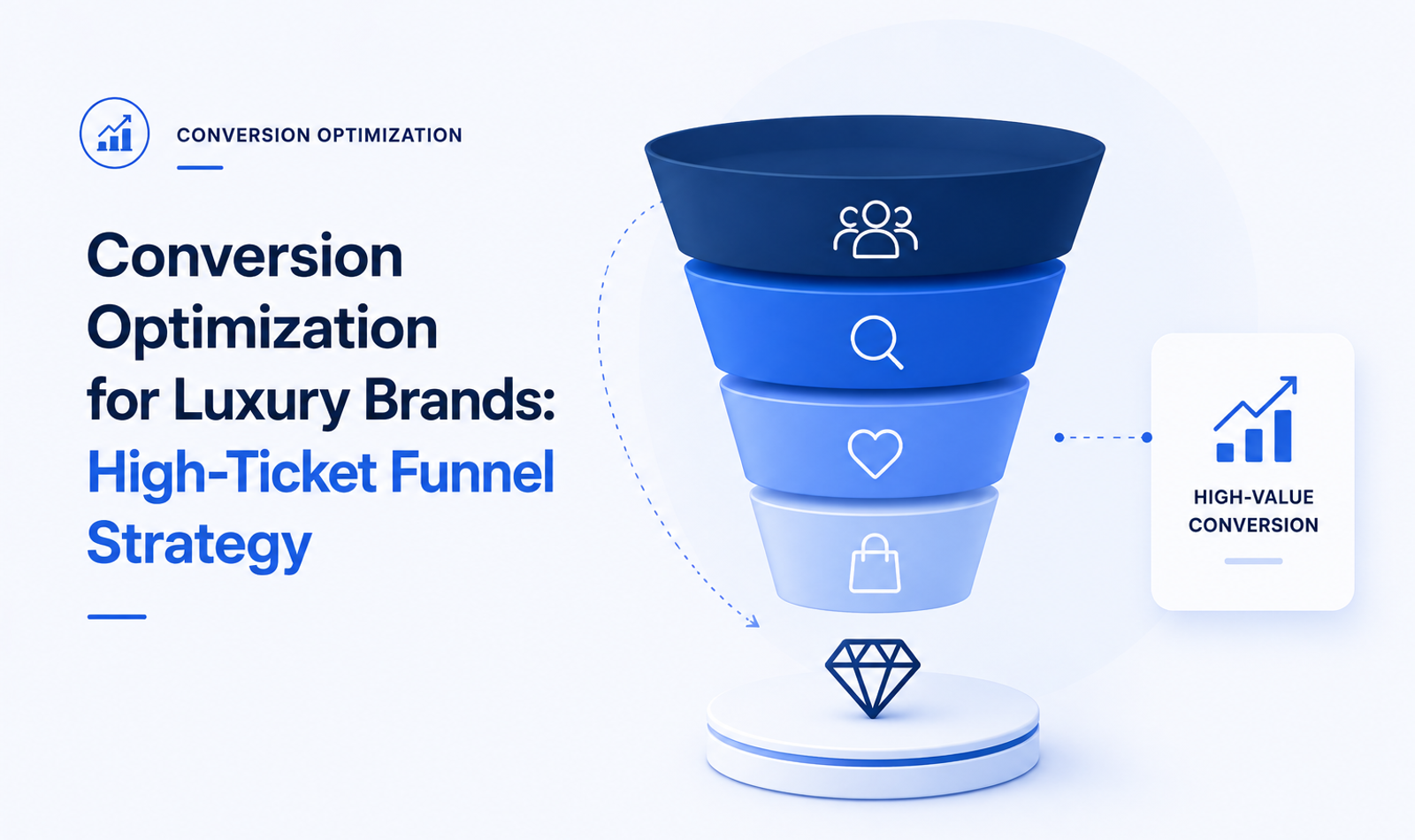
A structured luxury brand funnel from awareness to conversion can help brands understand how discovery, consideration, trust, consultation and conversion connect across a longer buying cycle.
For this reason, luxury conversions should include actions such as arranging a consultation, booking a viewing, requesting a private demonstration, joining a priority list or scheduling a call.
These actions represent meaningful progress through the funnel even when revenue is not generated immediately.
Why Standard Conversion Tactics Can Damage Luxury Positioning
Many common conversion tactics are designed for high-volume ecommerce and short decision cycles.
They may work effectively for certain businesses but feel inappropriate for a luxury audience.
Repeated pop-ups, false scarcity messages, oversized discount labels and aggressive timers can make a premium brand appear less confident. They shift attention from quality and value towards price pressure.
Luxury customers generally expect a more controlled experience.
This does not mean that urgency or scarcity can never be used. Genuine limited availability, private releases and time-sensitive experiences may be highly relevant.
The difference is authenticity.
A numbered collection, limited reservation window or invitation-only event creates meaningful scarcity. A countdown timer that restarts every time the visitor returns damages trust.
Luxury conversion strategy should rely on relevance and confidence rather than manipulation.
The objective is to make the decision easier, not to make the customer feel trapped.
Begin With Premium Positioning
Conversion optimization begins before the visitor reaches a form or product page.
The brand must communicate why its offering deserves a premium position.
If the website cannot explain the value clearly, later conversion tactics will have limited effect.
Premium positioning should answer what the brand offers, who it is designed for and why it is meaningfully different.
A luxury interior design studio should communicate more than the fact that it creates beautiful spaces. It may specialise in highly personalised residences, rare materials and complete project execution.
A premium travel company may provide private access, specialised itineraries and continuous support rather than standard holiday packages.
A detailed luxury brand strategy roadmap can help define the audience, competitive difference, emotional territory, tone and value proposition before conversion pages are developed.
The positioning should be visible across the entire funnel.
The advertisement, social content, landing page, portfolio and consultation process should communicate the same level of quality.
When the positioning changes between stages, customers may become uncertain.
A premium advertisement that leads to a generic landing page creates a gap between expectation and experience.
Consistency strengthens confidence.
Define the Right Conversion
Luxury brands often measure the wrong actions.
A business may celebrate an increase in form submissions without examining whether those enquiries are suitable.
A high-ticket funnel should prioritise quality as well as quantity.
The most valuable conversion may be a qualified consultation rather than a basic contact submission. For a property company, it may be a confirmed viewing with an eligible buyer. For a premium agency, it may be a project enquiry that matches the service level and investment range.
The primary conversion should reflect actual business value.
Secondary conversions can show earlier interest. These may include viewing a case study, saving a product, downloading a private guide or joining an invitation list.
These actions help the brand understand progress, but they should not be confused with a completed commercial outcome.
The business should also identify what happens after the website conversion.
If enquiries are not answered promptly or consultations are handled inconsistently, improving the website alone will not produce the desired result.
The high-ticket funnel must connect marketing, website experience and sales follow-up.
Understand the Luxury Customer
Luxury customers do not form one identical audience.
Some are experienced buyers who already understand the category. Others are making an occasional premium purchase and require more reassurance.
Some visitors may be researching on behalf of another person. Others may be advisers, stylists, assistants or family members involved in the decision.
The funnel should recognise these different needs.
An experienced collector may want direct access to specifications, provenance and private availability. A first-time luxury buyer may need greater explanation about craftsmanship, authenticity and aftercare.
The website should provide enough information for both without making the experience feel complicated.
Audience research can include customer interviews, sales conversations, enquiry data and feedback from showroom or consultation teams.
The business should understand why customers choose it, what concerns delay decisions and what information is usually requested before purchase.
These insights should influence the website content and funnel structure.
Map the High-Ticket Customer Journey
The high-ticket journey is rarely linear.
A visitor may first discover the brand through social media, later search for its name, read an editorial article, explore a gallery and leave without taking action.
They may return through a saved link, view a specific product and then contact the brand several days later.
Another customer may begin on a high-intent service page and request a consultation during the first visit.
The funnel should support these different paths.
Awareness content introduces the brand and creates initial interest. Consideration content explains the offering and demonstrates capability. Decision-stage content provides reassurance and a clear path to personal contact.
After the first conversion, follow-up communication and consultation become part of the experience.
The website should make it easy to move between these stages.
Editorial content can link to relevant collections or services. Product pages can link to private appointments. Project galleries can connect to detailed case studies and consultation forms.
A carefully designed conversion-focused marketing funnel helps connect these different touchpoints without forcing every customer through the same rigid sequence.
The journey should remain connected regardless of the entry page.
Create Awareness Without Reducing Exclusivity
Luxury awareness campaigns should create recognition and desire while remaining aligned with the brand.
This may involve editorial storytelling, short films, founder perspectives, cultural collaborations, design features or behind-the-scenes content.
The purpose is not to explain every commercial detail immediately.
At the awareness stage, the brand is introducing a world, perspective or experience.
However, awareness content should still connect to the broader funnel.
A campaign film can lead to a collection page. An architectural story can connect to selected residences. A destination article can guide the reader towards a private itinerary.
The transition should be subtle but clear.
Brands can also use the benefits and use cases of AI video advertising to create cinematic campaign assets while maintaining consistent positioning across awareness channels.
The brand should avoid attracting irrelevant traffic simply because a topic is popular.
A premium business benefits more from reaching a smaller qualified audience than from generating large numbers of visitors who do not value the offering.
Awareness should support positioning rather than dilute it.
Use Consideration Content to Communicate Value
Once visitors become interested, they need more detailed information.
High-ticket customers usually require enough evidence to justify both the financial and emotional investment.
Consideration content may include product details, case studies, process explanations, material information, service descriptions, comparison tools and client experiences.
The content should answer practical questions without losing the premium tone.
A luxury furniture page can explain dimensions, materials, construction and customisation. An event company can describe planning, production, guest management and design capabilities.
A premium agency can explain its strategic process, project scope and types of clients served.
The content should connect features to value.
Rare materials matter because of their quality, longevity or character. Personal consultation matters because it creates a more relevant outcome. A dedicated project team matters because it improves accountability and communication.
A structured content strategy for brand websites can connect editorial articles, service pages, galleries, case studies and lead magnets with each stage of consideration.
Visitors should understand not only what is included but why it matters.
Use Case Studies as Conversion Assets
Case studies are particularly valuable for high-ticket services.
They help potential customers understand how the brand approaches complex work and whether it can deliver the required quality.
A strong case study begins with the client’s objective or challenge. It explains the strategy, process and execution before presenting the outcome.
Visuals should show the work, but they should not be the only information.
Context demonstrates expertise.
For a luxury wedding project, the case study may explain guest logistics, venue transformation, entertainment and production. For a premium website project, it may describe positioning, UX, visual identity and development.
Verified results can strengthen the case study, but they should not be exaggerated.
When confidentiality prevents the brand from identifying a client, an approved anonymous case study can still communicate the process.
Detailed automotive and hospitality website transformation case studies demonstrate how strategy, UX, content, technical execution and outcomes can be presented together.
The case study should include a relevant next action.
A visitor impressed by a similar project should be able to begin a consultation without returning to the homepage.
Develop Luxury Landing Pages
Luxury landing pages should continue the promise made by the campaign or search result.
A person clicking an advertisement for private villa design should reach a page focused on private villa design, not a general homepage covering every service.
Message consistency reduces uncertainty.
The opening section should confirm the offering and communicate the primary value. Strong visuals can create atmosphere, but the page must still explain what the visitor is considering.
The appropriate page length depends on the level of commitment.
A private event registration may require a concise page. A high-value architecture or consulting service may need detailed content about approach, experience, projects and consultation.
The page should have one primary conversion goal.
Unrelated menu items and competing promotions can distract from the intended journey.
However, removing all navigation is not always appropriate for luxury customers. Some visitors may want to explore the brand before submitting a high-value enquiry.
The landing page should remain focused without making the visitor feel restricted.
Use Refined Calls to Action
Luxury calls to action should be clear without feeling aggressive.
The language should match the nature of the service and the expected commitment.
“Arrange a Private Viewing,” “Book a Consultation,” “Request a Personalised Proposal” and “Discover Private Availability” communicate specific next steps.
Generic labels such as “Submit” or “Learn More” provide less clarity.
The call to action should appear after the page has created enough value and confidence.
On longer pages, it can be repeated at logical points. A consultation button may appear after the introduction, case studies and process section.
The design should create sufficient visual emphasis without relying on bright colours or flashing animation.
A refined CTA feels like an invitation rather than a demand.
Design for Consultation-Based Conversions
Many luxury businesses complete conversions through consultation rather than direct checkout.
The consultation page should prepare the visitor for this interaction.
It can explain who the consultation is for, what will be discussed and what happens afterwards.
This reduces uncertainty.
The form should collect enough information to prepare the team without becoming overly demanding.
Name, contact details, service interest and a brief description may be sufficient for an initial conversation.
For complex services, optional fields can ask about timeline, location or approximate investment.
The business should be careful when asking about budget.
A budget field can improve qualification, but it can also feel impersonal when presented without context.
A more refined approach may provide project ranges or ask the visitor to select the level most relevant to their needs.
The form should never make the visitor feel that they must justify themselves before the brand has provided value.
Qualify Leads Without Creating Friction
High-ticket brands need qualified leads, but excessive qualification can reduce conversion.
The objective is to identify suitable prospects while preserving a welcoming experience.
Qualification can happen gradually.
The website may begin with a concise enquiry form. An automated or personal follow-up can then request additional information before the consultation.
Alternatively, a multi-step form can divide the process into manageable stages.
The first step may ask about the service. The second may ask about timeline and location. The final step collects contact details.
The sequence should explain why the information is useful.
Qualification criteria should reflect actual business needs. Collecting unnecessary data creates friction without improving the sales process.
The team should also distinguish between lack of immediate readiness and poor lead quality.
A suitable customer may be at an early planning stage. A strong nurturing process can maintain the relationship until the timing becomes appropriate.
Build Trust Through Evidence
Luxury customers need confidence that the experience will match the promise.
Trust should be built throughout the website.
Original photography, accurate descriptions, consistent branding and professional performance all contribute to credibility.
Client testimonials, selected projects, media features, awards and specialist credentials can provide additional reassurance.
Evidence should be specific.
A testimonial describing the quality of communication, personalisation or project execution is more useful than a general statement saying the service was excellent.
Press features should link to or identify the genuine publication where appropriate.
Awards should be presented accurately.
Brands can also use their completed work and client projects to provide direct proof of quality, strategic thinking and execution.
The website should also communicate practical trust. Clear contact information, secure payment, transparent policies and professional confirmation messages all matter.
Luxury branding cannot compensate for operational uncertainty.
Communicate Price and Investment Carefully
Pricing is a sensitive area for luxury brands.
Some products require visible pricing because customers expect to evaluate and purchase them directly. Certain bespoke services require custom proposals because the scope varies significantly.
Hiding pricing does not automatically create exclusivity.
When visitors cannot understand whether an offering is remotely suitable, they may leave rather than enquire.
A brand can provide useful guidance without publishing a fixed price for every service.
It may communicate starting prices, typical investment ranges or the factors that influence cost.
A bespoke interior project may explain that investment depends on property size, materials and execution. A premium agency may describe different levels of engagement.
Transparency can improve lead quality because visitors gain a realistic understanding before making contact.
The language should focus on value and scope rather than defensiveness.
Use Personalisation With Restraint
Personalisation can improve a luxury funnel when it reduces effort and makes the experience more relevant.
A returning visitor may see recently viewed products or projects. A customer from a particular region may receive relevant appointment or delivery information.
A private client may receive a personalised collection or proposal after speaking with the team.
However, personalisation should not feel intrusive.
Luxury customers often value privacy and discretion.
The brand should avoid using personal information in unexpected ways or revealing how extensively the visitor has been tracked.
Personalisation is most effective when it feels like thoughtful service rather than automated surveillance.
The customer should also retain control over preferences and communication.
Create a High-Quality Lead Magnet
Lead magnets can support luxury funnels when they are positioned correctly.
A generic checklist may attract a broad audience without producing qualified interest.
A stronger luxury lead magnet provides specialised value connected to the paid offering.
An architecture studio may offer a private residence planning guide. A luxury wedding company may provide a destination celebration planning framework.
A high-end property company may offer a carefully researched investment report.
The resource should feel premium in both content and presentation.
It should not be a basic document created only to collect email addresses.
The landing page should explain who the resource is for and what insight it provides.
The follow-up should continue the same subject and gradually introduce the relevant service.
Build a Refined Nurturing Journey
High-ticket customers may not convert immediately after downloading a resource or making an initial enquiry.
Lead nurturing helps maintain relevance during the consideration period.
The communication should provide value rather than repeated sales pressure.
A sequence may include the promised resource, a relevant case study, an explanation of the process and an invitation to speak privately.
The timing should reflect the buying cycle.
A premium property or architectural service may require a longer sequence than an event booking with a fixed date.
Personal follow-up can be introduced when behaviour indicates stronger interest.
For example, a visitor who has viewed several project pages and requested a guide may be more ready for a consultation than someone who opened one article.
Automation can support the process, but the communication should remain human and well written.
Optimise Luxury Ecommerce Product Pages
Luxury ecommerce product pages must create desire while providing complete information.
High-quality images should show the product from useful perspectives. Detail images can communicate materials, texture and craftsmanship.
The description should explain both the emotional story and practical qualities.
Customers may need dimensions, sizing, care instructions, delivery details, availability and return conditions.
These details should not be hidden for the sake of maintaining a minimal layout.
The purchase action should remain visible and easy to understand.
Alternative actions such as booking a virtual appointment, requesting assistance or saving the item can support customers who are not ready to purchase immediately.
Availability messaging should be accurate.
Genuine limited production can strengthen exclusivity, but artificial scarcity damages trust.
The product page should also explain authenticity, warranty and aftercare where relevant.
Improve the Luxury Checkout Experience
A premium experience must continue through checkout.
A visually refined product page followed by a confusing checkout creates inconsistency at the most important stage.
Customers should understand the complete cost, delivery conditions and expected timeline before payment.
Unexpected charges can create abandonment.
The checkout should request only required information and should work smoothly on mobile devices.
Guest checkout may be useful for customers who do not want to create an account before purchasing.
Payment methods should reflect the market and value of the product. High-value transactions may require additional verification, financing or contact with the brand.
These steps should be explained clearly.
The confirmation page should provide reassurance, order information and a suitable contact method.
Post-purchase communication should maintain the same tone and quality as the website.
Reliable ecommerce and booking website security and maintenance helps protect payments, customer information, uptime and confidence throughout the final transaction.
Optimise the Mobile Funnel
Luxury customer journeys increasingly happen on mobile devices.
A person may discover the brand on social media, review several products and submit an enquiry entirely through a phone.
The mobile experience must preserve the brand’s quality while remaining practical.
Headlines should scale correctly, images should use suitable crops and forms should be easy to complete.
Large videos and animation may need lighter alternatives.
Calls to action should remain accessible without covering content.
Telephone, messaging and appointment actions can be useful on mobile, but they should be tracked and managed properly.
The website should not remove important proof or information merely to shorten the page.
Luxury mobile design requires careful prioritisation rather than simplification without strategy.
Protect Speed and Technical Quality
A slow website weakens trust and interrupts the funnel.
Luxury websites often use high-resolution imagery, video, animation and custom typography. These assets require technical optimisation.
Images should be served at appropriate sizes and compressed carefully. Below-the-fold media can load later, while primary content should receive priority.
Video should be used selectively and supported by suitable poster images.
Third-party scripts should be reviewed regularly. Chat tools, advertising pixels, analytics and personalisation services can collectively make pages slow.
Forms, booking systems and checkout components should respond quickly.
The website should remain stable as it loads. Content should not move unexpectedly while customers are reading or attempting to select an action.
Strong technical SEO foundations for speed, mobile usability and Core Web Vitals help protect performance across both discovery and conversion pages.
Technical quality is part of the luxury experience.
Use Social Proof Strategically
Luxury brands should use social proof without making the website feel crowded or insecure.
Selected testimonials, project features and respected media coverage can be more effective than a large wall of badges.
The proof should be relevant to the page.
A client quotation about project management belongs near the process section. A testimonial about product quality may appear on the appropriate product or collection page.
Case studies should be connected to the service being considered.
Luxury buyers may also value discretion. Not every customer or project can be publicly identified.
The brand can use approved anonymised examples while maintaining accuracy.
Social proof should support confidence without becoming the central message.
Measure the Complete Funnel
Luxury brands should measure more than direct online purchases.
The funnel may include several meaningful actions before revenue appears.
These can include private-viewing requests, showroom appointments, consultation bookings, qualified applications, brochure requests, saved products and contact with a personal adviser.
Each event should be defined according to its business value.
Analytics should distinguish between a basic interaction and a genuine lead.
The brand should also connect digital activity with customer relationship management data.
A form submission may appear successful online but may not become a qualified opportunity.
By connecting website sources, lead status and eventual revenue, the business can understand which campaigns and pages attract valuable customers.
Measurement should respect privacy and consent.
Collecting unnecessary information simply because it is technically possible does not create a better funnel.
Evaluate Lead Quality
Conversion rate alone can be misleading for high-ticket brands.
A landing page may generate many submissions but few suitable customers.
Another page may produce fewer enquiries with a much higher commercial value.
The business should review lead quality by source, campaign, service and landing page.
Sales or consultation teams can provide feedback about relevance, readiness and investment suitability.
This feedback should return to the marketing process.
If a page attracts the wrong audience, the message may be too broad or focused on the wrong benefit.
If suitable visitors are not converting, the page may lack evidence, clarity or a suitable next step.
The purpose of optimization is not to maximise every number. It is to improve valuable customer acquisition.
Analyse Funnel Drop-Off
Drop-off analysis helps identify where customers stop progressing.
A large number of visitors may view a service page but never open the consultation form. This may indicate that the value is unclear or the action feels too demanding.
Visitors may begin a form and leave when asked for excessive information.
Ecommerce customers may leave after discovering unexpected delivery conditions.
Analytics can show where the drop occurs, but qualitative research helps explain why.
User testing, customer interviews, enquiry feedback and session analysis can reveal confusion that numbers alone cannot explain.
Not every exit represents failure.
A visitor may leave to discuss the decision and return later. Luxury journeys frequently involve multiple sessions.
The analysis should consider assisted and delayed conversions rather than evaluating every visit independently.
Test Without Weakening the Brand
Conversion testing should protect the brand’s long-term value.
A test may increase clicks by using aggressive copy, but this does not mean it is suitable.
The team should begin with a clear hypothesis based on customer behaviour.
It may test whether a more specific value proposition improves consultation requests or whether a shorter form increases completion among qualified visitors.
It may compare different ways of presenting investment information or social proof.
The selected metric should include quality where possible.
A higher form-completion rate is not valuable when the submissions are less relevant.
Visual tests should remain within the brand system.
Conversion optimization should refine the luxury experience rather than turn the website into a generic sales page.
Align Marketing and Sales Teams
The high-ticket funnel continues after the website conversion.
Marketing may create strong interest, but the final outcome depends on how the enquiry is handled.
The sales or consultation team should understand the campaign and promise that generated the lead.
Responses should be prompt, personalised and consistent with the brand.
A generic automated reply followed by several days of silence weakens the premium experience.
The team should have access to the information submitted and should avoid asking the customer to repeat unnecessary details.
Follow-up should guide the customer towards a meaningful next step, such as a consultation, showroom visit or personalised proposal.
Feedback between sales and marketing improves the funnel over time.
Design the Post-Conversion Experience
The confirmation page is part of the luxury customer journey.
It should reassure the visitor that the action was successful and explain what happens next.
A consultation confirmation may include the expected response time and any information required for the conversation.
A purchase confirmation may include delivery expectations, care guidance or a direct support contact.
The communication should use the same tone and visual quality as the rest of the brand.
The post-conversion period is also an opportunity to strengthen the relationship.
Thoughtful onboarding, personalised updates and reliable service can turn a new customer into a long-term client and advocate.
The luxury funnel should include retention, repeat purchase and referral rather than ending at the first transaction.
Common Luxury Funnel Mistakes
A common mistake is assuming that luxury customers do not need information.
Minimal pages may appear visually refined but fail to answer essential questions.
Another mistake is hiding every price and investment detail. This can create unnecessary uncertainty and low-quality enquiries.
Some luxury websites rely heavily on atmosphere but provide no clear path to action.
Other businesses use aggressive mass-market conversion tactics that weaken exclusivity.
Long forms, slow-loading media and inconsistent booking platforms also create friction.
A further mistake is measuring all leads equally. The business may optimise for volume while attracting customers who are not aligned with its positioning.
Following strong luxury website UX principles can help brands balance emotional impact, minimalism, speed and conversion clarity.
Luxury conversion optimization requires balance.
The brand must remain desirable while becoming easier to understand and engage.
A Practical High-Ticket Funnel Structure
A high-ticket funnel can begin with premium awareness content that introduces the brand’s world, expertise or perspective.
Interested visitors move towards editorial pages, collections, project galleries or detailed services.
Consideration content explains the offering, process, craftsmanship and value. Case studies and testimonials provide evidence.
The website then offers an appropriate conversion, such as a private appointment, consultation, application or purchase.
Lead qualification gathers the information required for the next step without creating excessive friction.
Confirmation and follow-up establish expectations and continue the premium experience.
Nurturing content maintains the relationship when the visitor is not ready to proceed immediately.
Sales and consultation teams then guide qualified prospects through the final decision.
After conversion, onboarding, service and retention complete the journey.
The exact structure will vary by business, but every stage should feel connected to the same brand promise.
Frequently Asked Questions
What Is Conversion Optimization for Luxury Brands?
Conversion optimization for luxury brands is the process of improving the customer journey so the right audience can move from interest to a meaningful high-value action. This may include booking a consultation, requesting a private viewing, asking for a personalised proposal, joining a priority list or completing a premium purchase.
Unlike mass-market conversion tactics, luxury conversion optimization focuses on trust, positioning, clarity and qualified enquiries.
Why Do Luxury Brands Need a Different Funnel Strategy?
Luxury brands need a different funnel strategy because their customers usually take longer to make decisions. High-ticket purchases often involve higher investment, emotional value, personal expectations and greater comparison.
The funnel must therefore build desire, communicate value, reduce uncertainty and create a refined path towards personal interaction instead of pushing for instant action.
What Is a High-Ticket Funnel?
A high-ticket funnel is a structured customer journey designed for premium products or services with significant financial or emotional value.
It usually includes awareness content, consideration pages, case studies, trust-building sections, lead qualification, consultation forms, private appointments and personalised follow-up.
The goal is to attract serious prospects and convert them into qualified opportunities.
Why Can Aggressive Conversion Tactics Damage Luxury Branding?
Aggressive tactics such as repeated pop-ups, fake countdown timers, oversized discount messages and constant urgency can make a luxury brand feel less premium.
Luxury customers usually expect a more controlled, confident and refined experience.
Scarcity and urgency can work only when they are genuine, such as limited collections, private releases or exclusive appointment windows.
What Is the Best Call to Action for a Luxury Brand Website?
The best call to action depends on the offer, but luxury CTAs should feel clear and refined.
Examples include “Arrange a Private Viewing,” “Book a Consultation,” “Request a Personalised Proposal,” “Discover Private Availability” or “Begin Your Project.”
The CTA should feel like a natural invitation rather than a hard sales push.
How Can Luxury Brands Qualify Leads Without Creating Friction?
Luxury brands can qualify leads by asking only for the information required for the next step.
A short enquiry form can collect name, contact details, service interest and a brief requirement.
More detailed qualification can happen later through a consultation or follow-up.
Multi-step forms can also help when more information is needed, as long as the process feels smooth and respectful.
Should Luxury Brands Show Pricing on Their Website?
Luxury brands do not always need to show fixed pricing, especially for bespoke services.
However, complete secrecy can create uncertainty and attract unsuitable enquiries.
Brands can explain starting prices, investment ranges or the factors that influence cost.
This helps serious customers understand whether the offer is relevant while preserving premium positioning.
How Do Case Studies Help High-Ticket Conversions?
Case studies help high-ticket conversions by showing how the brand solves real problems and delivers premium results.
They provide evidence of strategy, process, execution and outcome.
For luxury services, case studies are especially powerful because they help potential customers understand the level of detail, expertise and quality they can expect.
Why Is Mobile Optimization Important for Luxury Funnels?
Many luxury customers discover and evaluate brands on mobile devices.
If the mobile experience is slow, difficult to navigate or hard to complete, potential leads may drop off before taking action.
A luxury mobile funnel should preserve the premium appearance while making content, visuals, forms, calls to action and contact options easy to use.
How Should Luxury Funnel Success Be Measured?
Luxury funnel success should be measured through meaningful business outcomes, not only clicks or form submissions.
Important metrics include qualified consultations, private-viewing requests, showroom appointments, proposal requests, high-value purchases, lead quality, conversion source and long-term customer value.
Quality matters as much as quantity in high-ticket funnels.
What Is the Biggest Mistake in Luxury Conversion Optimization?
The biggest mistake is treating luxury conversion optimization like mass-market ecommerce.
Luxury brands should not rely only on discounts, urgency and volume-based tactics.
A strong luxury funnel protects exclusivity while improving clarity, trust, relevance and ease of action for the right customers.
Conclusion
Conversion optimization for luxury brands is not about pushing more visitors towards an immediate purchase.
It is about helping the right customers move from interest to confidence and from confidence to a meaningful high-value action.
A successful high-ticket funnel begins with clear premium positioning. The visitor should understand what the brand offers, who it serves and why the experience is valuable.
The website must then support the complete decision journey.
Awareness content creates recognition and desire. Consideration content communicates detail and expertise. Case studies, testimonials and transparent information reduce uncertainty.
The conversion action should match the nature of the offering. For some brands, this is an online purchase. For others, it is a consultation, private viewing or personalised proposal.
Forms should qualify interest without making the experience feel impersonal. Calls to action should remain refined but clear.
Performance, mobile usability and technical reliability are equally important. A slow or confusing website cannot provide a premium customer experience.
Measurement should focus on meaningful business outcomes rather than surface-level activity. Luxury brands need to understand which pages and campaigns generate qualified opportunities, completed purchases and long-term customer value.
The strongest optimization strategy does not weaken exclusivity. It removes avoidable friction while protecting the brand’s positioning.
Luxury customers should feel that the website understands their needs, respects their time and provides enough confidence for the next step.
When brand strategy, content, UX, technology and sales follow-up work together, the high-ticket funnel becomes more than a lead-generation system.
It becomes an extension of the luxury service itself: thoughtful, personalised, credible and effortless.
Ready to Build a High-Ticket Funnel for Your Luxury Brand?
Your luxury website should do more than look premium. It should attract the right audience, build desire, communicate value, qualify interest and convert serious prospects into meaningful enquiries, bookings and purchases.
At Double Trouble Studio, we help luxury and premium brands create conversion-focused websites, high-ticket funnels, refined UI/UX, strategic content, SEO, digital marketing, PR, AI video and complete creative growth solutions.
Businesses looking for website development and digital marketing services in Mumbai can work with our team across positioning, UX, landing pages, technical performance, content strategy and conversion optimization.
For wider brand authority and visibility, our PR and media marketing services can connect earned media, storytelling and digital campaigns with the high-ticket funnel.
Contact Double Trouble Studio for luxury conversion optimization, high-ticket funnel strategy, website development, UI/UX, SEO, branding, PR, AI video, digital marketing and creative strategy.
📩 info@dtsworld.in 📞 +91 80000 06021 📍 Andheri West, Mumbai
Need this for your brand?
Let DTS build your next campaign.
From PR, celebrity management and events to websites, social media, SEO and AI video production — Double Trouble Studio helps brands grow with strategy and execution.
Discuss Your Requirement →