Creating a Luxury Brand Funnel: From Awareness to Conversion
A luxury brand funnel is not simply a sequence of advertisements, landing pages and sales messages designed to produce an immediate purchase. It is a carefully planned customer journey that builds recognition, desire, trust and confidence over time.
Luxury customers often make decisions differently from mass-market buyers. They may take longer to evaluate a product or service, compare several options, review the brand repeatedly and seek reassurance before making contact. The decision may involve a significant financial investment, emotional importance or personal identity.
For this reason, luxury brands cannot rely only on aggressive offers or short-term promotional tactics. A high-value customer is rarely persuaded by repeated discount messages, artificial urgency or excessive calls to action.
The brand must first create meaning.
Potential customers need to understand what the brand represents, why its offering is valuable and how the experience differs from ordinary alternatives. They also need evidence that the business can deliver the level of quality, discretion and service being promised.
A successful luxury brand funnel supports this process from the first point of awareness to the final conversion.
It introduces the brand through emotionally engaging communication, develops interest through useful and aspirational content, strengthens confidence through proof and creates a refined path towards purchase, consultation, booking or enquiry.
Professional website development and digital marketing services can connect these stages through strategy, content, UX, technical development and measurable conversion paths.
The funnel should not feel like a mechanical sales system. It should feel like a premium customer experience.
When strategy, content, design, technology and follow-up work together, the luxury funnel becomes an extension of the brand itself.
Understanding the Luxury Brand Funnel
A marketing funnel describes the stages a customer may move through before completing a meaningful action.
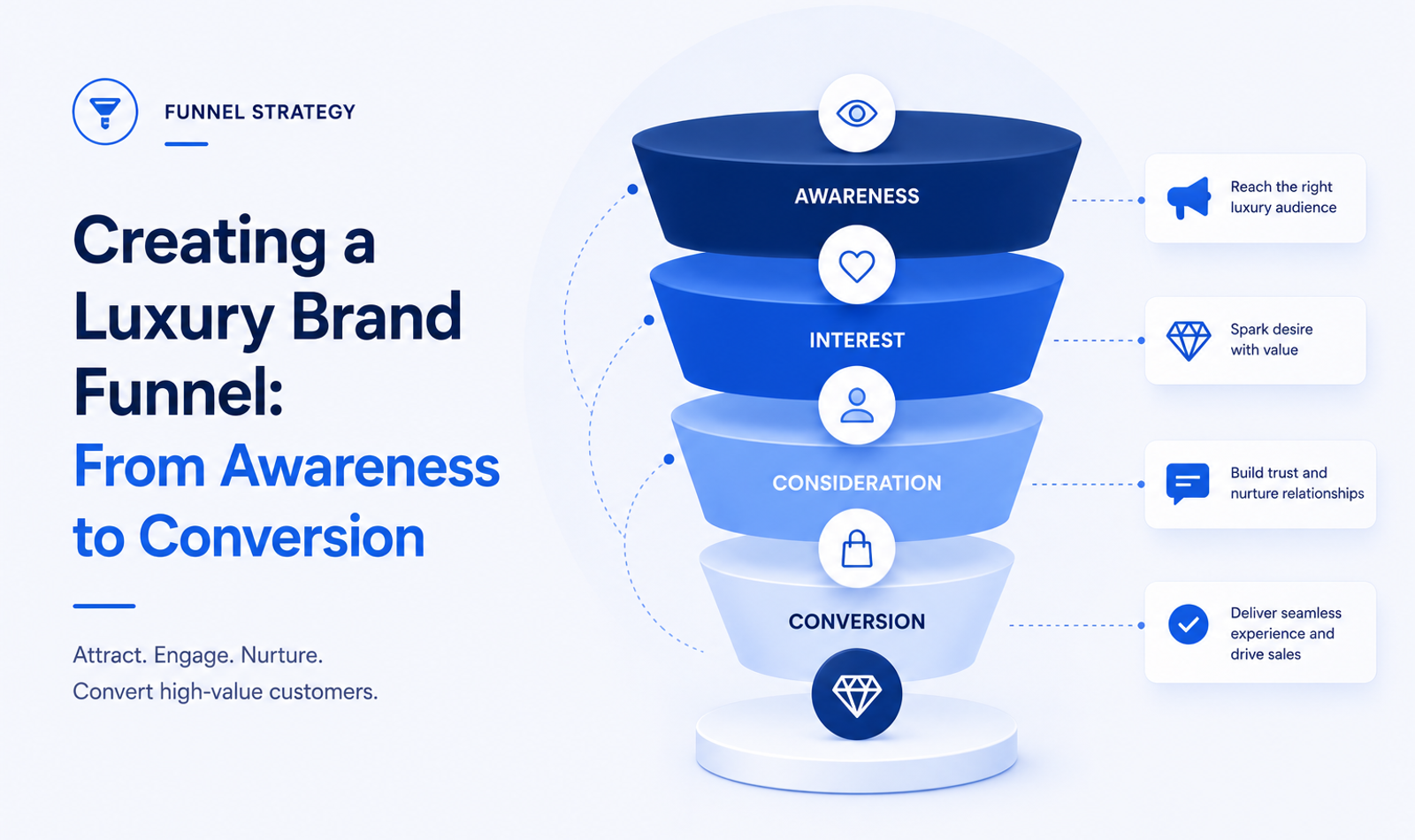
The traditional stages are commonly described as awareness, consideration and conversion. Luxury brands often require additional layers such as desire, trust, qualification, nurturing and retention.
At the awareness stage, the customer becomes familiar with the brand or recognises a relevant need. They may encounter a campaign, editorial article, search result, social media post, event or recommendation.
During consideration, the customer begins exploring the brand more seriously. They may review products, services, case studies, galleries, testimonials and pricing information.
The trust stage becomes especially important for luxury businesses. Customers want confidence that the brand is established, authentic and capable of delivering a premium experience.
The conversion stage may involve a purchase, but it may also involve requesting a consultation, arranging a private viewing, booking an appointment or submitting a qualified project enquiry.
After conversion, the funnel should continue through onboarding, customer service, retention and advocacy.
Luxury relationships often extend beyond one transaction. A satisfied customer may return, purchase additional services or introduce the brand to other high-value clients.
The funnel should therefore be understood as a connected customer lifecycle rather than a one-time sales process.
Luxury Customers Do Not Always Follow a Linear Journey
Luxury customer journeys are rarely simple or predictable.
A person may discover a brand through an Instagram campaign, later search for its name, visit the website, view several projects and leave without making contact.
They may return after reading a press feature, ask a friend for an opinion and then book a consultation several weeks later.
Another customer may receive a direct recommendation and convert during the first website visit.
The funnel must support both journeys.
It should allow first-time visitors to understand the brand while giving high-intent customers immediate access to the information and action they need.
This means that every important page should work as a possible entry point.
A blog article should introduce the brand clearly enough for a new visitor. A case study should provide context and a next step. A product page should communicate both emotional value and practical details.
The funnel should not depend on every customer beginning on the homepage and following the same sequence.
Instead, the website and marketing ecosystem should create multiple connected paths towards trust and conversion.
Begin With Clear Luxury Positioning
A funnel cannot perform effectively when the brand positioning is unclear.
Before creating campaigns, content or landing pages, the business must define what type of luxury it represents.
Luxury may be based on craftsmanship, rarity, heritage, privacy, convenience, cultural relevance, personalisation or exceptional service.
Different forms of luxury require different communication.
A heritage jewellery brand may emphasise craftsmanship, provenance and timeless design. A premium technology company may communicate precision, innovation and performance. A private travel company may focus on access, personal planning and discretion.
The brand should understand who it serves and what those customers value.
It should also identify what makes its offering meaningfully different from lower-priced alternatives and other premium competitors.
A structured luxury brand strategy roadmap can help clarify the audience, positioning, competitive difference, communication style and customer experience before funnel campaigns are developed.
This positioning becomes the foundation of the funnel.
Awareness campaigns introduce it. Content explains it. Case studies prove it. The consultation or purchase experience delivers it.
When positioning changes across stages, the funnel becomes less credible.
A sophisticated campaign followed by a generic website creates inconsistency. A premium website followed by an impersonal sales response weakens confidence.
Every part of the journey should communicate the same value.
Define the Right Audience
Luxury marketing should not attempt to reach everyone.
A smaller, relevant audience is often more valuable than a large audience with little interest or purchasing ability.
Audience definition should go beyond age, location and income.
The brand should understand motivations, preferences, concerns and buying behaviour.
Some customers value status and recognition. Others value quality, design, privacy or personal service. Some may already understand the category, while others are making their first premium purchase.
A luxury architecture firm may target private homeowners, property developers and hospitality investors. Each group requires different information.
A premium wedding company may serve couples, families and professional planners involved in the same decision.
The funnel should account for these differences.
Messages should reflect the customer’s actual priorities. A high-net-worth customer may be less concerned with general affordability and more concerned with trust, exclusivity and execution.
Audience research can come from customer interviews, consultation calls, sales feedback, social engagement and previous enquiry data.
The objective is to create a funnel that feels highly relevant to the people the brand genuinely wants to serve.
Set a Meaningful Conversion Goal
Every funnel needs a primary conversion goal.
For a luxury ecommerce brand, the goal may be a completed purchase. For a high-end property company, it may be a private viewing. For a premium service provider, it may be a qualified consultation.
The action should reflect real commercial value.
Luxury businesses often make the mistake of treating every enquiry as equally important. A short contact form may generate many submissions, but only a small percentage may be suitable.
The funnel should therefore distinguish between basic engagement and qualified conversion.
Secondary actions can indicate interest. These may include viewing a case study, downloading a private guide, saving a product or joining an invitation list.
These actions help the brand understand progress, but they should not be treated as final outcomes.
The funnel should also define what happens after the conversion.
A consultation request requires a response process. A private viewing requires scheduling and confirmation. A high-value purchase may require personalised service.
The conversion is only successful when the customer receives a consistent next experience.
Awareness: Introduce the Brand World
The awareness stage is where the customer first encounters the brand.
The objective is not always to generate an immediate sale. It is to create recognition, curiosity and emotional interest.
Luxury awareness content should introduce the brand’s world.
This may happen through campaign films, editorial photography, cultural collaborations, founder stories, design features, events, public relations and social media.
The communication should be distinctive enough to become memorable.
A premium brand should avoid relying only on generic promotional statements. Phrases such as “quality you can trust” or “luxury redefined” are widely used and provide little differentiation.
The awareness message should reflect the actual positioning.
A luxury resort may introduce the feeling of privacy and place. A bespoke fashion brand may focus on craftsmanship and personal expression. A premium agency may communicate strategic thinking and high-quality execution.
The purpose is to help the right audience recognise that the brand is relevant to them.
Use Emotional Storytelling at the Top of the Funnel
Emotion plays a central role in luxury awareness.
Customers are often attracted to the meaning and identity associated with the brand before they evaluate practical features.
Storytelling can communicate origin, inspiration, craft, place and philosophy.
A premium product may become more desirable when customers understand the materials and creative process behind it. A private hospitality experience becomes more meaningful when the website communicates the atmosphere and destination.
The principles involved in designing high-end luxury websites can help brands combine storytelling, visual identity, UX and technology within one coherent premium experience.
The story should be authentic.
Invented heritage or exaggerated claims can damage trust when customers investigate the brand more deeply.
Emotional storytelling should also remain connected to the offering.
A beautiful campaign may generate attention, but the customer should still understand what the brand provides.
The transition from story to product, service or experience should feel natural.
Campaign films and immersive brand assets can also use the benefits and use cases of AI video advertising to create distinctive awareness content across digital channels.
Build Awareness Through Search
Search visibility allows luxury brands to reach customers who are actively researching relevant topics.
Potential customers may search for inspiration, comparisons, locations or specialist services before they know the brand.
A luxury interior design studio may attract visitors through articles about premium residential design, materials or space planning.
A high-end travel company may publish destination guides and private itinerary content.
The brand should select topics that attract relevant audiences rather than chasing the largest possible search volume.
Broad traffic is not always useful.
A lower-volume search related to a specialised premium need may produce more valuable engagement.
A focused approach to SEO for luxury brands can improve positioning, keyword relevance and authority without weakening the brand’s refined communication.
Search content should remain aligned with the brand voice and visual identity.
SEO should make the brand easier to discover without making the content feel generic or keyword-driven.
Use Social Media as a Discovery Channel
Social media is often one of the first places customers encounter luxury brands.
Visual platforms can introduce products, experiences, founders and projects in a highly emotional format.
However, social content should be connected to the broader funnel.
A campaign reel should lead to a collection, project or editorial page. A behind-the-scenes post can direct visitors towards the complete story. An event feature can connect to private registration or enquiry.
The social profile should not become a separate brand experience disconnected from the website.
Typography, imagery, tone and positioning should remain consistent.
The brand should also avoid over-publishing low-value content simply to maintain frequency.
Luxury communication benefits from curation.
Fewer strong pieces of content can create greater impact than constant generic posting.
A clear content strategy for brand websites can connect social campaigns, blogs, galleries, case studies and lead magnets with the complete customer journey.
Use Public Relations to Create Authority
Luxury customers often rely on external recognition when evaluating a brand.
Coverage in respected publications, interviews, reviews and expert features can strengthen awareness and credibility.
Public relations should focus on stories that provide genuine editorial value.
A significant project, collaboration, research insight, launch or founder perspective may create a meaningful media opportunity.
The funnel should then use this coverage strategically.
Press features can be included within the website’s trust sections, shared through social channels and connected to relevant landing pages.
Professional PR and media marketing services can help brands develop credible stories, secure relevant visibility and connect earned media with wider digital campaigns.
The brand should not rely on logos alone. Where appropriate, visitors should be able to understand the context of the recognition.
Authority becomes stronger when external visibility supports the same positioning communicated by the brand itself.
Consideration: Help Customers Evaluate the Offering
Once customers become interested, they need more detailed information.
The consideration stage should explain what the brand offers, how the experience works and why it is valuable.
This is where service pages, product pages, collections, galleries, process explanations and case studies become important.
Luxury customers still require practical information.
A premium product page should explain materials, dimensions, delivery and care. A luxury service page should explain the process, personalisation and expected experience.
The design can remain minimal, but the information should not be hidden.
Strong luxury website UX principles can help brands balance minimalism, speed, emotional impact and practical clarity throughout the consideration journey.
Customers should not have to contact the brand simply to understand basic details.
The consideration stage should reduce uncertainty while preserving desire.
Create Detailed Service Pages
High-ticket services require more than a short paragraph and a contact button.
Potential customers may want to understand the scope, process, expertise and level of involvement.
A luxury wedding company can explain planning, design, production, guest management and entertainment.
An architecture studio can describe consultation, concept development, material selection and execution.
The page should identify who the service is for and what makes the approach distinctive.
Relevant case studies, testimonials and frequently asked questions can strengthen the page.
Following clear UI/UX design principles for high-end brand websites helps ensure that detailed information remains accessible without making premium service pages feel crowded.
The call to action should reflect the nature of the relationship.
“Begin a Private Consultation” or “Discuss Your Project” may feel more appropriate than a general “Buy Now.”
The service page should help suitable customers become more confident about making contact.
Create Product Pages That Support Desire and Confidence
Luxury product pages should combine emotional presentation with complete information.
Photography and video create desire, while descriptions explain design, craftsmanship and meaning.
Practical information supports confidence.
Customers may need to know dimensions, materials, sizing, authenticity, availability, delivery and returns.
Minimalism should organise this information rather than remove it.
The purchase action should remain clear.
Customers who are not ready to buy may benefit from alternative actions such as saving the product, booking a virtual consultation or locating a showroom.
The page should make it easy to continue the relationship.
Use Galleries as Proof
Luxury customers often want to see evidence before making a decision.
Galleries can show products, completed projects, properties, events or experiences.
However, a gallery should not be treated as a random collection of attractive images.
It should be curated according to the brand’s positioning.
The work displayed should represent the quality and type of future business the brand wants to attract.
Project titles, descriptions and captions can provide useful context.
A visitor should understand what was created and why it matters.
Brands can use their completed work and client projects to demonstrate execution, creative range and relevant experience through real examples.
Selected gallery items can link to detailed case studies, allowing customers to move from visual interest to deeper evaluation.
The gallery becomes a strategic part of the funnel rather than a visual dead end.
Use Case Studies to Demonstrate Capability
Case studies are among the strongest consideration assets for luxury service brands.
They show how the business approaches complex work and delivers quality.
A strong case study begins with the customer’s objective or challenge. It then explains the strategy, process and execution.
The outcome should be described accurately.
Where verified performance data is available, it can be included. When confidentiality applies, approved anonymous examples can still provide useful insight.
Case studies should communicate more than visual results.
They should demonstrate decision-making, project management and attention to detail.
Detailed automotive and hospitality website transformation case studies demonstrate how context, strategy, UX and measurable outcomes can be combined within commercially useful project stories.
A relevant call to action should appear at the end.
A customer impressed by a similar project should be able to begin a consultation without searching through the website.
Build Trust Before Asking for Commitment
Trust is one of the most important stages in the luxury funnel.
Customers need confidence that the brand is established, professional and capable of delivering the promised experience.
Trust develops through the complete website.
Original photography, accurate content, fast performance and consistent design all contribute.
Client testimonials, press recognition, certifications, awards and selected partnerships can provide additional reassurance.
The strongest trust signals are specific and verifiable.
A testimonial describing communication, discretion or execution is more persuasive than a general compliment.
The business should also provide clear contact information, company details and policies.
Luxury does not require secrecy around basic business information.
Transparency often strengthens premium positioning because it communicates confidence and accountability.
Reliable secure website practices for premium clients also help protect customer data and reinforce trust through secure forms, privacy information and dependable technical infrastructure.
Use Testimonials Strategically
Testimonials should appear near relevant decision points.
A quote about project management may support a service process section. Feedback about product quality may appear near the relevant collection.
The testimonial should provide enough context to feel genuine.
Where client identity cannot be disclosed, the brand can use an approved role or project description.
The website should avoid using an excessive number of testimonials simply to create the appearance of proof.
A small number of specific, credible statements is often more effective.
The role of the testimonial is to reduce uncertainty, not to replace detailed information.
Communicate Pricing and Investment Carefully
Pricing is an important part of consideration.
Some luxury brands display prices clearly because customers expect to purchase directly. Others provide bespoke services where the final investment depends on scope.
Hiding all pricing information does not automatically create exclusivity.
It can produce unsuitable enquiries or discourage qualified customers who want an initial understanding.
A premium service may provide starting prices, typical investment ranges or an explanation of the factors that influence cost.
The language should focus on scope and value.
A bespoke interior project may explain that investment depends on property size, materials and execution. A luxury event company may describe different levels of planning and production.
Clear guidance helps customers evaluate fit before entering the sales process.
Nurture Customers Who Are Not Ready to Convert
Luxury decisions often require time.
A visitor may be interested but not ready to make contact during the first visit.
Lead nurturing allows the brand to continue the relationship.
This can begin through newsletter subscriptions, private guides, invitation lists, saved products or event registrations.
The value offered should be connected to the customer’s interest.
A high-end property company may offer a market or location report. A luxury wedding business may provide a destination planning guide.
The resource should feel premium in both content and presentation.
The follow-up communication should continue the same subject rather than immediately switching to unrelated promotions.
Nurturing should feel like service, not pressure.
Create High-Value Lead Magnets
A luxury lead magnet should solve a specific problem for a relevant audience.
Generic checklists may generate large numbers of downloads without producing qualified leads.
A stronger resource may include specialised insight, planning tools, private reports or curated guidance.
The landing page should explain who the resource is for and what the customer will receive.
The form should request only necessary information.
A name and email address may be sufficient for an early-stage guide. More detailed information can be collected later when the relationship develops.
The design of the resource should reflect the brand.
A poorly presented document can reduce confidence even when the information is useful.
Use Email Nurturing With Restraint
Email can help luxury brands remain relevant during longer decision cycles.
The first message should deliver the promised resource or confirmation immediately.
Further messages can provide related insight, project examples and invitations.
The communication should remain useful and carefully timed.
Sending frequent promotional messages can make the brand feel less exclusive.
The sequence may introduce the process, explain a common decision, share a relevant case study and offer a private consultation.
A strategy for building conversion-focused marketing funnels can help connect email nurturing with website content, service pages, lead qualification and final conversion actions.
The tone should feel personal and professional.
Automation can support the system, but the customer should not feel as though they are receiving generic mass communication.
Conversion: Make the Next Step Clear
The conversion stage should provide a simple and confident path to action.
Luxury brands sometimes avoid clear calls to action because they fear appearing too commercial.
This can leave interested customers uncertain.
The call to action can remain refined while being direct.
“Arrange a Private Viewing,” “Book a Consultation,” “Request a Personalised Proposal” and “Reserve Your Experience” clearly explain what will happen next.
Each page should have one primary action.
Secondary options can support customers who are still exploring.
The call to action should appear after enough value and evidence have been provided.
It should feel like the logical conclusion of the page.
Design Conversion Pages Around Reassurance
A conversion page should explain what the customer is committing to.
A consultation page can describe who the conversation is for, what will be discussed and what happens afterwards.
A private-viewing page can explain scheduling and confirmation.
An ecommerce checkout should display complete costs, delivery expectations and policies before payment.
The customer should not encounter unexpected information at the final stage.
The design should remain connected to the rest of the website.
A premium website followed by a generic or confusing form creates a break in the brand experience.
Applying conversion optimisation for luxury brands can improve these pages without introducing aggressive sales tactics that weaken exclusivity.
Consistency reassures the customer that they are still dealing with the official business.
Luxury ecommerce, reservation and payment experiences should also follow suitable ecommerce and booking website security and maintenance practices to protect customer confidence at the final stage.
Use Forms to Qualify Without Creating Friction
High-ticket businesses need enough information to respond effectively, but long forms can reduce conversion.
The form should collect what is required for the next step.
Name, contact details, service interest and a short description may be enough for an initial consultation.
Optional fields can ask about location, timeline or investment.
When qualification requires more detail, a multi-step form can make the process feel easier.
The brand should explain why sensitive or detailed information is being requested.
A budget question may improve lead quality, but it should be presented carefully.
The form should not make the customer feel that they must prove their value before the brand has provided a meaningful experience.
Personalise the Conversion Experience
Personalisation can make the luxury funnel feel more attentive.
A customer may receive a consultation form connected to the specific service or project they viewed.
A returning ecommerce visitor may see recently viewed items or saved products.
A private client may receive a curated collection or proposal.
Personalisation should reduce effort and increase relevance.
It should not feel intrusive.
Luxury customers often value privacy and discretion. The brand should avoid unexpected references to tracked behaviour or excessive data collection.
The best personalisation feels like thoughtful service rather than automated surveillance.
Respond Quickly and Professionally
The funnel does not end when the form is submitted.
The quality and speed of follow-up can determine whether the customer continues.
A premium customer should receive immediate confirmation that the enquiry was successful.
The message should explain when the team will respond and what will happen next.
The sales or consultation team should have access to the context already provided.
Customers should not be asked to repeat the same information unnecessarily.
The response should feel personal and relevant to the original enquiry.
A generic reply sent several days later can weaken the trust created by the website.
Luxury conversion requires operational consistency as well as strong marketing.
Design the Consultation Experience
For many luxury businesses, the consultation is a major part of the conversion process.
It should be structured enough to feel professional but personal enough to reflect the customer’s needs.
The team should understand the customer’s objectives before presenting solutions.
The conversation should explain the process, expected investment, timeline and next steps clearly.
Luxury does not mean avoiding practical details.
Customers often appreciate direct communication when it is delivered with confidence and respect.
Any proposal or follow-up material should maintain the same visual and verbal quality as the website.
The consultation is not separate from the brand experience. It is one of its most important expressions.
Create a Strong Post-Conversion Journey
After a customer converts, the brand should continue providing a premium experience.
A purchase confirmation can include delivery expectations, care information and direct support.
A consultation confirmation can explain what the customer should prepare.
A project onboarding process may include a welcome document, timeline and communication structure.
This stage helps reduce uncertainty and reinforces the customer’s decision.
A strong post-conversion journey can also support retention and advocacy.
Satisfied customers may return, upgrade or recommend the brand to others.
The funnel should therefore include customer service, loyalty and referral rather than ending after payment or enquiry.
Retain Luxury Customers Through Service
Luxury customers often expect ongoing attention.
Retention may involve personalised recommendations, private previews, priority access, maintenance services or relevant invitations.
The communication should reflect the customer’s relationship with the brand.
A previous buyer may receive early access to a collection. A hospitality guest may receive a personalised invitation to return.
The brand should not use customer history only to send more promotions.
Retention should provide meaningful value.
Exceptional service can become one of the strongest forms of marketing because premium customers often rely on trusted recommendations.
Encourage Advocacy Naturally
Luxury advocacy should grow from genuine satisfaction.
Customers may provide testimonials, referrals, reviews or user-generated content when the experience has been memorable.
The brand can request feedback at an appropriate moment, but it should avoid making the interaction feel transactional.
Some customers may value privacy and may not want their identity or purchase displayed publicly.
The business should respect this.
Private referrals can be just as valuable as public reviews.
Advocacy strengthens the top of the funnel by introducing new customers through trusted relationships.
Align the Website With the Complete Funnel
The website should support every stage of the luxury customer journey.
The homepage introduces positioning. Editorial content supports awareness. Product and service pages support consideration.
Galleries and case studies provide proof. Trust sections reduce uncertainty. Forms, bookings and checkout enable conversion.
Confirmation pages and client portals support post-conversion experience.
Internal links should connect these stages.
An article can guide visitors towards a relevant service. A gallery can link to a case study. A case study can lead to consultation.
The website should not contain isolated content with no next step.
The complete structure should feel connected and intentional.
Optimise the Funnel for Mobile Users
Many luxury customers will discover and evaluate the brand through mobile devices.
The mobile experience should preserve the same quality, information and conversion options.
Large images need suitable crops, and videos may require lighter alternatives.
Navigation should remain easy to use. Forms should be simple to complete, and buttons should have enough space for touch interaction.
Important content should not be removed simply to shorten the page.
A mobile visitor should be able to explore a collection, review a case study, book an appointment or complete a purchase without switching devices.
Premium mobile UX is essential to the complete funnel.
Protect Website Speed
A slow website can interrupt the funnel before the customer evaluates the brand.
Luxury websites often use large media, animation and custom typography, but these assets must be optimised.
The main content should appear quickly. Images should be delivered at appropriate sizes, and video should not delay access to important information.
Third-party tools should be reviewed carefully.
Analytics, chat, personalisation, advertising and booking scripts can collectively affect performance.
Strong technical SEO foundations for speed, mobile usability and Core Web Vitals help protect performance across every stage of the customer journey.
Speed is not only a technical measurement. It influences trust, attention and emotional momentum.
A premium brand should feel responsive and controlled.
Measure Meaningful Funnel Performance
A luxury funnel should not be measured only through total traffic or basic form submissions.
The business should track actions that represent real progress.
These may include product saves, case-study views, guide downloads, consultation bookings, private-viewing requests, qualified applications and completed purchases.
The measurement system should distinguish between early engagement and commercial conversion.
Lead quality should also be reviewed.
A page may generate fewer enquiries but produce customers who are more aligned with the brand’s positioning.
Sales teams should provide feedback about relevance, readiness and investment fit.
The business should connect marketing data with actual customer outcomes where possible.
Understand Attribution Across a Longer Journey
Luxury customers may interact with several channels before converting.
A customer may first discover the brand through social media, return through organic search and convert after receiving an email.
Giving all credit to the final click can hide the value of earlier stages.
The brand should examine assisted journeys and repeated visits.
Awareness content may not produce an immediate enquiry, but it may influence recognition and trust.
Case studies may support the final decision even when the conversion occurs through a direct visit.
Attribution should be used as a guide rather than a perfect explanation of customer psychology.
Qualitative feedback can provide additional insight.
Asking customers how they discovered the brand and what influenced their decision can reveal information that analytics misses.
Analyse Funnel Drop-Off
Funnel analysis can identify where customers stop progressing.
A large number of visitors may view a service page but avoid the consultation form. The page may lack clarity, evidence or investment guidance.
Customers may begin a form and leave when too much information is requested.
Ecommerce visitors may abandon checkout after discovering unexpected delivery costs.
Analytics can show where the drop occurs, but user testing and customer feedback help explain why.
Not every exit represents failure.
Luxury customers may leave to consider the decision and return later.
The analysis should consider longer buying cycles and multiple sessions.
Test Funnel Improvements Carefully
Conversion optimisation should protect the brand.
A more aggressive headline may increase clicks but weaken premium positioning.
Tests should begin with a clear customer problem.
The brand may test whether more specific service information increases qualified enquiries or whether a shorter form improves completion.
It may compare different ways of presenting social proof, investment guidance or consultation details.
The success metric should include quality, not only volume.
A test that increases submissions but produces unsuitable leads is not necessarily successful.
Improvements should refine the premium experience rather than turn the funnel into a generic sales system.
Common Luxury Funnel Mistakes
One common mistake is attempting to convert customers before building enough value.
A visitor who has just discovered the brand may not be ready for a high-commitment action.
Another mistake is relying too heavily on visual atmosphere while providing little information.
Some brands hide pricing, process and contact details in the belief that mystery creates exclusivity.
Others use mass-market tactics such as repeated pop-ups, false urgency and constant promotional messaging.
Long forms and slow follow-up also reduce conversion.
Another common problem is treating every lead as equally valuable.
The business may optimise for submission volume without considering suitability.
Finally, many brands stop the funnel after the first transaction and fail to build retention or advocacy.
A Practical Luxury Funnel Structure
A practical luxury funnel begins with positioning and audience definition.
Awareness is created through search, social media, editorial content, campaigns, collaborations and public relations.
Interested visitors move towards the website, where product pages, service pages, galleries and editorial content support consideration.
Case studies, testimonials, press coverage and transparent information build trust.
Lead magnets and invitation lists nurture customers who are not ready to convert.
High-intent visitors are guided towards a purchase, private appointment, consultation or proposal request.
Forms collect enough information to support the next step without creating excessive friction.
Confirmation and personal follow-up continue the premium experience.
After conversion, onboarding, service, retention and advocacy strengthen the long-term relationship.
Every stage should communicate the same brand promise.
Frequently Asked Questions
What is a luxury brand funnel?
A luxury brand funnel is a carefully planned customer journey that moves premium customers from first awareness to trust, consideration and conversion. It does not depend on aggressive sales tactics or instant purchase pressure. Instead, it builds desire, communicates value, proves credibility and creates a refined path towards enquiry, booking, consultation or purchase.
Why do luxury brands need a different funnel strategy?
Luxury brands need a different funnel strategy because premium customers often take longer to make decisions. They may compare options, review the brand multiple times, seek reassurance and expect a higher level of service. A luxury funnel must build confidence over time instead of relying only on discounts, urgency or repeated promotional messages.
What are the main stages of a luxury brand funnel?
The main stages of a luxury brand funnel include awareness, consideration, trust, conversion, retention and advocacy. Awareness introduces the brand. Consideration helps customers evaluate the offering. Trust builds confidence through proof. Conversion creates a clear next step, while retention and advocacy continue the relationship after purchase or enquiry.
How can luxury brands create awareness?
Luxury brands can create awareness through emotional storytelling, search visibility, social media, editorial content, public relations, campaign films, events, collaborations and founder-led communication. The goal is to introduce the brand world, create curiosity and attract the right audience without making the brand feel mass-market.
Why is storytelling important in a luxury funnel?
Storytelling helps luxury brands communicate meaning beyond the product or service. It can explain craftsmanship, heritage, materials, destination, philosophy, process or personalisation. Strong storytelling creates emotional connection and helps customers understand why the brand is valuable and different from ordinary alternatives.
What content is useful during the consideration stage?
During the consideration stage, customers need detailed service pages, product pages, galleries, case studies, testimonials, process explanations, FAQs and investment guidance. This content helps them understand the offering, evaluate quality and decide whether the brand matches their expectations.
How do case studies support a luxury brand funnel?
Case studies support a luxury funnel by showing real proof of capability. They explain the client objective, strategy, execution and outcome. For premium services, case studies help customers understand the brand’s process, attention to detail, problem-solving ability and quality of delivery.
Should luxury brands use lead magnets?
Yes, luxury brands can use lead magnets when they provide genuine premium value. A strong luxury lead magnet may be a private guide, planning framework, investment report, curated checklist or expert resource. It should attract relevant customers and support the buying journey instead of simply collecting email addresses.
What kind of call to action works for luxury brands?
Luxury calls to action should be clear, refined and aligned with the customer journey. Examples include “Book a Consultation,” “Arrange a Private Viewing,” “Request a Personalised Proposal,” “Reserve Your Experience” or “Begin Your Project.” The CTA should feel like a natural invitation rather than a hard sales push.
How can luxury brands improve conversion without losing exclusivity?
Luxury brands can improve conversion by removing friction, improving clarity, strengthening trust and making the next step easier. This includes better service pages, faster websites, refined forms, clear CTAs, transparent follow-up and stronger proof. Conversion optimisation should protect the brand’s premium positioning while helping serious customers act with confidence.
Why is follow-up important in a luxury funnel?
Follow-up is important because luxury conversions often continue after the first enquiry. A customer may request a consultation, private viewing or proposal before making a final decision. Prompt, personal and professional follow-up reinforces trust and ensures the customer experience remains premium beyond the website.
How should luxury funnel performance be measured?
Luxury funnel performance should be measured through qualified enquiries, consultation bookings, private-viewing requests, product purchases, proposal requests, guide downloads, lead quality, repeat customers and long-term customer value. Total traffic or form submissions alone do not show whether the funnel is attracting the right audience.
Conclusion
Creating a luxury brand funnel requires more than arranging marketing activity into awareness, consideration and conversion.
The funnel must reflect the way premium customers actually make decisions.
They may take longer to evaluate the brand, seek detailed information, compare options and return several times before acting.
The journey should therefore build recognition, desire, trust and confidence gradually.
Clear positioning provides the foundation.
The brand must understand what type of luxury it represents, who it serves and why its offering is valuable.
Awareness campaigns should introduce the brand world through distinctive, emotionally engaging communication.
Consideration content should explain products, services, process and craftsmanship clearly.
Galleries, case studies, testimonials and press recognition provide evidence.
Lead magnets and nurturing communication help maintain relationships with customers who are not ready to convert immediately.
The final conversion path should feel simple, refined and transparent.
Calls to action should remain clear, forms should qualify without creating excessive friction and follow-up should be personal and prompt.
The funnel should continue after conversion through onboarding, customer service, retention and advocacy.
Website speed, mobile usability and consistent brand presentation support every stage.
Measurement should focus on qualified actions and long-term customer value rather than traffic or submission volume alone.
The strongest luxury funnel does not pressure customers into making faster decisions.
It makes the decision feel more confident.
When strategy, storytelling, trust, UX and service work together, the funnel becomes an extension of the brand experience.
It guides the right customers from first awareness to meaningful conversion while preserving the exclusivity and quality that attracted them in the first place.
Ready to Build a Luxury Brand Funnel That Converts?
Your luxury brand funnel should do more than attract attention. It should build desire, create trust, guide premium customers clearly and convert serious interest into qualified enquiries, bookings, consultations or purchases.
At Double Trouble Studio, we help luxury and premium brands create complete funnel strategies with refined positioning, website development, UI/UX, SEO, content strategy, digital marketing, PR, AI video and creative growth solutions.
Businesses looking for website development and digital marketing services in Mumbai can work with our team across funnel strategy, premium website development, content, SEO, UI/UX and long-term digital growth.
Contact Double Trouble Studio for luxury brand funnel strategy, website funnels, SEO, premium website development, branding, PR, AI video, digital marketing and creative strategy.
📩 info@dtsworld.in 📞 +91 80000 06021 📍 Andheri West, Mumbai
Need this for your brand?
Let DTS build your next campaign.
From PR, celebrity management and events to websites, social media, SEO and AI video production — Double Trouble Studio helps brands grow with strategy and execution.
Discuss Your Requirement →