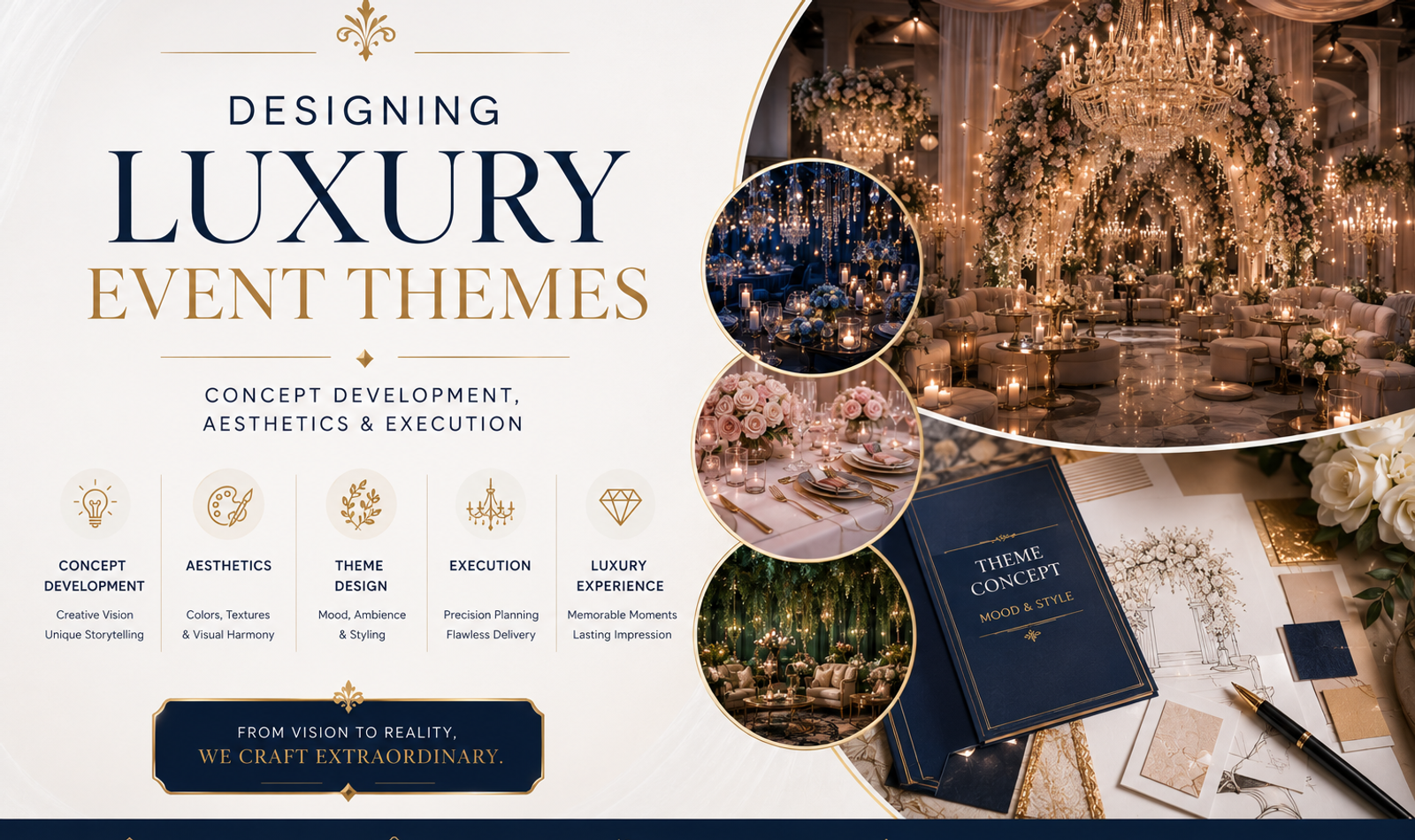
Designing Luxury Event Themes: Concept Development, Aesthetics & Execution
A luxury event theme is not simply a colour palette, floral arrangement or decorative style. It is a complete creative system that gives an event its emotional identity, visual language and experiential direction. From the first invitation received by a guest to the final moment of departure, every detail should feel connected to one intentional idea.
Whether the event is a destination wedding in Udaipur, an intimate celebration in Alibaug, a luxury product launch in Mumbai, a corporate gala in Delhi or a private milestone celebration in Goa, the theme influences how guests interpret the entire experience. It determines the mood of the venue, the pace of the evening, the style of hospitality and the memories guests carry with them.
The strongest luxury event themes do not feel imposed upon a space. They feel naturally connected to the host, brand, culture, venue and purpose of the occasion. Décor, entertainment, food, lighting, music, technology, service and communication work together rather than competing for attention.
Designing such an experience requires far more than visual creativity. It requires research, strategic concept development, financial planning, technical understanding, vendor coordination and disciplined execution. A beautiful idea must survive budgets, venue restrictions, weather conditions, installation timelines and real guest movement.
This guide explains how luxury event themes are developed from the initial creative brief through aesthetics, production and final on-ground delivery.
What Is Luxury Event Theme Design?
Luxury event theme design is the process of creating a unified creative concept that influences the visual, emotional, sensory and operational elements of an event. It converts the purpose of a celebration or brand experience into a physical environment that guests can enter, explore and remember.
A standard event theme might be described through broad labels such as royal, floral, vintage, tropical or futuristic. A luxury theme goes deeper. It establishes why the environment looks a certain way, how guests should feel within it and how each detail supports the central story.
For example, a luxury forest-inspired celebration should not rely only on green florals and artificial foliage. The concept could be built around the experience of entering a moonlit botanical world. The lighting might replicate filtered moonlight, the soundscape could include subtle natural textures and the food presentation might use stone, wood and botanical forms.
The guest does not simply see a forest theme. The guest feels transported into a designed environment.
Luxury event theme design normally brings together:
Creative storytelling
Spatial transformation
Sensory engagement
Technical production
Cultural relevance
Personalised details
Operational precision
The success of the theme depends on how seamlessly these components are integrated.
Why Luxury Event Themes Require Strategic Planning
Luxury guests are exposed to premium hospitality, international travel, high-end restaurants, fashion, architecture, art and entertainment. Generic decoration is therefore unlikely to leave a lasting impression. They expect an event to offer originality, comfort, relevance and emotional value.
However, creating visual spectacle without a strategic foundation can result in an event that feels expensive but disconnected. Multiple decorative ideas may be individually attractive yet fail to create a coherent atmosphere. Guests may notice the scale of production without understanding what the event is trying to communicate.
Strategic theme planning prevents this fragmentation. It provides one central reference against which every creative and operational decision can be evaluated.
When a new design element is proposed, the planning team should ask whether it strengthens the story, improves the guest experience or solves an operational requirement. If it does none of these, it may be unnecessary regardless of how visually appealing it appears.
A theme strategy also supports financial control. It helps planners prioritise high-impact elements instead of distributing the budget across excessive props, florals and installations. Luxury is created through clarity and quality, not through uncontrolled quantity.
For more detailed planning around costs, see this guide to event budgeting for luxury experiences.
Luxury Event Theme Development Framework
Development Phase
Central Question
Primary Output
Main Risk
Client Discovery
What should the event represent?
Creative brief
Generic direction
Concept Creation
What is the central story?
Theme narrative
Style without meaning
Visual Development
How should the story look?
Mood board and design system
Inconsistent aesthetics
Spatial Planning
How will guests experience the venue?
Zoning and layout plan
Poor flow
Budget Alignment
What can be delivered effectively?
Cost allocation
Overspending
Technical Planning
How will the concept be produced safely?
Production drawings
Installation failure
Vendor Coordination
Who is responsible for each element?
Execution matrix
Miscommunication
On-Site Execution
Does the final space match the vision?
Completed environment
Quality variations
Guest Experience
How will people interact with the theme?
Experience journey
Passive engagement
Post-Event Review
What created the strongest impact?
Performance insights
No measurable learning
Step One: Understanding the Event Purpose
Concept development begins with the purpose of the event rather than with décor references. A wedding, anniversary, luxury brand launch, investor dinner and awards night may all require sophisticated design, but their emotional and commercial objectives are different.
A wedding theme may need to represent two families, personal histories and cultural traditions. A corporate gala may need to communicate leadership, ambition and credibility. A luxury brand event may need to transform product positioning into a physical experience that generates media coverage and customer engagement.
The planning team should define what the host wants guests to think, feel and remember. These three questions create a much stronger foundation than beginning with favourite colours or trending design images.
The discovery process should explore the event’s objectives, guest profile, venue conditions, desired atmosphere, cultural considerations, budget boundaries and non-negotiable requirements. References from fashion, travel, art, films, architecture, music and personal memories can also reveal valuable creative directions.
A detailed discovery meeting may uncover that a couple’s strongest shared memory is travelling through Rajasthan, that a founder wants the brand to feel progressive without becoming cold or that a family values understated elegance rather than visible extravagance.
These insights become the raw material for an original theme.
Step Two: Defining the Creative Narrative
The creative narrative is the central story that connects every component of the event. It is normally expressed through a concise concept statement explaining the inspiration, atmosphere and intended guest experience.
A concept titled “Royal Rajasthan” is too broad to guide a truly distinctive event. A stronger narrative might be “Letters from a Desert Palace,” inspired by old travel journals, faded palace frescoes, hand-painted correspondence, candlelit courtyards and the warm colours of the Thar Desert.
This version immediately creates possibilities for invitation design, entrance installations, live art, stationery, music, fabrics, menus and guest keepsakes. It gives vendors a more precise creative world to interpret.
Similarly, a corporate technology event does not need to resemble a predictable futuristic exhibition. Its narrative could explore “Human Intelligence in a Digital World,” combining responsive technology with warm materials, conversational spaces and interactive stories about innovation.
An effective theme narrative should be distinctive enough to inspire creativity but clear enough to support production decisions. It should not become so abstract that vendors cannot translate it into tangible elements.
The narrative should answer four questions:
What inspires the concept?
What emotion should dominate?
What visual world supports it?
How will guests experience it?
Once these answers are approved, they should remain consistent throughout the planning process.
Step Three: Creating the Event Mood Board
The event mood board translates the narrative into a visual reference system. It may include colours, materials, architecture, typography, floral forms, fashion details, lighting references, furniture styles, table settings and artistic compositions.
A professional mood board should communicate an overall atmosphere rather than operate as a shopping list of decorations. Every image must support the same creative direction. Combining unrelated Pinterest references can create confusion and encourage vendors to interpret the concept differently.
The mood board should also distinguish between inspiration and literal reproduction. A photograph of an old European theatre may be included to communicate lighting, scale or architectural drama. It does not necessarily mean that the entire venue must be reconstructed as a theatre.
For a multi-event Indian wedding, separate mood boards may be created for the welcome dinner, haldi, mehendi, sangeet, wedding ceremony and reception. However, a common design thread should connect the complete celebration.
That connection could be created through recurring motifs, typography, materials, floral language or a gradual colour transition. This allows every function to have a distinctive personality without making the wedding feel like a collection of unrelated events.
Step Four: Establishing the Visual Design System
A luxury event requires a visual design system similar to the identity system used by a premium brand. The design system ensures that different vendors and creative departments produce work that feels consistent.
The system should define the colour palette, typography, materials, textures, motifs, floral approach, lighting character, signage style and graphic treatment. It may also specify which colours or materials should not be used.
The primary palette establishes the dominant atmosphere, while secondary tones add depth. Metallic details, natural textures and accent colours should be selected carefully so that the event avoids appearing visually overloaded.
Typography is equally important. The fonts used on invitations, welcome signs, menus, room keys, stage graphics and digital communication should belong to the same design family. Inconsistent fonts can make even an expensive event feel poorly coordinated.
Custom motifs can strengthen personalisation. These may be derived from architecture, family symbols, brand geometry, regional crafts, initials, botanical forms or meaningful locations. A motif can appear subtly across fabric, stationery, projections, gifts and tableware.
The objective is not to repeat the same graphic everywhere. It is to build recognition through controlled visual continuity.
Step Five: Designing for the Venue
Luxury event design should respond to the existing character of the venue instead of ignoring it. A heritage palace, modern ballroom, private residence, beach resort, industrial warehouse and garden venue each require a different creative approach.
The design team must evaluate ceiling height, entry points, existing architecture, service access, power capacity, fire regulations, weather exposure, acoustics and installation permissions. These factors influence what can be produced safely and efficiently.
A ballroom with a low ceiling may not support oversized suspended installations. Instead, the design can create depth through layered lighting, scenic walls, mirrored surfaces and lower sculptural arrangements. An open lawn may offer scale but require contingency planning for rain, wind, insects and uneven surfaces.
Heritage venues require particular sensitivity. Their architecture should normally remain visible rather than being hidden behind generic structures. Lighting, furniture and floral interventions can enhance the venue while respecting its historical character.
In a modern venue, the theme may require more extensive transformation because the space begins as a neutral shell. Temporary architecture, draping, projection, scenic fabrication and layered zoning can establish a completely new identity.
A venue walkthrough should therefore take place before the final theme is approved. Otherwise, the team may develop a concept that becomes difficult or excessively expensive to execute.
For broader decision-making around venues, see venue selection and negotiation for premium weddings and events.
Step Six: Creating an Intentional Colour Palette
Colour influences emotional perception before guests consciously notice individual details. A successful luxury palette must therefore be selected according to the story, venue, time of day, season and lighting environment.
Soft ivory, champagne, stone, sage and muted metallics may create quiet sophistication for a daytime celebration. Burgundy, plum, tobacco brown and antique gold can establish depth for an evening gala. Cobalt blue, silver, white and reflective materials might support a modern brand experience.
Luxury colour planning usually involves tonal variation rather than using one exact shade across every surface. Multiple values of the same colour create dimension and prevent the environment from appearing flat.
The palette should also be tested under event lighting. Fabrics and florals can appear significantly different under warm, cool or coloured illumination. A shade that looks refined in daylight may become dull or overly saturated under artificial light.
The design team should review physical samples of important fabrics, laminates, carpets, printed graphics and floral combinations. Digital screens cannot represent every material accurately.
Step Seven: Selecting Materials and Textures
Texture makes an event environment feel layered and tangible. It can transform a simple palette into an immersive luxury setting without requiring excessive decoration.
Premium event materials may include velvet, raw silk, linen, handwoven textiles, natural wood, brushed metal, stone, glass, mirror, ceramic, leather, cane, handmade paper and sculptural plaster finishes. The selection should reflect the concept rather than simply signal expense.
A contemporary Indian theme might combine handwoven textiles with clean architectural frames. A romantic garden concept could use weathered stone textures, translucent fabric and delicate glass. A fashion-led celebration might include lacquered surfaces, metallic mesh and dramatic textile draping.
Material hierarchy is essential. When every surface has a strong finish, the space becomes visually exhausting. One or two dominant textures should lead the design, while supporting materials provide contrast.
Quality is particularly visible at close range. Guest-facing items such as menus, table linen, cutlery, chairs, bar finishes and lounge furniture require careful attention because guests interact with them directly.
Step Eight: Planning Florals as Architecture
Flowers are often treated as the default definition of luxury event décor. However, quantity alone does not create sophistication. Floral design should support the spatial composition and emotional identity of the event.
The floral direction should define shape, scale, density, movement and colour. Loose garden arrangements create a different atmosphere from structured botanical sculptures. Monochromatic flowers communicate differently from wild seasonal compositions.
Large floral installations should have a clear purpose. They may frame an entrance, guide movement, create a ceremony focal point or soften large architectural volumes. Random floral coverage can consume a significant budget without improving the overall experience.
Luxury floral design can also incorporate foliage, branches, fruits, herbs, grasses, dried materials and locally available botanical elements. This creates richer storytelling and may reduce dependency on imported flowers.
Seasonality should be discussed early. When a concept depends on one specific flower that is unavailable or unstable in the required weather, the design becomes vulnerable. A professional florist should propose alternatives that preserve the intended shape and colour.
Step Nine: Using Lighting to Build Atmosphere
Lighting is one of the most powerful tools in luxury event design. It changes how colours, materials, architecture and people appear. It also determines whether the environment feels intimate, dramatic, energetic or emotionally flat.
Decorative lighting and technical lighting should be planned together. Chandeliers, lamps, candles and illuminated objects may contribute to the visual theme, while architectural lighting shapes the space itself.
A successful lighting plan can guide guests from one zone to another, reveal focal points gradually and create visual transitions across the event. The entrance may begin with low, mysterious illumination before opening into a brighter celebration space.
Stage lighting must also support photography and video. Strong coloured light may look exciting in person but create unnatural skin tones on camera. Lighting designers, photographers and filmmakers should align on important moments such as entries, performances, speeches and ceremonies.
Lighting cues can transform the same environment throughout the evening. A reception may begin with warm ambient lighting, move into focused performance lighting and later shift into a more energetic after-party atmosphere.
These transitions create progression without requiring the entire décor to change.
Step Ten: Designing the Guest Journey
The event theme should unfold as guests move through the venue. This is known as experience mapping or guest journey design.
The journey begins before arrival through invitations, digital communication, travel assistance and dress guidance. It continues through the driveway, valet experience, registration, welcome moment, transition areas, main venue, dining, entertainment and departure.
Each stage should reveal the theme without repeating the same visual information. The entrance may introduce the story, the cocktail area may encourage exploration and the main venue may deliver the strongest visual reveal.
Transitions are especially important in luxury events. Guests should never feel that they are moving through neglected service corridors or waiting without guidance. Passageways can be enhanced with sound, light, art, fragrance or live performance.
Guest flow must remain practical. A dramatic installation should not create a bottleneck. A photo moment should not block the entrance. Bars, food counters, restrooms and exits should remain easy to locate even when signage is integrated subtly into the design.
An event feels luxurious when navigation appears effortless.
For larger celebrations, professional guest management helps connect arrival, registration, hospitality, movement and departure into one coordinated experience.
Step Eleven: Building Multi-Sensory Experiences
A visually impressive environment may attract immediate attention, but multi-sensory experiences create stronger emotional memory. Luxury event design can engage sound, scent, taste and touch alongside sight.
A custom soundscape can establish atmosphere before live entertainment begins. Music may evolve across different zones or stages of the event. In a culturally layered wedding, classical instruments can be reinterpreted within a contemporary musical arrangement.
Scent should be used carefully because it can strongly influence perception. A subtle botanical, woody or citrus fragrance may reinforce the theme, while an excessive artificial scent can become uncomfortable.
Food and beverage presentation can also become part of the creative concept. Ingredients, serving materials, menu language and live culinary moments can support the event narrative. A coastal theme may incorporate regional flavours and sculptural seafood displays, while a heritage-inspired dinner may reinterpret family recipes through refined presentation.
Tactile details such as handmade paper, embroidered menus, textured table linen and custom ceramic tableware create intimacy because guests physically interact with them.
The objective is not to overwhelm every sense simultaneously. The strongest sensory design is controlled, subtle and coordinated.
Step Twelve: Integrating Entertainment Into the Theme
Entertainment should feel like a continuation of the event environment rather than a separate booking placed within it. The performance style, costumes, stage design, music and timing should reinforce the central concept.
For a palace-inspired evening, entertainment might draw from classical storytelling, contemporary Indian dance and live orchestration. A luxury automotive launch may use kinetic performance, light choreography and sound design to express movement and engineering.
Interactive entertainment can also improve guest participation. Live artists, guided tastings, personalised performances, design workshops and responsive installations give guests a role within the experience.
However, interaction should remain appropriate for the audience. Senior corporate guests may prefer structured networking and elegant performances, while a younger wedding audience may respond to gamified experiences and spontaneous entertainment.
The entertainment programme should also respect the rhythm of the event. Too many performances can interrupt conversations and dining. Too little programming can make a large venue feel inactive.
A detailed show flow helps balance spectacle with social engagement.
For events involving high-profile artists or personalities, professional celebrity management can help coordinate appearance schedules, logistics and event integration.
Step Thirteen: Personalising the Theme
Personalisation is one of the clearest differences between standard decoration and luxury event design. It demonstrates that the event was created for a specific host, couple, family or brand rather than selected from a catalogue.
Personalisation can be visible through monograms, photographs and custom signage, but the most meaningful forms are often less obvious. The concept might reference a couple’s travels, a family tradition, a founder’s journey or a brand’s design philosophy.
For weddings, menus can include meaningful dishes, tables can be named after important places and music can reflect different periods of the couple’s relationship. Guest rooms may contain locally curated gifts and handwritten notes.
For brands, personalisation may involve adapting the experience to different customer groups, media representatives, partners or creators. Digital registration data can help tailor agendas, communication and product interactions.
The goal is to make guests feel recognised without turning the event into a display of excessive branding.
Indian Culture and Luxury Event Theme Design
Indian luxury events offer extraordinary creative possibilities because of the country’s regional architecture, textiles, crafts, music, food, rituals and visual traditions. However, cultural references should be researched and interpreted respectfully.
A Punjabi-inspired celebration should not be reduced to bright colours, tractors and generic folk props. The design may explore phulkari geometry, agricultural landscapes, heritage homes, traditional musical instruments or the warmth of Punjabi hospitality through a contemporary lens.
A Rajasthan-inspired event can move beyond predictable palace décor by drawing from stepwell architecture, miniature paintings, desert textiles, blue pottery, carved stone or regional poetry.
Similarly, South Indian themes can explore temple architecture, brass craftsmanship, banana fibre, jasmine, classical dance forms and regional cuisine without becoming theatrical or superficial.
Modern luxury often emerges from restraint. One authentic craft used with scale and precision may create more impact than multiple cultural references placed together without context.
Collaboration with local artisans can also introduce originality while supporting traditional skills. Custom textiles, pottery, metalwork, paper, embroidery and hand-painted surfaces can become meaningful parts of the event environment.
Theme Development for Multi-Day Weddings
Multi-day weddings require an overall creative strategy because each function needs its own identity. The objective is to provide variety while maintaining continuity.
The welcome dinner might introduce the destination through relaxed hospitality. The mehendi may focus on colour, craft and social interaction. The sangeet may become theatrical and performance-led. The wedding ceremony may feel sacred and emotionally grounded, while the reception may express formal elegance.
A strong wedding narrative can progress across these functions like chapters of one story. Colours may move from bright daytime tones toward deeper evening shades. Motifs can become more refined. Entertainment can progress from local and informal to dramatic and contemporary.
Guest communication should explain practical changes in dress code, timing and location while continuing the same visual identity. This creates anticipation and helps guests understand the character of each event.
Production planning becomes more complex when venues must be transformed overnight. Décor teams need precise installation and dismantling schedules, especially when the same ballroom or lawn is reused.
For broader planning, see the luxury wedding planning guide for destination celebrations.
Theme Design for Luxury Corporate Events
Corporate event themes must balance creativity with business objectives. The environment should support brand positioning, networking, product communication, leadership visibility and measurable engagement.
A corporate theme should begin with the central message of the event. A brand celebrating innovation may need a different experience from one communicating heritage, sustainability or market leadership.
Brand colours can be incorporated without covering every surface in the logo palette. Materials, lighting, geometry and movement can express the brand more elegantly than repetitive graphics.
For a product launch, the theme should create a controlled reveal. Guests may first encounter the product story through installations, demonstrations or sensory cues before seeing the final product. This builds curiosity and improves attention.
Corporate guests also require comfortable networking environments. Lounge furniture, acoustics, lighting and service placement must support conversation. A visually spectacular event that makes business interaction difficult has not achieved its purpose.
For more strategic planning around this format, see planning ultra-luxury events in India.
Luxury Event Budget Allocation
The creative concept must be aligned with the available budget before detailed production begins. Otherwise, the team may spend weeks developing a design that requires major compromises.
Budget priorities will vary according to the venue and event objective, but the following allocation can provide an initial planning reference.
Design Component
Indicative Share of Theme Budget
Scenic fabrication and structures
20–25%
Florals and botanical styling
15–20%
Lighting and technical production
15–20%
Furniture and spatial styling
10–15%
Stage and entertainment integration
10–15%
Signage and graphic production
5–8%
Table styling and guest details
5–10%
Logistics and installation labour
8–12%
Contingency reserve
8–10%
These percentages are not fixed. A venue with strong natural architecture may require less scenic fabrication but more lighting. A floral-focused wedding may assign a larger amount to botanical installations. A technology-led launch may direct more investment toward screens, projection, interaction and content.
The budget should protect the event’s hero moments. These are the areas guests will encounter most strongly, such as the entrance, ceremony, stage, dining environment or product reveal.
Reducing quality across every element normally creates a weaker result than simplifying secondary areas while preserving the main experience.
Converting Creative Concepts Into Technical Plans
Once the visual concept is approved, the design must be converted into detailed technical documents. Mood boards alone are not sufficient for production.
The team may require floor plans, elevations, three-dimensional renders, structural drawings, lighting plots, electrical load plans, material specifications, floral recipes and installation schedules.
Measurements must be verified at the venue. A design based on approximate dimensions can create serious on-site difficulties. Existing pillars, fire exits, air-conditioning vents, service doors and ceiling rigging points must be marked accurately.
Structural elements should be reviewed by qualified professionals where required. Suspended installations, large scenic walls, stages and outdoor structures must account for weight, wind, guest safety and venue regulations.
Technical drawings also support accurate vendor quotations. Without specifications, different vendors may calculate costs for different interpretations of the same design.
Vendor Coordination and Quality Control
Luxury event themes are delivered through multiple specialist partners. These may include décor fabricators, florists, lighting teams, audiovisual companies, rental suppliers, graphic printers, entertainment agencies, caterers and hospitality teams.
Each vendor should receive a relevant section of the approved design guide. However, one central creative team must supervise the complete environment. Without central control, departments may make independent decisions that weaken consistency.
Responsibilities should be documented through an execution matrix identifying the owner, deadline, approval process and installation requirement for each element.
Regular coordination meetings should review design changes, technical dependencies, production status and budget movement. When one vendor changes a measurement or material, the effect on other departments must be evaluated.
Quality checks should take place during fabrication, not only after items reach the venue. Material samples, print tests, mock-ups and workshop visits can identify problems before installation.
For operational guidance, see vendor management for coordinating event suppliers.
On-Site Execution and Installation
The installation phase is where the creative idea encounters real conditions. Delayed access, weather changes, unavailable materials, transportation issues and venue restrictions can all affect delivery.
A detailed production schedule should identify loading times, build sequences, technical rehearsals, cleaning, styling and final handover. Large installations must be completed before delicate florals, tableware and guest-facing details are placed.
The creative director should conduct regular visual checks from the guest’s perspective. The environment must be reviewed from the entrance, key seating areas, stage, dining tables and photography positions.
Lighting must be tested after sunset for evening events. During daytime setup, it can be difficult to judge the final atmosphere accurately.
Every visible cable, unfinished edge, damaged surface, incorrect print and inconsistent floral arrangement should be addressed before guest arrival. Luxury is often defined by the details that do not attract attention because they have been resolved properly.
Theme Execution Contingency Planning
Contingency planning protects both the creative concept and the guest experience. Outdoor events require clear plans for rain, wind, heat, humidity and power interruption.
A rain plan should be designed as a genuine alternative rather than an emergency compromise. Guests should not feel that they have been moved into an undecorated backup space.
Important décor materials should have substitutes. Additional printed stationery, candles, lighting fixtures, floral supplies and hardware should be available for urgent replacement.
Technical systems should include backups for power, audio, presentation content and show control. Critical files must be available in multiple formats and devices.
A command structure should also be established so that urgent decisions can be made quickly without multiple conflicting approvals.
Common Luxury Event Theme Design Mistakes
One common mistake is selecting a theme only because it is trending. A fashionable aesthetic may look impressive online but feel unrelated to the host, brand or venue.
Another mistake is adding too many creative ideas. Combining royal, botanical, futuristic and vintage references in one environment often produces confusion rather than richness.
Excessive branding can also reduce elegance. Corporate logos and wedding monograms should be integrated intentionally instead of printed across every available surface.
Designing primarily for photographs is equally risky. Social media moments are valuable, but the physical comfort and movement of guests must remain the priority.
Other frequent problems include insufficient lighting, poor-quality furniture, weak signage, unrealistic installation schedules, uncontrolled vendor substitutions and a lack of weather planning.
The best protection against these mistakes is one approved concept, one central creative authority and one detailed execution plan.
Luxury Event Theme Concepts for Inspiration
The Modern Maharaja
This concept combines the scale of Indian royal architecture with contemporary restraint. Stone textures, deep jewel tones, custom metalwork and sculptural lighting replace predictable palace props.
Moonlit Botanical Conservatory
A romantic environment built through silver-green foliage, translucent fabric, reflective water surfaces, delicate florals and controlled moonlight effects. The atmosphere feels natural, immersive and cinematic.
Letters From India
A travel-inspired concept using handwritten notes, archival maps, regional craft, vintage trunks and stories from meaningful destinations. It works particularly well for destination weddings and milestone celebrations.
The Art of Time
Designed for luxury watches, anniversaries or heritage brands, this theme explores time through kinetic installations, layered projection, precision detailing and evolving light.
Indian Modernism
A refined interpretation of Indian design combining local materials, geometric architecture, craft traditions and contemporary furniture. It offers cultural character without becoming overly ornate.
A Night at the Opera
A theatrical gala concept featuring layered curtains, dramatic lighting, performance-led transitions and rich formal styling. The event unfolds through different acts rather than one static reveal.
Future of Nature
This concept integrates responsive technology, organic forms, sustainable materials and immersive botanical environments. It is suitable for innovation summits, automotive launches and sustainability-focused brands.
Measuring the Success of an Event Theme
The success of a luxury theme should not be judged only by photographs. The experience must also support guest satisfaction, event objectives and operational performance.
Wedding hosts may evaluate guest feedback, emotional engagement, hospitality quality and the smoothness of different functions. Brands may measure attendance, media coverage, social engagement, product interaction, lead generation and partner response.
Operational indicators include entry waiting time, movement between zones, seating efficiency, technical performance, food service flow and the number of unresolved guest requests.
Post-event discussions with the client and vendors can identify which design choices created value and which processes need improvement. These insights strengthen future event planning.
Brands that want to extend the value of the experience can also integrate events, PR and digital into the broader brand roadmap.
Luxury Event Theme Planning Checklist
Before approving the final theme, confirm that the concept has a clear narrative and reflects the event’s purpose. The mood board, palette, materials, florals, lighting and graphics should communicate one connected visual world.
The design must respond to the venue’s architecture, technical limits and weather conditions. Guest flow, seating, hospitality, entertainment and service access should be tested against the floor plan.
Budgets must include fabrication, transportation, labour, installation, dismantling, technical support, taxes and contingency. Vendor responsibilities and approval timelines should be documented.
Finally, review the event from the guest’s perspective. The theme should be visible before arrival, emotionally engaging during the event and memorable after departure.
Frequently Asked Questions
What makes an event theme luxurious?
A luxury event theme combines original storytelling, premium materials, detailed personalisation, guest comfort and precise execution. It does not depend only on expensive décor. The complete environment must feel intentional, consistent and effortless.
How is an event theme developed?
Event theme development begins with understanding the occasion, host, audience, venue and desired emotion. The planning team then creates a narrative, mood board, visual system, spatial plan, budget and production strategy.
What is the difference between event décor and event design?
Event décor refers mainly to the visible decorative elements placed within a venue. Event design is broader and includes storytelling, layout, lighting, sound, entertainment, food presentation, guest movement and sensory experience.
How long does luxury event theme development take?
The timeline depends on event scale and production complexity. A detailed luxury wedding, corporate gala or brand launch may require several months of concept development, design approvals, sourcing, fabrication and technical planning.
How can a luxury event theme remain within budget?
The theme should prioritise a few high-impact areas and simplify secondary spaces. Early budget alignment, accurate technical specifications and controlled vendor changes help prevent unnecessary expenses.
Can different functions have different themes?
Yes. Multi-day weddings and conferences may have distinct themes for different functions. However, colours, motifs, storytelling or graphic identity should create continuity across the complete event.
Are sustainable materials suitable for luxury events?
Yes. Reusable structures, local flowers, rental furniture, regional materials and modular fabrication can support premium design. Sustainability works best when it is integrated into planning rather than added as a final claim.
For more detail, see sustainable luxury events and eco-conscious planning.
How important is lighting in luxury event design?
Lighting is essential because it controls atmosphere, spatial depth, visual focus and photography quality. Even exceptional décor can appear flat or poorly finished when the lighting is not designed professionally.
What is immersive event design?
Immersive event design places guests inside a complete sensory environment. Décor, lighting, sound, performance, food and interaction work together to make guests feel that they have entered another world or narrative.
Why should brands invest in themed corporate events?
A themed corporate event can make brand positioning tangible, improve product understanding, encourage media coverage and create stronger engagement with customers, partners and employees.
Conclusion
Designing luxury event themes is a strategic process that brings together storytelling, aesthetics, engineering, hospitality and operational planning. The theme must communicate more than a visual style. It should give the entire event a clear emotional identity.
The process begins by understanding what the occasion represents and what guests should remember. That insight is developed into a creative narrative, mood board and visual system before being adapted to the venue, guest journey, technical requirements and available budget.
Every visible element should support the same story, but successful execution also depends on the details guests may never notice. Accurate measurements, safe structures, thoughtful service access, backup systems, clear signage and coordinated vendors allow the final environment to feel effortless.
Luxury is not created by placing more decoration into a venue. It is created through meaningful choices, premium quality, cultural sensitivity, personal relevance and disciplined delivery.
When concept development, aesthetics and execution operate as one connected system, an event moves beyond decoration. It becomes a designed experience that guests can see, feel and remember.
Design and Execute Luxury Events With Double Trouble Studio
Double Trouble Studio creates strategically designed weddings, private celebrations, corporate events, brand launches and immersive luxury experiences across Mumbai, Delhi, Punjab, Goa, Rajasthan and other destinations in India.
Our event management team supports concept development, creative direction, venue transformation, décor planning, guest management, celebrity coordination, technical production, entertainment, hospitality and complete on-ground execution.
Every experience is developed around the client’s identity, audience and objectives. From the initial creative narrative to the final guest departure, our team manages the details required to transform an idea into a refined, memorable and operationally seamless event.
Plan your next luxury event with Double Trouble Studio.
For consultations, contact Double Trouble Studio to discuss your event concept, venue, budget and execution requirements.
📩 info@dtsworld.in 📞 +91 80000 06021 📍 Andheri (West), Mumbai
Related reading: Luxury event design trends 2026–2027.
Need this for your brand?
Let DTS build your next campaign.
From PR, celebrity management and events to websites, social media, SEO and AI video production — Double Trouble Studio helps brands grow with strategy and execution.
Discuss Your Requirement →