Luxury Website UX Principles: Minimalism, Speed & Emotional Impact
Luxury is not created by adding more.
In many cases, it is created by knowing exactly what to remove.
The same principle applies to digital experiences.
A luxury website should not feel crowded, confusing or desperate for attention. It should feel intentional. Every image, word, transition, interaction and piece of white space should contribute to how the customer perceives the brand.
But minimalism alone does not create luxury.
A nearly empty website that is difficult to navigate is not premium.
A cinematic homepage that takes too long to load is not premium.
Beautiful typography that becomes unreadable on mobile is not premium.
A dramatic animation that prevents customers from finding important information is not premium.
Luxury website UX is therefore about balance.
It combines visual restraint with usability.
Emotion with clarity.
High-quality imagery with performance.
Brand storytelling with conversion.
Exclusivity with accessibility.
For premium businesses, the website is often one of the first meaningful brand experiences a potential customer encounters. Before someone visits a showroom, books a hotel, schedules a consultation, attends an event or purchases a premium product, they may spend several minutes evaluating the brand digitally.
Those minutes matter.
This guide explores the most important luxury website UX principles, including minimalism, visual hierarchy, typography, speed, mobile design, emotional storytelling, trust and conversion.
What Is Luxury Website UX?
Luxury website UX is the design of a digital experience that reflects the quality, positioning and service standards of a premium brand while making the website easy and satisfying to use.
UX stands for user experience.
It includes much more than how a website looks.
UX considers:
How quickly users understand the brand.
How easily they navigate.
How information is organised.
How fast pages load.
How content behaves on mobile.
How users interact with forms.
How products are discovered.
How bookings are completed.
How enquiries are submitted.
How the website makes people feel.
A luxury website therefore needs to perform on two levels.
It must create a strong emotional impression.
And it must work exceptionally well.
A professional website development and digital marketing strategy should bring these two requirements together rather than treating design and functionality as separate decisions.
Why Luxury Website UX Is Different
A mass-market website may prioritise speed of transaction, product volume, discounts and promotional visibility.
Luxury websites often need to communicate something different.
Craftsmanship.
Scarcity.
Heritage.
Expertise.
Personalisation.
Status.
Design.
Experience.
Service.
Emotion.
The website may need to persuade customers to spend significantly more than they would with a mainstream alternative.
That changes the role of UX.
A luxury customer may spend time evaluating the details.
They may examine photography.
Read the brand story.
Review past work.
Explore materials.
Investigate the founder.
Look for media coverage.
Compare alternatives.
Check Instagram.
Return several times before making contact.
The website should support this considered decision-making process.
Luxury UX Begins With Brand Positioning
Before designing the interface, understand the brand.
What does the company represent?
Who is it for?
Why is it premium?
What makes it different?
What should customers feel?
What should they remember?
What level of service should the digital experience communicate?
A luxury resort and a luxury watch brand may both be premium, but their digital identities should not necessarily look the same.
One may communicate tranquillity and escape.
Another may communicate precision and engineering.
A fashion house may emphasise culture and creative expression.
A private wealth business may emphasise discretion and authority.
A strong luxury brand positioning strategy should therefore inform website decisions before layouts are created.
UX should express positioning rather than decorate it.
Principle 1: Use Minimalism With Purpose
Minimalism is strongly associated with luxury digital design.
But minimalism is frequently misunderstood.
It does not mean removing information until the customer has no idea what the business offers.
It means removing what does not contribute to the experience.
A minimalist luxury website may use:
Fewer navigation options.
Shorter blocks of copy.
Large imagery.
Controlled colour palettes.
Clear typography.
Generous spacing.
Limited calls to action.
Purposeful animation.
The key word is purposeful.
Every element should earn its place.
If a section exists only because every competitor has one, question whether it is necessary.
If an animation adds no meaning, remove it.
If five CTAs compete for attention, prioritise the most important action.
Minimalism works when it increases clarity.
Principle 2: Use White Space to Create Focus
White space is one of the most powerful tools in premium design.
It gives content room to breathe.
It creates separation.
It improves readability.
It directs attention.
It can also increase the perceived importance of individual elements.
Imagine a luxury watch displayed alone in a glass showcase.
The empty space around the product contributes to its presentation.
Digital design can use the same principle.
A hero image surrounded by controlled negative space may feel more important than the same image surrounded by banners, icons and promotional messages.
White space does not need to be literally white.
Dark luxury websites can use negative space just as effectively.
The principle is visual breathing room.
Principle 3: Create a Strong Visual Hierarchy
Customers should understand what matters without having to consciously analyse the page.
Visual hierarchy helps guide attention.
This can be created through:
Scale.
Position.
Contrast.
Spacing.
Typography.
Image size.
Motion.
Colour.
A strong hierarchy might guide the user from:
Headline → visual → supporting statement → CTA.
A weak hierarchy makes everything compete.
If the logo, navigation, headline, promotion, CTA, social icons and background video all demand equal attention, the experience becomes noisy.
Luxury design should feel controlled.
Decide what the user should notice first.
Then second.
Then third.
The page should reveal information intentionally.
Principle 4: Choose Typography That Reflects the Brand
Typography plays an unusually important role in luxury design.
The typeface itself can communicate personality.
Serif typography may suggest heritage, editorial sophistication or craftsmanship.
A clean sans-serif may communicate modernity, architecture or technical precision.
Custom or distinctive typography can create stronger brand recognition.
But aesthetic choice should never destroy readability.
Consider:
Font size.
Line height.
Contrast.
Paragraph width.
Mobile behaviour.
Font loading.
Hierarchy.
Weight.
Spacing.
Luxury websites sometimes use very small typography because it appears sophisticated on a design mockup.
If customers struggle to read it, the experience is not premium.
Good typography should look refined and remain effortless to consume.
Principle 5: Invest in Premium Photography
Luxury customers often judge the quality of the brand through imagery before reading much text.
Photography therefore carries significant responsibility.
Poor imagery can make an expensive product appear ordinary.
Strong photography can communicate:
Material.
Texture.
Scale.
Atmosphere.
Craftsmanship.
Lifestyle.
Emotion.
Context.
Premium photography should feel intentional rather than generic.
Hospitality brands should show the atmosphere of the property.
Interior brands should reveal material and spatial detail.
Automotive brands should communicate design and experience.
Fashion brands should establish a world around the collection.
Event brands should capture scale, emotion and production quality.
The website should not simply contain images.
The imagery should participate in storytelling.
Principle 6: Use Video Strategically
Video can create strong emotional impact.
A carefully directed hero film can communicate a hotel, property, automobile, fashion collection or event in seconds.
But video creates trade-offs.
Large files can damage page speed.
Autoplay can distract.
Aggressive movement can make text difficult to read.
Mobile data usage may increase.
Accessibility can suffer.
The solution is not to avoid video.
It is to use it intentionally.
Ask:
Does this video communicate something a still image cannot?
Is the file optimised?
Does it load appropriately?
Can important content remain usable if the video fails?
Is text readable over the footage?
Does it behave properly on mobile?
Brands exploring more advanced visual storytelling can also use AI video and VFX production for concept films and digital campaigns, provided the creative direction remains aligned with the brand.
Principle 7: Website Speed Is Part of Luxury
Luxury customers expect responsiveness.
When someone enters a premium store, they do not expect to wait several minutes before anyone acknowledges them.
Digital experiences should follow the same principle.
A slow website creates friction before the customer has even experienced the brand.
Common causes include:
Oversized images.
Uncompressed video.
Excessive JavaScript.
Too many tracking scripts.
Poor hosting.
Heavy animations.
Large font files.
Third-party widgets.
Unoptimised code.
Performance should be considered from the beginning rather than repaired after launch.
The technical principles covered in Technical SEO foundations, speed, mobile and Core Web Vitals are particularly relevant for luxury websites because premium visual assets can easily become performance liabilities.
Principle 8: Make Navigation Effortless
Luxury should not mean mysterious navigation.
Customers should not have to discover that an invisible symbol in the corner opens the main menu.
Creative navigation can be appropriate, but basic usability should remain intuitive.
Visitors should easily find:
Products.
Services.
Collections.
Portfolio.
About information.
Locations.
Bookings.
Contact options.
The exact navigation depends on the business.
A luxury hotel may prioritise rooms, dining, experiences and reservations.
A designer may prioritise portfolio, studio and enquiries.
A fashion brand may prioritise collections and shopping.
An event company may prioritise services, work and contact.
Navigation should reflect customer priorities rather than internal company structure.
Principle 9: Create Emotional Impact Through Storytelling
Luxury purchasing decisions are rarely purely functional.
Emotion matters.
Customers may be buying:
Identity.
Celebration.
Recognition.
Comfort.
Belonging.
Escape.
Confidence.
Memory.
Status.
Craftsmanship.
The website should communicate the emotional value surrounding the product or service.
This can happen through:
Photography.
Film.
Copywriting.
Sound where appropriate.
Editorial storytelling.
Founder narratives.
Craftsmanship stories.
Customer experiences.
Case studies.
Interaction design.
A hotel should not merely show a room.
It can communicate the feeling of waking up there.
A jewellery brand should not only describe materials.
It can communicate meaning and occasion.
A wedding company should not simply list services.
It can communicate how an experience feels for the couple and guests.
Luxury storytelling turns information into meaning.
Principle 10: Design the Homepage as an Experience
The homepage often carries too much responsibility.
Brands try to place everything on it.
Every service.
Every award.
Every testimonial.
Every client.
Every social post.
Every promotion.
Every contact option.
The result can feel like a catalogue rather than a luxury experience.
A premium homepage should prioritise.
It may include:
A strong opening statement.
A signature visual.
Core positioning.
Selected products or services.
A concise brand story.
Selected work.
Proof.
A clear next step.
The exact sequence should follow the customer's likely decision journey.
For a deeper framework around visual identity and premium digital experience, see our guide to designing high-end luxury websites.
Principle 11: Design for Mobile, Not Just Desktop
Luxury websites are often designed first on large desktop screens because large canvases make photography and typography look impressive.
Customers do not experience the website only on those screens.
They discover brands through Instagram.
Open links from WhatsApp.
Search on Google.
Browse while travelling.
Research during meetings.
Compare products from their phones.
Mobile UX therefore needs independent attention.
Review:
Image crops.
Typography.
Spacing.
Menu behaviour.
Button size.
Form fields.
Video.
Sticky CTAs.
Product galleries.
Checkout.
Booking systems.
Phone links.
WhatsApp links.
A desktop experience should not simply be compressed into a smaller screen.
Principle 12: Use Motion With Restraint
Animation can make luxury interfaces feel polished.
Examples include:
Subtle fades.
Image reveals.
Controlled parallax.
Hover interactions.
Menu transitions.
Micro-interactions.
Page transitions.
But motion should support the experience.
Too much animation can make the website feel like a technology demonstration.
Users should not wait for a three-second animation every time they open a page.
Scrolling should not become difficult.
Buttons should respond immediately.
Text should remain readable.
Motion should create rhythm and refinement rather than delay.
Principle 13: Micro-Interactions Should Confirm Actions
Small interactions can make websites feel responsive.
When a user:
Adds a product.
Opens a menu.
Submits a form.
Selects a room.
Chooses a date.
Saves an item.
Changes a product option.
The interface should provide clear feedback.
These responses can be subtle.
A colour shift.
A checkmark.
A smooth transition.
A short confirmation.
The purpose is to reassure the user that the system understood the action.
Premium UX often comes from these details.
Principle 14: Balance Exclusivity With Accessibility
Exclusivity is part of many luxury brands.
Digital exclusion should not be.
A website should remain usable for people with different needs.
Consider:
Readable contrast.
Keyboard navigation.
Alternative text.
Clear form labels.
Captions for important video.
Logical heading structure.
Appropriate text sizing.
Reduced-motion preferences.
Accessible interactions.
Accessibility and luxury are not opposing ideas.
Both are based on thoughtful attention to the customer.
Principle 15: Build Trust Into Every Stage
Luxury purchases frequently involve significant financial or emotional commitment.
Customers therefore look for evidence.
Trust signals can include:
Client testimonials.
Case studies.
Media coverage.
Awards.
Professional credentials.
Secure payment systems.
Clear contact information.
Transparent policies.
Company history.
Founder expertise.
Recognised partnerships.
Authentic customer reviews.
Trust signals should appear where they help the decision.
A testimonial beside a relevant service may be more useful than placing every testimonial on a separate page.
Security also contributes to trust. Premium businesses should understand how secure websites, data protection and trust signals influence customer confidence when people submit enquiries, create accounts, make bookings or complete payments.
Luxury Product Page UX
Luxury product pages need to balance desire with information.
Customers may want:
Multiple high-resolution images.
Zoomed detail.
Video.
Materials.
Dimensions.
Craftsmanship information.
Availability.
Delivery information.
Care instructions.
Product story.
Related products.
Contact assistance.
The page should make information easy to access without becoming visually crowded.
Progressive disclosure can help.
Important information appears first.
Additional detail can be revealed when requested.
This preserves visual simplicity while supporting serious buyers.
Luxury Service Page UX
Premium services are often harder to communicate than physical products.
The customer cannot inspect the final result before purchasing.
The service page therefore needs to reduce uncertainty.
Explain:
What the service includes.
Who it is designed for.
How the process works.
What makes the approach different.
Relevant experience.
Previous work.
Expected next steps.
Frequently asked questions.
A clear CTA.
Do not assume customers will contact the company simply because the imagery looks impressive.
Give them enough information to feel confident taking the next step.
Luxury Ecommerce UX
Luxury ecommerce should feel more considered than a generic online store.
The journey may include:
Editorial discovery.
Collection exploration.
Product storytelling.
Detailed imagery.
Wishlist.
Personal assistance.
Premium packaging information.
Delivery information.
Secure checkout.
Post-purchase communication.
Avoid overwhelming customers with constant promotional pop-ups.
Discount-first messaging can also conflict with certain luxury positioning strategies.
The ecommerce experience should communicate value before urgency.
Luxury Hospitality Website UX
Hospitality websites sell experiences before customers physically arrive.
The website should help visitors imagine the stay.
Important information may include:
Rooms.
Suites.
Dining.
Spa.
Experiences.
Location.
Events.
Weddings.
Amenities.
Availability.
Reservations.
Photography is critical, but practical information should remain easy to find.
Customers should not need to search through cinematic pages to discover whether a room is available.
Emotion and utility should work together.
Luxury Automotive Website UX
Luxury automotive websites need to communicate design, engineering and experience.
Customers may want to:
Explore models.
Compare specifications.
View interiors.
Watch films.
Configure options.
Find locations.
Book test drives.
Request information.
The visual experience can be highly immersive.
However, model information and actions should remain accessible.
The customer should never become lost inside the presentation.
Luxury Real Estate and Interior Website UX
Luxury real estate and interior websites depend heavily on visual storytelling.
Customers want to understand:
Space.
Material.
Light.
Scale.
Location.
Design philosophy.
Past work.
High-resolution photography and film can communicate these qualities effectively.
But galleries need structure.
Project information should provide context.
Mobile browsing should remain smooth.
Enquiry pathways should be clear.
A portfolio should inspire confidence rather than become an endless image feed.
Luxury Event and Wedding Website UX
Event and wedding websites sell something customers cannot fully experience until the event happens.
Past work therefore becomes extremely important.
Potential clients may evaluate:
Event scale.
Design quality.
Guest experience.
Production.
Locations.
Entertainment.
Hospitality.
Past clients.
Planning expertise.
Brands offering premium events and wedding services can use case studies and visual storytelling to demonstrate capability while service pages explain the planning and execution process.
The website should communicate both creativity and operational confidence.
Content Is Part of UX
Content strategy and UX are closely connected.
Even beautifully designed websites can feel frustrating if customers cannot find the information they need.
Content should be structured according to the customer journey.
Short copy may work on the homepage.
Detailed guides may work in the blog.
Service pages may require process information.
Product pages may need specifications.
Case studies may need deeper storytelling.
A strategic content approach for brand websites helps determine where different information belongs.
Minimalism should control presentation, not eliminate useful knowledge.
SEO and Luxury UX Should Support Each Other
SEO and luxury design are sometimes treated as competing priorities.
They should not be.
Search engines need understandable content and technical structure.
Customers need elegant experiences.
Both can coexist.
A luxury website can use:
Clear headings.
Well-structured content.
Fast pages.
Descriptive URLs.
Internal links.
Optimised images.
Useful service information.
Accessible navigation.
Without looking like a generic SEO template.
A strong SEO strategy for luxury brands connects search visibility with positioning, keyword intent and authority rather than sacrificing brand quality for rankings.
Technical UX Happens Behind the Interface
Customers may never see the technical architecture.
They experience its results.
A technically strong website loads consistently.
Links work.
Forms submit correctly.
Redirects behave properly.
Mobile pages render accurately.
Search engines can access important content.
Errors are handled gracefully.
Technical SEO and website development therefore influence UX even when the user cannot see the underlying work.
A broader technical SEO optimization framework can help teams identify issues involving crawlability, indexing, architecture and performance before they affect visibility or customer experience.
Conversion Optimization Without Damaging Luxury Positioning
Luxury websites still need to convert.
But conversion tactics should match the brand.
Aggressive countdown timers, constant pop-ups and oversized discount banners may increase urgency but weaken premium perception.
Instead, conversion can be supported through:
Clear CTAs.
Strong case studies.
Relevant testimonials.
Simple enquiry processes.
Private consultation options.
Appointment booking.
Personal assistance.
Transparent next steps.
Strategic lead qualification.
Trust signals.
High-ticket customers may require a longer consideration period.
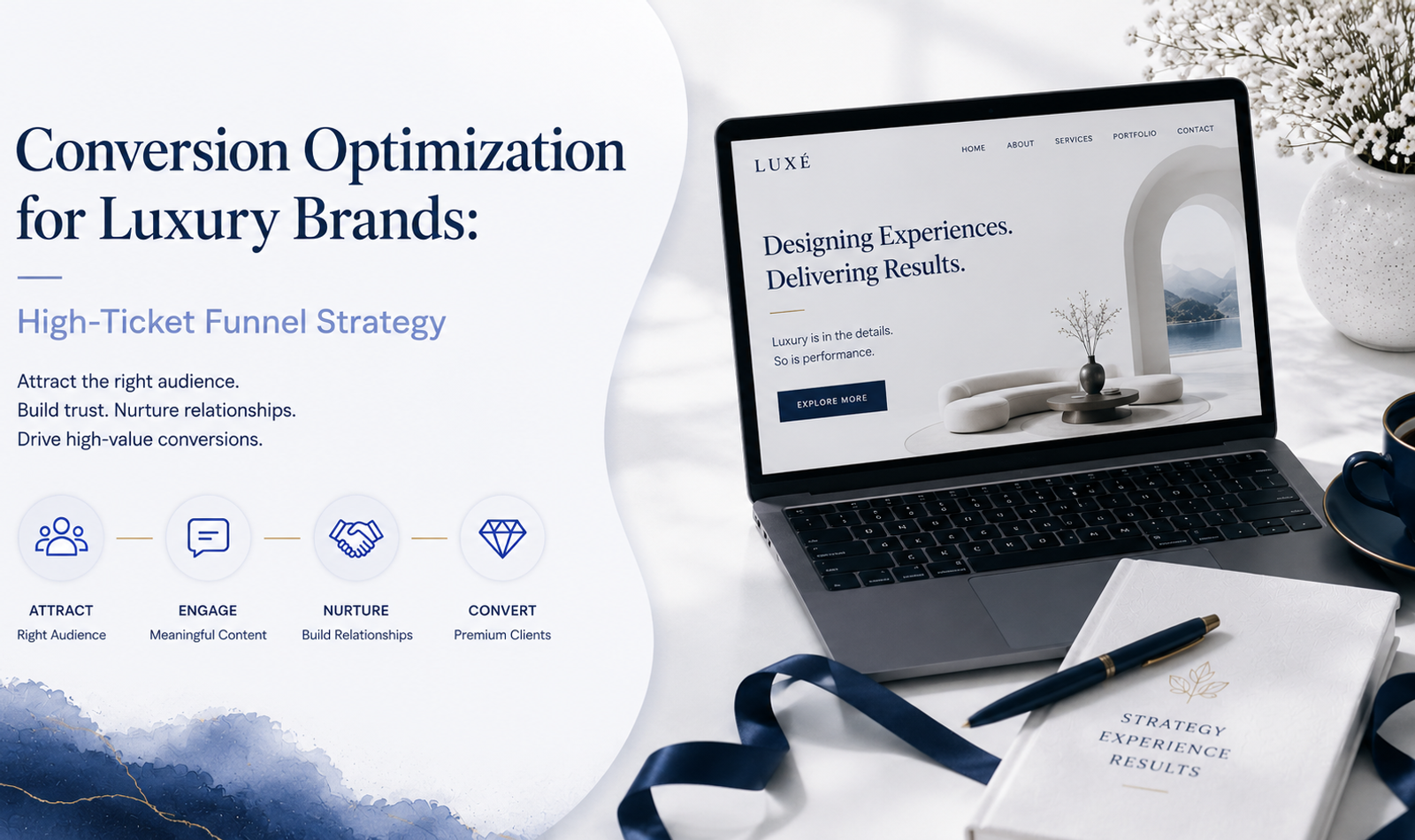
Our guide to conversion optimization for luxury brands explains how premium businesses can structure these journeys around qualified prospects rather than raw lead volume.
Personalisation in Luxury UX
Personalisation can make premium experiences more relevant.
A hospitality website might adapt recommendations according to whether someone is planning a romantic stay, family trip or corporate retreat.
A fashion website might personalise recommendations based on browsing behaviour.
An event website might guide visitors according to wedding, corporate or private celebration requirements.
A premium service business might show different case studies based on industry.
Personalisation should be useful rather than intrusive.
Customers should feel understood, not watched.
AI and Luxury Digital Experiences
AI can support website experiences in several ways.
Potential applications include:
Personalised recommendations.
Intelligent search.
Customer-service assistance.
Content discovery.
Multilingual support.
Lead routing.
Product recommendations.
However, automation should not eliminate the human qualities customers expect from luxury service.
For high-value decisions, customers may still want direct access to knowledgeable people.
AI should reduce friction where appropriate while preserving human expertise.
Security Is Part of Premium UX
A website cannot provide a premium experience if customers do not trust it with their information.
Secure connections.
Protected forms.
Reliable payments.
Responsible data collection.
Access control.
Backups.
Maintenance.
Clear privacy practices.
All contribute to the experience.
Security should be designed into the website rather than added after launch.
For ecommerce and booking businesses in particular, ongoing website security and maintenance is essential because the website may continuously process customer and transaction information.
Common Luxury Website UX Mistakes
Mistake 1: Confusing Minimalism With Missing Information
Removing useful content does not automatically make a website premium.
Mistake 2: Prioritising Animation Over Usability
Visitors should not have to wait for visual effects before using the website.
Mistake 3: Ignoring Mobile Design
A beautiful desktop site can still create a poor customer experience on mobile.
Mistake 4: Using Oversized Media
Premium imagery should be optimised rather than delivered at unnecessarily large file sizes.
Mistake 5: Hiding Navigation
Creativity should not make basic actions difficult.
Mistake 6: Using Tiny Typography
Sophisticated typography still needs to be readable.
Mistake 7: Too Many CTAs
Every section does not need several competing actions.
Mistake 8: Generic Stock Photography
Visuals should strengthen the specific brand world.
Mistake 9: Designing Without Brand Positioning
Luxury is not one universal visual style.
Mistake 10: Ignoring Conversion
A beautiful website should still support business objectives.
Mistake 11: Ignoring Technical SEO
A premium experience loses value if important pages cannot be discovered properly.
Mistake 12: Treating Launch as the End
Websites need ongoing performance, security, content and UX improvements.
Luxury Website UX Checklist
Before launching or redesigning a luxury website, review the following areas.
Brand
Does the website reflect the brand's actual positioning?
Does it feel distinctive rather than generically luxurious?
Visual Design
Is there enough visual breathing room?
Is hierarchy clear?
Does photography meet the expected quality?
Typography
Is text readable?
Does typography remain consistent across devices?
Navigation
Can customers find important pages quickly?
Are menu labels understandable?
Performance
Are images and videos optimised?
Does the website respond quickly?
Mobile
Has every major page been tested on real mobile layouts?
Are buttons, forms and navigation comfortable to use?
Content
Can visitors understand what the brand offers?
Are important questions answered?
Trust
Are relevant testimonials, credentials and policies available?
Does the website feel legitimate and secure?
Conversion
Is the next step clear?
Does the CTA match the customer's level of intent?
Technical Quality
Do links work?
Do forms submit correctly?
Are important pages indexable?
Are redirects and canonical URLs configured correctly?
Accessibility
Can users read, navigate and interact with the website comfortably?
Maintenance
Who is responsible for updates, backups, security and performance after launch?
How to Measure Luxury Website UX
UX should not be evaluated only by whether stakeholders like the design.
Use behavioural and commercial signals.
Depending on the website, useful metrics may include:
Engagement with important pages.
Navigation behaviour.
Form completion.
Booking completion.
Checkout completion.
Mobile conversion rate.
Page performance.
Return visits.
High-intent page views.
Qualified enquiries.
Consultation bookings.
Revenue.
Customer feedback.
Heatmaps and session analysis can also reveal where users experience confusion, provided data is collected responsibly.
The goal is not to optimise every page for maximum clicks.
It is to understand whether the experience helps the right customers accomplish meaningful actions.
Frequently Asked Questions
What is luxury website UX?
Luxury website UX is the design of digital experiences that combine premium brand presentation with usability, speed, accessibility, trust and intuitive customer journeys.
What makes a website feel luxurious?
A luxury website typically uses strong brand positioning, premium imagery, refined typography, purposeful white space, controlled visual hierarchy, smooth interactions and careful attention to detail.
Why is minimalism important in luxury website design?
Minimalism can reduce visual noise and create stronger focus. However, useful information should not be removed simply to make pages look empty.
Does white space make a website look premium?
White space can create focus, improve readability and increase the perceived importance of content. It works best when used intentionally as part of the overall visual hierarchy.
How important is website speed for luxury brands?
Very important. Customers expect premium digital experiences to feel responsive. Slow loading can create frustration and weaken both usability and brand perception.
Should luxury websites use animation?
Yes, when animation supports storytelling, hierarchy or interaction. Excessive animation can slow the experience and make navigation frustrating.
What typography works best for luxury websites?
There is no universal luxury font. Typography should reflect the specific brand identity while remaining readable across desktop and mobile devices.
How important is photography for luxury website UX?
Photography is often one of the most influential elements because premium customers use visual quality to understand products, environments, craftsmanship and brand positioning.
How should luxury websites approach mobile UX?
Mobile should be designed intentionally rather than treated as a compressed desktop experience. Navigation, typography, imagery, video, forms and CTAs should all be tested specifically for smaller screens.
How does SEO affect luxury website UX?
SEO helps relevant customers discover the website, while UX determines what happens after they arrive. Strong strategies combine clear content and technical structure with premium visual presentation.
Can luxury websites be minimalist and SEO-friendly?
Yes. SEO does not require visually cluttered pages. Detailed content can be structured intelligently across service pages, editorial sections, FAQs and supporting articles while maintaining a refined interface.
How does UX affect luxury website conversions?
Good UX reduces confusion and helps customers find information, establish trust and take appropriate next steps. Poor UX can create friction even when the product or service is highly desirable.
What trust signals should luxury websites use?
Relevant trust signals may include authentic testimonials, case studies, media coverage, credentials, secure payments, transparent policies, company information and professional customer support.
Should luxury brands use AI on their websites?
AI can improve recommendations, search, assistance and lead routing when it genuinely improves the customer journey. It should complement rather than unnecessarily replace premium human service.
What is the biggest luxury website UX mistake?
One of the biggest mistakes is designing for appearance alone. A website can look beautiful but still fail if it is slow, confusing, difficult to navigate or unclear about what the customer should do next.
Conclusion
Luxury website UX is not defined by one colour palette, one font style or one design trend.
It is defined by intention.
Every element should contribute to the experience.
Minimalism should create focus.
White space should create breathing room.
Typography should communicate identity.
Photography and video should create emotion.
Navigation should feel effortless.
Performance should feel immediate.
Mobile experiences should feel considered.
Security should create confidence.
Content should provide clarity.
Conversion paths should respect the customer's decision process.
The strongest luxury websites understand that digital experience is part of the product.
Customers begin forming opinions before they speak with the company, visit the property, enter the showroom or experience the service.
A website therefore needs to communicate the same standards the brand promises offline.
Not through unnecessary complexity.
Through detail.
Restraint.
Clarity.
Performance.
Emotion.
And consistency.
Double Trouble Studio brings together website strategy, UX, development, SEO, content, creative production and digital marketing to build brand experiences designed around both perception and performance.
Explore our selected work to see how creative strategy and digital execution come together across premium brand experiences.
If you are planning a luxury website, redesign or digital experience and want to balance premium aesthetics with speed, SEO and conversion, connect with Double Trouble Studio.
📩 info@dtsworld.in 📞 +91 80000 06021 📍 Andheri (West), Mumbai.
Need this for your brand?
Let DTS build your next campaign.
From PR, celebrity management and events to websites, social media, SEO and AI video production — Double Trouble Studio helps brands grow with strategy and execution.
Discuss Your Requirement →