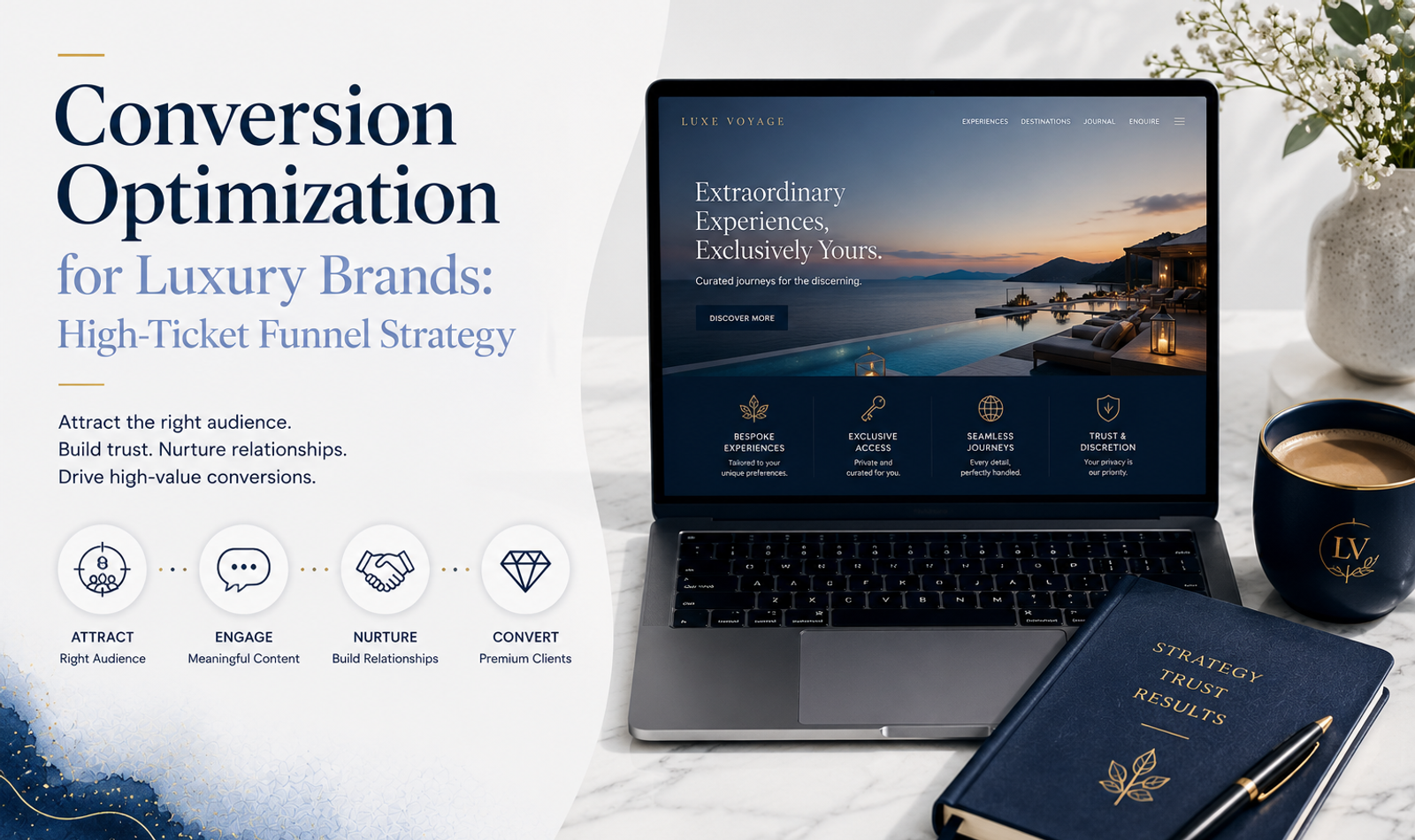
Conversion Optimization for Luxury Brands: High-Ticket Funnel Strategy
Luxury brands do not convert customers in the same way as mass-market businesses.
When someone is considering a premium residence, luxury hotel, designer product, high-end automobile, bespoke service, private event, jewellery purchase or other high-value experience, the decision rarely happens after seeing one advertisement and clicking “Buy Now.”
The customer may discover the brand through social media, search for it on Google, visit the website, compare alternatives, read editorial coverage, watch videos, explore Instagram, ask friends, contact the company, speak with a representative and return several times before making a decision.
This is why luxury brand conversion optimization requires more than improving a button colour or adding another enquiry form.
It requires designing the entire high-ticket customer journey.
A strong luxury conversion strategy connects brand positioning, website experience, content, search visibility, paid advertising, PR, social proof, lead qualification, personalisation, sales conversations and follow-up into one coordinated system.
The objective is not necessarily to generate the highest possible number of leads.
It is to attract the right prospects, build sufficient confidence and desire, and make it easy for qualified customers to take the next step.
For luxury and premium businesses, this distinction matters.
A funnel producing 500 low-quality enquiries may be less valuable than one producing 50 serious prospects with stronger purchasing intent.
This guide explains how luxury brands can design and optimise high-ticket funnels that protect premium positioning while improving enquiries, consultations, bookings and sales.
What Is Conversion Optimization for Luxury Brands?
Conversion optimization is the process of improving the journey that moves a potential customer from interest to action.
For an ecommerce business, the conversion may be a purchase.
For a luxury hotel, it could be a reservation.
For an interior designer, it may be a consultation request.
For an event company, it could be a qualified project enquiry.
For a luxury automobile business, it might be a test-drive request or dealership appointment.
For a premium B2B company, the conversion could be a meeting with a decision-maker.
The important point is that conversion optimization is not limited to ecommerce checkout.
Any meaningful customer action can be treated as a conversion.
For premium businesses, conversion optimization should therefore focus on the complete customer experience rather than isolated website elements.
A strategically developed website and digital marketing ecosystem should help customers understand the brand, build confidence, evaluate the offer and move naturally towards the appropriate next action.
Why Luxury Conversion Funnels Are Different
Mass-market funnels often depend on convenience, price, urgency and volume.
Luxury purchasing behaviour is different.
A high-value customer may ask:
Is this brand credible?
Does it understand customers like me?
Is the experience genuinely premium?
Is the quality worth the price?
Will the service match the promise?
Who else trusts this brand?
Does this company have enough expertise?
Will I receive personal attention?
Is this the right choice compared with other premium options?
These questions create a longer consideration cycle.
That is why a luxury brand funnel from awareness to conversion must build perception and confidence at every stage.
Trying to force a high-ticket customer towards conversion too quickly can actually reduce trust.
The objective is not to remove consideration.
The objective is to make consideration easier.
High-Ticket Conversion Starts With Brand Positioning
Conversion problems sometimes begin much earlier than the landing page.
If customers do not understand what makes the brand different, no amount of button testing will solve the problem.
A premium brand must clearly communicate:
Who it serves.
What it offers.
Why it is different.
What level of experience customers should expect.
Why its premium pricing is justified.
What emotional or functional value it provides.
This is where positioning becomes part of conversion optimization.
A strong luxury brand positioning strategy creates the perception required for premium pricing.
When positioning is unclear, visitors compare mainly on price.
When positioning is strong, customers can compare based on expertise, experience, identity, quality, service and relevance.
For high-ticket brands, that difference can significantly influence conversion quality.
Understand the Luxury Customer Before Building the Funnel
A conversion funnel should be designed around customer behaviour, not internal company structure.
Start by identifying who actually makes the purchase decision.
For some luxury categories, the buyer and user are the same person.
For others, several people may influence the decision.
A destination wedding may involve the couple, parents, planners and family representatives.
A luxury real-estate purchase may involve family members, financial advisors and brokers.
A corporate event may involve marketing, procurement, leadership and finance teams.
A premium B2B service may require approval from several decision-makers.
Understanding this helps determine what information the funnel needs.
Different prospects may require different evidence before converting.
One person may care about portfolio quality.
Another may care about price.
Another may need reassurance about execution.
Another may want proof that the company has worked with similar clients.
Conversion optimization begins with understanding these decision criteria.
Map the High-Ticket Customer Journey
A useful luxury funnel can be divided into five broad stages:
Awareness → Interest → Consideration → Intent → Conversion
However, real customer journeys are rarely perfectly linear.
A customer might discover the brand through Instagram, search Google two days later, read a blog article, leave the website, see a retargeting advertisement, return through branded search, review the portfolio and finally send an enquiry through WhatsApp.
Another customer may first discover the brand through PR coverage and contact the company directly.
Instead of assuming one path, map the most common routes.
Identify:
Where prospects discover the brand.
Which pages they visit.
Which questions they ask.
What causes hesitation.
What builds confidence.
What action signals serious intent.
Where leads typically drop out.
This creates the foundation for meaningful conversion optimization.
Stage 1: Awareness — Attract the Right Audience
The first stage of a high-ticket funnel is not about converting everyone.
It is about attracting people who could realistically become customers.
Luxury brands can generate awareness through search, social media, influencer collaborations, PR, events, video, paid advertising and referrals.
Search can capture customers already looking for a solution.
Social media can create aspiration and familiarity.
PR can strengthen credibility.
Events can create direct experiences.
Influencers can introduce brands to relevant communities.
Video can communicate atmosphere, craftsmanship and emotion.
The strongest funnels combine several of these channels rather than relying completely on one.
For example, integrating PR and digital marketing into a full-funnel growth strategy can help a brand build authority while also creating measurable paths towards website visits and enquiries.
The objective at this stage is qualified attention.
Stage 2: Interest — Give Customers a Reason to Explore
Awareness does not automatically create interest.
The customer must quickly understand why the brand deserves further attention.
This is where creative direction, messaging and content matter.
A luxury brand's first impression should answer three questions:
What is this?
Why is it relevant to me?
Why should I keep exploring?
The answer should be communicated without overwhelming the visitor.
Luxury communication often benefits from clarity and restraint.
Strong photography, carefully selected typography, concise messaging and purposeful white space can communicate more than a crowded page filled with claims.
The goal is to create curiosity while establishing the correct level of brand perception.
Stage 3: Consideration — Build Trust and Reduce Uncertainty
Consideration is one of the most important stages in high-ticket funnels.
This is where customers investigate whether the brand can actually deliver what it promises.
They may examine:
Case studies.
Portfolio work.
Client testimonials.
Media coverage.
Founder credentials.
Brand history.
Service details.
Customer reviews.
Process information.
FAQs.
Pricing guidance.
Project outcomes.
Social media presence.
The more expensive or complex the purchase, the more evidence customers may require.
Trust should therefore be distributed throughout the website rather than placed only on one testimonial page.
Relevant proof should appear close to the decisions it supports.
If a visitor is exploring a premium service, show related work.
If they are considering an expensive project, explain the process.
If they are worried about execution, provide evidence of experience.
Conversion optimization is often about answering questions before the customer has to ask them.
Stage 4: Intent — Recognise High-Value Signals
Not every website visitor has the same level of intent.
Someone reading an educational article may still be researching.
Someone visiting a pricing page, portfolio, contact page and service page within one session may be much closer to conversion.
Brands should identify high-intent actions such as:
Repeated website visits.
Viewing several case studies.
Downloading a brochure.
Checking pricing.
Starting a booking process.
Opening WhatsApp.
Submitting a partial form.
Watching a detailed product video.
Visiting the contact page.
Returning through branded search.
These signals can help shape remarketing and follow-up strategies.
Instead of treating every visitor identically, high-ticket funnels should respond to the level of intent.
Stage 5: Conversion — Make the Next Step Clear
Luxury does not mean complicated.
A premium website can be visually sophisticated while still making the next action obvious.
Depending on the business, the CTA could be:
Book a Private Consultation
Request a Proposal
Schedule a Viewing
Speak With Our Team
Plan Your Experience
Book an Appointment
Enquire Privately
Request Availability
The CTA should match the buying stage.
Asking someone to “Buy Now” may be inappropriate for a ₹25 lakh service.
At the same time, asking every prospect to fill out a 20-field form creates unnecessary friction.
The next step should feel proportional to the commitment.
Luxury Website UX Has a Direct Impact on Conversion
A customer may never speak with your team if the website creates the wrong impression.
For many premium brands, the website is effectively the first showroom, consultation room or brand environment.
That makes UX part of the sales process.
Good luxury UX should combine aesthetics with usability.
Visitors should immediately understand where they are, what the brand offers and how to explore further.
Navigation should remain intuitive.
Important information should not be hidden simply to create a minimalist appearance.
Images should load efficiently.
Forms should work properly.
Mobile layouts should feel intentional.
A deeper understanding of luxury website UX principles can help brands balance minimalism, speed and emotional impact without sacrificing usability.
Design High-End Websites Around Customer Decisions
Beautiful websites do not automatically convert.
The design needs to support customer decision-making.
A high-end homepage should typically establish positioning, show the core offer, communicate visual identity, introduce credibility and provide clear paths to deeper information.
Service and product pages should then answer more specific questions.
A luxury hospitality page might need to communicate atmosphere, rooms, dining, location and booking information.
A premium event company may need to communicate capabilities, past work, process and enquiry options.
A luxury automotive website may need to show vehicles, experience, service standards and booking pathways.
This is why designing high-end luxury websites requires more than creating attractive layouts.
Every section should have a purpose in the customer journey.
Optimize Landing Pages for High-Ticket Leads
Paid campaigns should not automatically send every visitor to the homepage.
Dedicated landing pages can create a more relevant experience.
If an advertisement promotes luxury wedding planning in Mumbai, the landing page should continue that exact conversation.
If a campaign promotes premium corporate event services, the visitor should immediately see information related to corporate events.
A strong high-ticket landing page may include:
A clear value proposition.
Premium hero visual.
Relevant benefits.
Selected case studies.
Testimonials.
Process explanation.
Trust signals.
Frequently asked questions.
Clear CTA.
Contact options.
The page should remove unnecessary distractions while giving customers enough information to move forward confidently.
The broader principles behind building conversion-focused marketing funnels can help brands connect landing pages with acquisition, nurturing and conversion rather than treating each page as an isolated asset.
Use Content to Support High-Ticket Decisions
Content is not only an SEO tool.
It can be part of the sales process.
A customer considering a premium service may search questions long before contacting a company.
If your brand answers those questions clearly, it can become part of the customer's research journey.
Useful content may include:
Buying guides.
Planning guides.
Cost explainers.
Comparison articles.
Case studies.
Industry insights.
Process guides.
FAQs.
Trend reports.
Expert commentary.
The objective is not to publish content simply to increase blog volume.
Each article should solve a real customer question and connect naturally with relevant commercial pages.
A strong content strategy for brand websites can turn blogs, galleries and lead magnets into supporting assets throughout the funnel.
SEO Should Bring High-Intent Customers Into the Funnel
Ranking for broad keywords can generate traffic.
But traffic alone does not create revenue.
Luxury SEO should consider search intent.
A person searching “luxury wedding planner cost Mumbai” may have stronger commercial intent than someone searching “wedding ideas.”
A customer searching “premium chauffeur service Mumbai airport” may be closer to booking than someone searching “luxury cars.”
Keyword strategy should therefore balance awareness terms with commercial and transactional searches.
This is particularly important for SEO for luxury brands, where visibility needs to support premium positioning as well as search demand.
High-quality traffic is more valuable than irrelevant volume.
Paid Advertising Should Qualify, Not Just Generate Clicks
Luxury paid advertising can become expensive when campaigns optimise only for traffic.
A campaign may generate thousands of clicks without producing serious buyers.
Ad messaging should help pre-qualify the audience.
Premium positioning, service category, location and relevant value propositions should be clear enough that unsuitable prospects are less likely to click.
Campaigns can then segment audiences according to intent.
Cold audiences may receive storytelling and awareness content.
Engaged audiences may see case studies or service benefits.
High-intent visitors may receive direct consultation or enquiry campaigns.
A well-structured approach to performance digital ads across Meta, Google and LinkedIn can help brands reach high-value audiences while connecting advertising activity to actual business outcomes.
Build Trust Through PR and Third-Party Authority
Luxury customers often look beyond what a brand says about itself.
Third-party credibility can influence high-ticket decisions.
Media coverage, industry recognition, respected collaborations, expert commentary and credible partnerships can reduce perceived risk.
PR therefore has a role inside the conversion funnel.
A customer may discover a brand through an advertisement but feel more confident after finding credible media coverage.
Another customer may discover the brand through an article and later search for it directly.
Professional PR and media marketing can therefore support both brand awareness and conversion confidence when it is integrated with the broader customer journey.
Use Video to Communicate Premium Experience
Luxury products and services often contain qualities that are difficult to communicate through text alone.
Atmosphere.
Movement.
Craftsmanship.
Scale.
Emotion.
Service.
Detail.
Video can make these qualities easier to understand.
A hotel can show how the property feels.
An event company can demonstrate production scale.
A fashion brand can show movement and fabric.
An automotive brand can communicate design, interiors and driving experience.
An interior brand can reveal spatial detail.
Modern AI video and VFX production can also help brands create concept films, campaign assets and visual storytelling at different stages of the funnel.
However, video should have a strategic purpose.
A beautiful film that gives customers no clearer understanding of the brand may create attention without improving conversion.
Personalisation Can Improve High-Ticket Conversion
Premium customers often expect more personalised experiences.
This does not necessarily require complex technology.
Personalisation can begin with simple choices.
A website can allow customers to select whether they are planning a wedding, corporate event or private celebration.
A hospitality brand can distinguish between leisure, business and celebration enquiries.
A luxury retailer can recommend products based on occasion or gifting needs.
Sales teams can adapt follow-ups according to what the prospect viewed or requested.
The objective is to reduce irrelevant communication.
When customers feel understood, the journey becomes more useful.
Lead Qualification Matters More Than Lead Volume
One of the biggest mistakes in high-ticket marketing is celebrating every enquiry equally.
A luxury business may receive hundreds of leads while its sales team struggles to find serious buyers.
This creates wasted time and misleading performance reports.
Lead qualification can include questions such as:
What service are you interested in?
Where is the project located?
What is the approximate timeline?
What is the expected scale?
What type of experience are you looking for?
What is the approximate investment range?
These questions should be used carefully.
The goal is not to interrogate the customer.
It is to understand whether the enquiry is relevant and route it correctly.
For very premium services, qualification can also make the experience feel more considered.
Optimize Enquiry Forms Without Making Them Cheap
Reducing form fields is common CRO advice.
But high-ticket funnels require balance.
A form asking only for a phone number may generate more submissions but lower lead quality.
A form asking 25 questions may discourage excellent prospects.
Use the minimum information required to start a useful conversation.
For example:
Name.
Email or phone.
Service required.
Location.
Approximate timeline.
Short project description.
Additional qualification can happen after the first contact.
The best form is not necessarily the shortest one.
It is the form that produces the right balance between conversion rate and lead quality.
WhatsApp Can Be Part of the Premium Funnel
For many Indian customers, WhatsApp is a natural communication channel.
Luxury brands can use it without making the customer experience feel informal.
The implementation matters.
Instead of a generic “Hi” message, the website can pre-fill context.
For example:
“Hello, I'm interested in discussing a private event in Mumbai.”
This helps the sales team understand the enquiry immediately.
WhatsApp can work alongside enquiry forms, calls and consultation booking.
Different customers prefer different communication methods.
Giving them appropriate options can reduce friction.
Follow-Up Is Part of Conversion Optimization
A customer submitting an enquiry does not mean the funnel is complete.
For high-ticket businesses, the follow-up process can determine whether the lead converts.
Response speed matters.
So does response quality.
A generic automated message saying “We will contact you soon” may not be enough.
The first response should acknowledge what the customer requested and explain what happens next.
If a prospect is not ready immediately, the brand should have a thoughtful nurturing process.
This might include:
Relevant case studies.
A brochure.
A consultation invitation.
A useful guide.
Project examples.
Availability updates.
Personal follow-up.
The objective is not to bombard the prospect with messages.
It is to remain useful during the decision period.
Retarget High-Intent Prospects Strategically
Most high-ticket visitors will not convert on the first session.
Retargeting helps brands continue the conversation.
However, showing the same generic advertisement repeatedly is rarely effective.
Retargeting should respond to behaviour.
Someone who viewed a case study could see another relevant project.
Someone who explored a service page could see an explainer video.
Someone who visited the contact page but did not enquire could see a consultation-focused advertisement.
Someone who engaged with brand storytelling but has not explored the offer may need more education before receiving a direct conversion message.
Retargeting should move customers forward rather than simply remind them that the brand exists.
Social Proof Should Be Specific
“Excellent service.”
“Highly recommended.”
“Great experience.”
These testimonials provide limited information.
Specific testimonials are stronger.
A useful testimonial might explain what the customer needed, what problem existed, how the company handled it and what the outcome was.
Case studies can go further.
Show:
The challenge.
The strategy.
The execution.
The outcome.
The customer experience.
For premium brands, qualitative outcomes can matter alongside numerical metrics.
Not every luxury project should be reduced to percentages.
Quality, complexity, discretion, experience and execution can also demonstrate value.
Remove Friction Without Removing Luxury
There is a misconception that premium experiences should be complex.
They should not.
Luxury often means effort has been removed for the customer.
A premium hotel handles details before the guest asks.
A chauffeur knows the route.
A concierge anticipates requirements.
A luxury digital experience should follow the same principle.
Forms should work.
Pages should load quickly.
Navigation should be clear.
Information should be easy to find.
Mobile experiences should be smooth.
CTAs should be obvious.
Payment or booking processes should be secure.
Luxury should exist in the quality of the experience, not in unnecessary difficulty.
Mobile Conversion Cannot Be an Afterthought
Many customers will discover the brand on Instagram, Google or an advertisement from their phones.
If the mobile website feels like a reduced desktop version, conversion may suffer.
Check:
Typography.
Button sizes.
Navigation.
Image cropping.
Page speed.
Forms.
WhatsApp links.
Phone links.
Sticky CTAs.
Booking systems.
Payment processes.
Luxury perception can disappear quickly when customers need to pinch, zoom or wait for oversized assets to load.
Mobile optimization should therefore be part of the original design process.
Website Speed Influences Both Experience and Conversion
Large photography and cinematic video are common on luxury websites.
But visual quality should not come at the cost of usability.
Slow pages can create frustration before the brand has communicated its value.
Compress images appropriately.
Use modern image formats.
Load video strategically.
Reduce unnecessary scripts.
Avoid excessive animation.
Prioritise above-the-fold content.
Monitor technical performance.
Technical quality supports both user experience and search visibility.
A premium website should feel visually rich without feeling technically heavy.
A/B Testing for Luxury Brands
Luxury brands can still use A/B testing, but tests should protect brand consistency.
Useful experiments may include:
CTA wording.
Form length.
Hero messaging.
Case-study placement.
Contact options.
Landing-page structure.
Social-proof placement.
Navigation labels.
Pricing presentation.
The objective is not to test random visual changes.
Each experiment should begin with a hypothesis.
For example:
“Visitors may not understand what happens after submitting the enquiry.”
The test might compare “Contact Us” with “Schedule a Private Consultation.”
Measure whether the change improves both submissions and lead quality.
Conversion rate alone should not determine the winner.
Measure Funnel Quality, Not Just Conversion Rate
A 10% conversion rate is not automatically better than a 3% conversion rate.
It depends on what is converting.
Luxury brands should track metrics across the funnel.
Useful indicators include website engagement, qualified traffic, high-intent page visits, enquiry conversion rate, qualified lead rate, cost per qualified lead, consultation bookings, proposal acceptance, customer acquisition cost, sales cycle length and revenue.
For some brands, lifetime customer value and referral rate are also important.
A strong measurement system connects marketing performance to commercial outcomes.
The purpose of CRO is not simply to improve dashboard numbers.
It is to improve business performance.
Common High-Ticket Funnel Mistakes
One common mistake is sending every campaign to the homepage.
Another is creating beautiful pages with weak messaging.
Some brands hide important information because they believe mystery automatically creates luxury.
Others overwhelm visitors with too much information.
Another mistake is asking for commitment too early.
A customer who has only just discovered the brand may not be ready to “Book Now.”
Poor follow-up can also destroy otherwise strong funnels.
The website generates a qualified enquiry, but nobody responds for two days.
Finally, many brands optimise for lead volume instead of revenue quality.
This creates marketing reports that look impressive while sales teams remain dissatisfied.
Conversion optimization should solve business problems, not create prettier dashboards.
A Practical High-Ticket Funnel Framework for Luxury Brands
A useful framework is:
1. Attract
Reach relevant audiences through SEO, paid media, social, PR, influencers, events and referrals.
2. Position
Immediately communicate why the brand is premium, relevant and different.
3. Educate
Answer the questions customers need before making a high-value decision.
4. Prove
Use portfolio work, testimonials, media, credentials, case studies and third-party authority.
5. Personalise
Make the journey relevant to the customer's requirements.
6. Qualify
Identify serious prospects without creating unnecessary friction.
7. Convert
Offer a clear, appropriate next step.
8. Follow Up
Respond quickly and continue providing useful information.
9. Nurture
Remain relevant to prospects who need more time.
10. Measure
Track qualified leads, sales outcomes and revenue rather than only clicks and submissions.
This creates a more complete view of conversion optimization.
Frequently Asked Questions
What is luxury brand conversion optimization?
Luxury brand conversion optimization is the process of improving the customer journey so qualified prospects are more likely to take valuable actions such as requesting a consultation, booking an appointment, making a reservation, submitting an enquiry or completing a premium purchase.
What is a high-ticket funnel?
A high-ticket funnel is a customer journey designed for products or services with significant value, price or consideration. It typically requires more trust, information, personalisation and human interaction than a low-cost ecommerce funnel.
How do luxury brands increase website conversions?
Luxury brands can improve conversions through stronger positioning, clearer messaging, premium UX, relevant social proof, better landing pages, faster websites, appropriate CTAs, lead qualification, personalisation and stronger follow-up.
Should luxury websites show prices?
It depends on the business model. Standardised products may benefit from transparent pricing, while bespoke services may require consultations. Some businesses can provide starting prices or investment ranges to help qualify prospects without presenting rigid packages.
What is the best CTA for a luxury brand?
There is no single best CTA. The CTA should reflect the buying stage and service. “Book a Private Consultation,” “Request a Proposal,” “Schedule a Viewing” and “Speak With Our Team” may be more appropriate than generic “Buy Now” messaging for high-ticket services.
Are fewer form fields always better for conversion?
No. Short forms can increase submission volume but may reduce lead quality. High-ticket brands should collect enough information to start a useful conversation without creating unnecessary friction.
How important is website design for luxury conversion?
Very important. Customers often use website quality as a signal of brand quality. However, design should support usability, positioning, trust and decision-making rather than focusing only on aesthetics.
Does SEO help high-ticket brands generate leads?
Yes. SEO can bring prospects into the funnel when they are actively researching products, services, costs, providers and solutions. Keyword selection should focus on relevance and intent rather than traffic volume alone.
How can paid ads improve luxury lead generation?
Paid advertising can reach specific high-value audiences, capture search demand and retarget interested prospects. Campaigns should optimise towards qualified enquiries and revenue rather than clicks alone.
How should luxury brands measure conversion performance?
Track enquiry conversion rate, qualified lead rate, consultation bookings, proposal acceptance, customer acquisition cost, sales cycle, revenue and lifetime value alongside website and advertising metrics.
Conclusion
Conversion optimization for luxury brands is not about making a premium customer move faster at every possible moment.
It is about making the journey clearer, more credible and easier to trust.
High-ticket customers often need time to understand the brand, evaluate alternatives, verify quality and decide whether the experience justifies the investment.
A successful funnel supports that process.
It attracts relevant audiences.
It establishes premium positioning.
It communicates value clearly.
It provides evidence.
It removes unnecessary friction.
It gives customers appropriate ways to make contact.
And it ensures qualified enquiries receive the level of follow-up expected from a premium brand.
The strongest luxury funnels therefore connect marketing, website design, content, SEO, paid advertising, PR, video, sales and customer experience rather than treating them as separate activities.
For brands building a wider growth system, Double Trouble Studio brings these disciplines together across digital strategy, websites, content, PR, events, AI video and brand experiences.
Explore our selected work to see how creative and digital thinking can translate into real brand experiences.
If your brand is attracting attention but struggling to turn the right prospects into qualified enquiries or customers, connect with Double Trouble Studio to discuss your website, digital funnel and conversion strategy.
📩 info@dtsworld.in 📞 +91 80000 06021 📍 Andheri (West), Mumbai.
Need this for your brand?
Let DTS build your next campaign.
From PR, celebrity management and events to websites, social media, SEO and AI video production — Double Trouble Studio helps brands grow with strategy and execution.
Discuss Your Requirement →