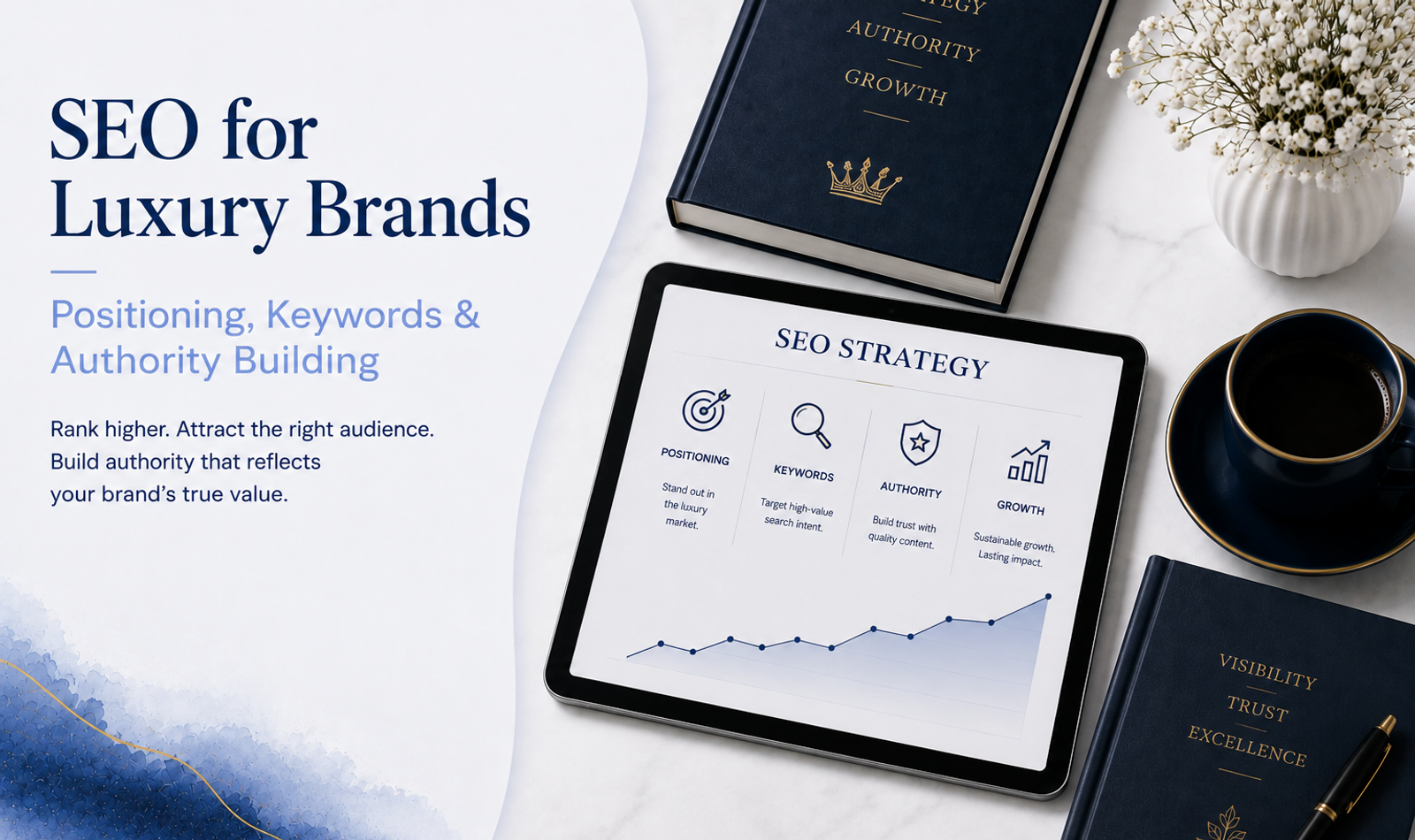
SEO for Luxury Brands: Positioning, Keywords & Authority Building
Luxury brands compete differently.
A premium hotel does not want to attract guests purely because it offers the lowest room rate. A luxury fashion label does not build desirability by trying to appear cheaper than every competitor. A high-end interior designer, jewellery house, automotive brand, event company or premium real-estate business is usually selling more than a product or service.
It is selling perception.
Expertise.
Craftsmanship.
Experience.
Identity.
Trust.
Exclusivity.
Service.
This changes how search engine optimization should be approached.
For luxury brands, SEO should not simply generate the largest possible amount of website traffic.
It should help the brand appear when the right audience is actively researching, comparing or considering premium products and services.
That requires a balance between search visibility and brand positioning.
The website must rank for commercially valuable searches without sounding generic. Content must answer real customer questions without reducing the brand to keyword-heavy copy. Technical SEO must make the website discoverable without compromising the visual experience expected from a premium brand.
Most importantly, authority must extend beyond individual rankings.
A strong luxury SEO strategy should help a brand become a credible source within its category.
This guide explains how luxury brands can use positioning, keyword research, content, technical SEO, digital PR, local search and authority building to create sustainable organic visibility.
What Is SEO for Luxury Brands?
SEO for luxury brands is the process of improving a premium brand's visibility across search engines while protecting and strengthening its positioning.
The fundamental principles of SEO remain the same.
Search engines need to discover pages.
They need to understand what those pages are about.
The website needs appropriate technical foundations.
Content needs to satisfy relevant search intent.
The brand needs credibility and authority.
But the strategic priorities can differ.
A mass-market business may prioritise enormous search volumes.
A luxury brand may receive greater commercial value from a much smaller group of highly relevant searches.
For example, ranking for a broad informational keyword could generate thousands of visitors.
Ranking for a more specific search such as:
“luxury wedding planner Mumbai”
“premium interior designer Mumbai”
“private villa Goa wedding venue”
“luxury chauffeur service Mumbai”
“bespoke jewellery designer India”
may produce substantially fewer searches but potentially stronger commercial intent.
Luxury SEO is therefore not about chasing traffic blindly.
It is about building relevant visibility among high-value audiences.
Businesses developing their wider organic presence should treat SEO as part of a professional web development and marketing strategy, rather than as an isolated activity added after the website has already been built.
Why Do Luxury Brands Need SEO?
Luxury customers still search.
They search before travelling.
They research hotels.
They compare designers.
They investigate brands.
They search for reviews.
They research products.
They look at media coverage.
They explore locations.
They compare experiences.
They search for costs.
They investigate founders.
They check social media.
They read guides before making significant decisions.
Even when the final purchase happens offline, search can influence the decision much earlier.
A potential customer might discover a brand through Instagram and then Google its name.
Another might first discover it through an editorial article.
Someone else might search for a category, find a detailed guide, explore the company's portfolio and contact the business several weeks later.
SEO gives luxury brands an opportunity to appear throughout these research journeys.
Luxury SEO Is Not About Ranking for Everything
One of the biggest SEO mistakes premium brands can make is assuming that more rankings automatically mean better performance.
They do not.
A luxury brand does not need to appear for every possible keyword related to its category.
It needs visibility for searches that support its positioning and commercial objectives.
Imagine a premium destination wedding company.
It could target broad keywords such as:
“wedding ideas”
“wedding decoration”
“wedding planning”
These terms may have considerable search demand.
But they are extremely broad.
More specific searches could include:
“luxury destination wedding planner India”
“Udaipur luxury wedding planning”
“premium wedding management company Mumbai”
“destination wedding guest management India”
These searches may have lower volume, but the intent can be considerably more relevant.
Luxury SEO therefore requires selectivity.
SEO Begins With Brand Positioning
Keyword research should not be the first strategic decision.
Positioning should.
Before deciding what a luxury brand should rank for, define what the brand wants to represent.
Ask:
Who is the ideal customer?
What category does the brand want to own?
What makes it different?
What level of service does it provide?
Which customer problems does it solve?
Which qualities justify premium pricing?
Which geographic markets matter?
Which competitors occupy similar search territory?
What should customers associate with the brand?
A clear luxury brand positioning strategy makes SEO decisions easier because it defines which search opportunities actually fit the business.
Without positioning, keyword research can pull the brand in too many directions.
Understand How Luxury Customers Search
Luxury customers do not always type the word “luxury.”
A customer looking for an expensive interior designer might search:
“best interior designer South Mumbai”
“bespoke residential interior designer Mumbai”
“high-end interior design firm Mumbai”
“interior designer for luxury apartment Mumbai”
These searches communicate premium intent in different ways.
Similarly, a customer looking for a premium hotel may search by location, experience, occasion, amenity or reputation rather than price category.
Keyword research should therefore investigate the language customers use throughout the buying journey.
This means studying more than keyword volume.
Look at:
Search intent.
Search-result composition.
Customer language.
Related questions.
Competitor visibility.
Location modifiers.
Product categories.
Service categories.
Problems.
Occasions.
Use cases.
Price-related searches.
Comparison searches.
The strongest keyword strategy reflects real customer behaviour.
Search Intent Is More Important Than Search Volume
Search volume tells you approximately how often people search for something.
It does not tell you whether those people are valuable to your business.
Search intent helps explain what the user is trying to accomplish.
SEO searches can broadly fall into several categories.
Informational Intent
The user wants information.
Examples:
“How much does a destination wedding cost in India?”
“How does luxury PR work?”
“What is bespoke furniture?”
Commercial Investigation
The user is evaluating options.
Examples:
“best luxury event companies Mumbai”
“top premium hotels Goa”
“best luxury branding agencies India”
Transactional Intent
The user is closer to taking action.
Examples:
“book luxury chauffeur Mumbai airport”
“luxury villa booking Goa”
“private event planner Mumbai enquiry”
Navigational Intent
The user already knows the brand and wants to find a particular website or page.
Luxury SEO strategies should address several stages rather than focusing only on one.
Informational content creates discovery.
Commercial pages support comparison.
Service and product pages capture stronger intent.
Branded search helps customers verify credibility.
Keyword Research for Luxury Brands
Luxury keyword research should begin with the brand's commercial priorities.
Create a list of core categories.
For a luxury hospitality business, this might include:
Luxury hotel.
Luxury resort.
Private villa.
Destination wedding venue.
Spa.
Fine dining.
Corporate retreat.
Then expand those categories by:
Location.
Audience.
Occasion.
Problem.
Service.
Experience.
Feature.
Comparison.
Intent.
A keyword should not be selected simply because an SEO tool reports high search volume.
Ask whether ranking for that keyword would attract the type of customer the brand actually wants.
Use Long-Tail Keywords to Reach High-Intent Customers
Long-tail keywords are longer and more specific searches.
They often have lower individual search volume.
But specificity can make them commercially useful.
Compare:
“wedding planner”
with:
“luxury destination wedding planner Udaipur”
The first search could represent many different budgets and intentions.
The second provides much more context.
Long-tail keywords can be particularly valuable for luxury businesses because customers often have specific requirements.
They may search by:
Location.
Product type.
Occasion.
Budget category.
Material.
Service style.
Property type.
Experience.
Audience.
A strong luxury SEO strategy should therefore evaluate relevance and intent alongside volume.
Build a Keyword Architecture, Not Just a Keyword List
A common SEO mistake is collecting hundreds of keywords in a spreadsheet without deciding where they belong.
Keywords need destinations.
Each important search theme should map to an appropriate page.
For example:
Homepage → broad brand/category positioning.
Service page → core service keyword.
Location page → service + geographic intent.
Product page → specific product intent.
Blog article → informational question.
Case study → proof and industry-specific relevance.
FAQ → specific customer questions.
This creates a structured relationship between search demand and website architecture.
It also reduces the risk of several pages competing for exactly the same keyword.
Avoid Keyword Cannibalization
Keyword cannibalization can occur when multiple pages on the same website target very similar search intent.
Instead of strengthening one authoritative page, the website may create several competing URLs.
Luxury brands should periodically review:
Similar blog articles.
Overlapping service pages.
Old campaign pages.
Duplicate location pages.
Near-identical product descriptions.
Legacy URLs.
If several pages answer essentially the same question, consider whether they should be consolidated, differentiated or redirected.
A clear content architecture helps search engines understand which page should rank for each topic.
Build Topic Clusters Around Luxury Expertise
Search authority is rarely created by publishing one article.
Brands can build deeper topical coverage around their commercial categories.
Imagine a luxury wedding company.
A topic cluster could include:
Luxury wedding planning.
Destination selection.
Wedding budgeting.
Guest management.
Venue selection.
Vendor coordination.
Luxury wedding trends.
Airport transfers.
RSVP management.
Event production.
Each article answers a different question while supporting the broader subject.
The pages should then be connected through contextual internal links.
This creates a more useful information architecture for customers and search engines.
The same principle can apply to luxury hospitality, automotive, jewellery, fashion, interiors, beauty and professional services.
Content Strategy for Luxury SEO
Luxury brands should avoid publishing generic content simply because competitors have blogs.
Content needs a strategic purpose.
A strong content strategy for brand websites can include different formats for different stages of the customer journey.
Educational articles help customers understand a subject.
Buying guides help them evaluate options.
Case studies demonstrate experience.
Trend reports create thought leadership.
FAQs address practical concerns.
Location guides capture geographic searches.
Cost guides capture budget-related research.
Comparison articles support consideration.
Portfolio stories demonstrate execution.
The objective is not maximum publishing frequency.
It is useful, distinctive and authoritative coverage.
Create Content That Demonstrates Expertise
Search-focused content should still sound like it comes from someone who understands the industry.
Generic statements provide little competitive advantage.
Instead of writing:
“Luxury events require careful planning.”
Explain what careful planning actually involves.
Discuss:
Guest movement.
Security.
Production timelines.
Vendor coordination.
Airport transfers.
Hospitality.
VIP handling.
Contingency planning.
Technical rehearsals.
Media requirements.
The more useful and specific the content becomes, the more effectively it can demonstrate expertise.
This matters for both search visibility and customer confidence.
Optimize Luxury Product and Service Pages
Blogs should not carry the entire SEO strategy.
Commercial pages matter.
A premium service page should clearly communicate:
What the service is.
Who it is for.
What is included.
What makes the brand different.
Where the service is available.
How the process works.
Relevant proof.
Frequently asked questions.
The next action.
Product pages should provide enough information for customers to make informed decisions while preserving the brand's visual language.
Do not hide important information simply because minimal copy appears more luxurious.
Minimalism works when every remaining element is useful.
On-Page SEO Still Matters
Luxury design does not replace basic SEO.
Each important page should have a clear topic.
Key on-page elements include:
Page title.
Meta description.
H1.
Logical H2 and H3 headings.
Readable URL.
Relevant body copy.
Image alt text.
Internal links.
Structured information.
Appropriate calls to action.
The purpose is not to insert the same keyword into every paragraph.
That creates poor writing.
Instead, make the topic clear naturally.
A practical on-page SEO checklist for higher rankings can help teams review these foundational elements consistently.
Luxury Website UX and SEO Need to Work Together
A website can rank and still fail commercially.
Luxury customers expect more than information.
They expect an experience.
Typography.
Photography.
Navigation.
Movement.
White space.
Page hierarchy.
Mobile design.
Content presentation.
All influence how the brand is perceived.
At the same time, visual sophistication should not make the website difficult to use.
Important text should not be hidden behind complicated interactions.
Navigation should remain understandable.
Mobile layouts should work properly.
Pages should load efficiently.
Calls to action should be visible.
The principles behind designing high-end luxury websites are particularly important when SEO traffic becomes a major source of customer discovery.
Search visibility gets the customer to the website.
Experience determines what happens next.
Technical SEO Is the Foundation
Excellent content cannot perform properly if search engines struggle to access the website.
Technical SEO helps search engines discover, crawl, render and understand pages.
Important areas include:
Indexability.
Crawlability.
Canonical tags.
Redirects.
XML sitemaps.
Robots directives.
Site architecture.
Internal linking.
Structured data where relevant.
HTTPS.
Mobile usability.
Page performance.
Duplicate content.
Broken pages.
A comprehensive technical SEO website optimization guide can help brands understand how these elements work together.
Technical SEO is particularly important for websites with many products, locations, filters or dynamically generated pages.
Page Speed Matters for Luxury Websites
Luxury websites frequently use large photography, full-screen video and animation.
These elements can create strong brand experiences.
They can also create performance problems.
Large media files may slow loading.
Excessive JavaScript can delay interactions.
Poorly implemented animation can affect usability.
Premium visual design should therefore be technically optimised.
Image compression.
Responsive image delivery.
Modern file formats.
Lazy loading where appropriate.
Video optimisation.
Font management.
Script reduction.
Caching.
Efficient rendering.
All contribute to a smoother experience.
Our guide to Technical SEO foundations, speed, mobile and Core Web Vitals explores these performance considerations in more depth.
Mobile SEO Is Essential
Luxury discovery frequently begins on mobile.
A potential customer may discover a hotel through Instagram, search the property name, browse rooms and send the link to someone else without ever opening a laptop.
A wedding customer may research venues while travelling.
A fashion buyer may discover a product through social media and immediately search for the brand.
Mobile therefore cannot be treated as a simplified version of desktop.
Review:
Navigation.
Typography.
Image cropping.
Forms.
Buttons.
Videos.
Sticky elements.
Booking interfaces.
Checkout.
WhatsApp integration.
Phone links.
Page speed.
The mobile journey should preserve both usability and premium perception.
Internal Linking Builds Context and Authority
Internal linking helps users discover related information.
It also helps search engines understand the relationship between pages.
A luxury SEO article about destination weddings might naturally link to pages about venue selection, budgeting, guest management and event production.
A luxury website article could link to technical SEO, conversion optimization and content strategy.
Internal links should be contextual.
Avoid placing dozens of unrelated links into every article.
Use descriptive anchor text that explains what the destination page is about.
A strong internal-link architecture helps distribute authority across the website while guiding visitors deeper into relevant content.
Authority Building Is Central to Luxury SEO
Luxury depends heavily on credibility.
A premium brand claiming that it is “the best” carries less weight than evidence from credible external sources.
Search authority can be strengthened through:
High-quality backlinks.
Media coverage.
Industry features.
Expert commentary.
Original research.
Useful resources.
Partnerships.
Awards.
Events.
Recognised collaborations.
Founder expertise.
Strong brand mentions.
Authority should develop naturally from genuine relevance and reputation.
Avoid buying large quantities of low-quality backlinks simply to increase an SEO metric.
Shortcuts can damage rather than strengthen long-term visibility.
Digital PR Can Strengthen SEO Authority
PR and SEO should not operate in complete isolation.
When a brand earns meaningful coverage from relevant publications, it can create awareness, branded search demand, referral traffic and sometimes valuable backlinks.
A luxury hospitality brand may benefit from travel media.
A jewellery brand may benefit from fashion and lifestyle publications.
An automotive brand may benefit from respected automotive media.
A premium business founder may contribute expert commentary to industry publications.
A strategic PR and media marketing programme can therefore support reputation while complementing organic search authority.
The objective should be credible coverage, not backlinks for their own sake.
Build Long-Term Media Relationships
Authority building becomes more sustainable when brands develop genuine relationships with journalists, editors and relevant publications.
Media relationships should not begin only when the brand wants coverage.
Brands can provide useful expert commentary, industry data, relevant stories, access, insights and timely responses.
Over time, this can strengthen both PR visibility and online authority.
Our guide to building long-term media relationships explains how trust, access and strategic visibility contribute to stronger media positioning.
For luxury brands, quality of coverage usually matters more than simply collecting the highest possible number of mentions.
Founder Authority Can Support Brand SEO
People often search for the individuals behind premium companies.
Founders, creative directors, designers, architects, chefs, stylists, doctors, consultants and executives can become important authority signals.
Brands can strengthen founder visibility through:
Expert articles.
Interviews.
Media commentary.
Speaking engagements.
Industry events.
Professional profiles.
Research.
Case studies.
Video content.
Clear author information.
A strong founder presence can make the brand more understandable and credible.
It also creates additional branded search opportunities.
Local SEO for Luxury Businesses
Luxury does not eliminate local intent.
Many premium searches are highly location-specific.
Examples include:
“luxury event planner Mumbai”
“premium salon Bandra”
“luxury car rental Mumbai”
“high-end interior designer Mumbai”
“luxury wedding venue Udaipur”
“fine dining restaurant South Mumbai”
Brands serving physical locations should optimise local visibility.
Important areas can include:
Accurate business information.
Location-specific website pages.
Google Business Profile management.
Relevant reviews.
Local content.
Consistent contact information.
Location-based backlinks and media coverage.
Businesses targeting Mumbai can explore our guide to local SEO for Mumbai businesses for a more detailed local search framework.
Location Pages Should Provide Real Value
Creating hundreds of city pages by replacing one location name with another is not a strong long-term strategy.
Useful location pages should contain information genuinely relevant to that market.
For example:
Services available in the city.
Local portfolio examples.
Relevant customer requirements.
Areas served.
Local expertise.
Location-specific FAQs.
Local contact options.
A Mumbai service page should have a reason to exist beyond containing the word “Mumbai.”
For businesses targeting premium customers in the city, a dedicated web development and marketing presence in Mumbai can connect service relevance with local search intent.
Image SEO Matters for Luxury Brands
Luxury websites are highly visual.
Images therefore deserve SEO attention.
Use descriptive file names where practical.
Provide useful alt text.
Compress files.
Use appropriate dimensions.
Avoid uploading unnecessarily large images.
Use responsive delivery.
Ensure important imagery does not significantly damage performance.
Alt text should describe the image rather than become a place for keyword stuffing.
For example:
“Luxury beachfront wedding setup at sunset in Goa”
is more useful than:
“best luxury wedding planner India wedding company luxury events.”
Image optimization should support accessibility, performance and search understanding simultaneously.
Video Can Support Search and Brand Authority
Video can communicate qualities that text cannot.
Craftsmanship.
Movement.
Scale.
Atmosphere.
Personality.
Process.
Experience.
A luxury hotel can show the environment.
A designer can explain creative decisions.
An event company can demonstrate production.
An automotive brand can reveal interior and exterior details.
Video can also support broader search visibility when titles, descriptions, surrounding page content and distribution are handled strategically.
Brands developing more advanced visual campaigns can integrate professional AI video and VFX production into wider content strategies while maintaining appropriate brand standards.
SEO for Luxury Ecommerce
Luxury ecommerce requires a balance between product discovery and premium presentation.
Important SEO areas include:
Category architecture.
Product titles.
Product descriptions.
Canonicalisation.
Product availability.
Structured data where appropriate.
Image optimization.
Internal linking.
Filter management.
Page speed.
Mobile checkout.
Avoid using identical manufacturer descriptions across many products.
Where possible, provide useful original information about materials, craftsmanship, sizing, styling, provenance, care or product experience.
Category pages can also contain carefully written supporting content without overwhelming the visual presentation.
SEO for Luxury Hospitality Brands
Luxury hospitality search behaviour often combines destination, property type, occasion and experience.
Potential topics include:
Luxury hotels.
Private villas.
Destination weddings.
Spa experiences.
Fine dining.
Corporate retreats.
Family stays.
Romantic stays.
Local experiences.
The content strategy should connect accommodation pages with destination guides, experience content, event information and practical travel resources.
Strong photography and video remain essential, but search engines also need enough textual context to understand each page.
SEO for Luxury Automotive Brands
Automotive search journeys can be long.
Customers may research models, features, ownership, comparisons, servicing, financing, dealerships and experiences.
Luxury automotive brands can build content around:
Model information.
Technology.
Design.
Performance.
Ownership experience.
Comparisons.
Location searches.
Events.
Launches.
Service.
Customer stories.
The website should connect aspirational content with useful decision-making information.
SEO for Luxury Events and Weddings
Event and wedding SEO can capture highly valuable planning searches.
Customers may research:
Venues.
Budgets.
Guest management.
Destinations.
Themes.
Production.
Entertainment.
Wedding timelines.
Celebrity appearances.
Transportation.
Hospitality.
These topics naturally create deep content clusters.
For example, brands working in premium celebrations can connect search strategy with dedicated events and weddings services while educational articles address questions customers ask before contacting an agency.
This creates a path from information to commercial consideration.
SEO for Fashion, Jewellery and Beauty Brands
Luxury fashion, jewellery and beauty SEO should combine product discovery with brand storytelling.
Potential search themes include:
Materials.
Collections.
Design styles.
Occasions.
Gifting.
Craftsmanship.
Care.
Styling.
Trends.
Product comparisons.
Brand heritage.
Search-focused content should not remove the emotional dimension that makes these categories desirable.
SEO should help customers discover the story rather than flatten the brand into a catalogue of keywords.
Search Visibility in the Age of AI Answers
Search behaviour continues to evolve as search engines and AI-powered interfaces provide more direct answers to user questions.
This makes clear, useful and well-structured content increasingly important.
Brands should create pages that answer real questions directly while also providing depth.
Useful practices include:
Clear headings.
Concise definitions.
Well-organised explanations.
Original expertise.
Specific examples.
FAQs where genuinely useful.
Accurate factual information.
Clear brand and author identity.
Logical internal links.
Supporting evidence where relevant.
However, brands should avoid chasing every new AI-search tactic without evidence.
Strong technical foundations, valuable content, credible authority and clear entity information remain sensible long-term priorities.
SEO Traffic Must Still Convert
Ranking is not the final objective.
A luxury website can receive strong organic traffic and still produce poor commercial results.
Visitors need a clear next step.
Depending on the business, this could be:
Book a private consultation.
Request availability.
Schedule an appointment.
Visit a showroom.
Speak with an advisor.
Request a proposal.
Book a viewing.
Make a reservation.
Purchase online.
The CTA should reflect the level of commitment.
High-ticket businesses often need a more considered journey than standard ecommerce.
This is why conversion optimization for luxury brands should be considered alongside SEO.
Organic visibility attracts potential customers.
Conversion strategy turns relevant visibility into business opportunity.
Measure SEO by Business Value
Luxury brands should not evaluate SEO only by total traffic.
Useful metrics include:
Organic visibility.
Relevant keyword rankings.
Non-branded organic traffic.
Branded search growth.
Qualified organic sessions.
Service-page traffic.
Organic enquiries.
Consultation bookings.
Revenue from organic search.
Conversion rate.
Qualified lead rate.
Backlink quality.
Media visibility.
Local search actions.
Some informational articles may not generate immediate enquiries.
They may contribute earlier in the customer journey.
Measurement should therefore consider both direct and assisted impact.
Common SEO Mistakes Luxury Brands Should Avoid
Chasing High-Volume Keywords Only
Large search volume does not automatically mean commercial relevance.
Writing for Algorithms Instead of Customers
Keyword-heavy copy can weaken both readability and brand perception.
Using Too Little Content
Minimal design does not require hiding important information from customers and search engines.
Publishing Generic AI Content at Scale
Large quantities of undifferentiated content do not automatically create authority.
Ignoring Technical SEO
Beautiful pages cannot perform properly if they are difficult to crawl, index or load.
Creating Duplicate Location Pages
City pages need genuine local relevance.
Buying Poor-Quality Backlinks
Authority should come from credible and relevant sources.
Ignoring Conversion
Traffic has limited value if qualified visitors do not know what to do next.
Treating SEO as a One-Time Project
Search strategy requires ongoing analysis, content improvement and technical maintenance.
A 90-Day SEO Framework for Luxury Brands
Luxury SEO is a long-term process, but the first 90 days can establish a strong foundation.
Days 1–30: Research and Audit
Review:
Brand positioning.
Competitors.
Keyword opportunities.
Search intent.
Website architecture.
Indexation.
Technical SEO.
Existing content.
Backlinks.
Local visibility.
Conversion paths.
The objective is to understand the current position before making large changes.
Days 31–60: Build the Foundation
Improve:
Technical issues.
Metadata.
Page structure.
Internal linking.
Core commercial pages.
Location pages.
Website performance.
Content architecture.
Conversion pathways.
Create a keyword-to-page map so each important topic has a clear destination.
Days 61–90: Build Authority
Begin publishing priority content.
Improve existing articles.
Develop digital PR opportunities.
Build relevant media relationships.
Strengthen founder expertise.
Earn credible mentions.
Monitor keyword movement.
Analyse organic conversions.
The process then continues through ongoing optimisation rather than stopping after 90 days.
How SEO, PR, Content and Conversion Work Together
The strongest luxury digital strategies are integrated.
SEO creates discoverability.
Content demonstrates expertise.
PR creates third-party credibility.
Website design shapes perception.
Technical SEO supports accessibility and performance.
Social media creates ongoing visibility.
Video creates emotional communication.
Conversion optimization guides customers towards action.
These disciplines should reinforce each other.
For example, an original luxury industry report can become:
A long-form SEO page.
A PR story.
Founder commentary.
LinkedIn content.
Short social videos.
Email content.
Sales material.
A source that other publications reference.
One strong strategic asset can therefore contribute across multiple channels.
Frequently Asked Questions
What is SEO for luxury brands?
SEO for luxury brands is the process of improving organic search visibility while maintaining premium positioning. It combines keyword strategy, content, technical SEO, website experience, local search and authority building to attract relevant high-value audiences.
How is luxury SEO different from regular SEO?
The technical principles are largely the same, but luxury SEO often places greater emphasis on audience quality, premium positioning, long consideration journeys, brand authority and high-value conversions rather than traffic volume alone.
Do luxury brands need SEO?
Yes, when their customers use search during discovery, research or comparison. Even customers who discover a brand offline or through social media may search for it before making a high-value decision.
How should luxury brands choose keywords?
Keywords should be selected according to customer relevance, search intent, brand positioning, geographic importance and commercial potential—not search volume alone.
Are long-tail keywords good for luxury brands?
Yes. Long-tail searches can reveal specific requirements and stronger intent, making them particularly valuable for premium services and high-consideration purchases.
Should luxury brands target high-volume keywords?
They can, when those keywords are relevant. However, high volume should not be the only criterion. A smaller keyword with strong commercial intent may generate more valuable business.
How can luxury brands build SEO authority?
Brands can build authority through expert content, credible backlinks, digital PR, media coverage, founder expertise, original research, partnerships, case studies and useful industry resources.
Does PR help SEO?
PR can complement SEO by creating brand awareness, mentions, referral traffic and potentially authoritative backlinks when coverage is earned from relevant publications.
Is technical SEO important for luxury websites?
Yes. Search engines need to access and understand the website, while customers expect fast and reliable experiences. Technical SEO supports crawling, indexing, mobile usability, site architecture and performance.
What role does website design play in luxury SEO?
Design affects usability, engagement, brand perception and conversion. Luxury websites need to balance strong visual identity with readable content, intuitive navigation, performance and mobile accessibility.
How important is local SEO for luxury businesses?
It can be extremely important for businesses serving specific cities or destinations, including hotels, restaurants, event companies, interior designers, clinics, automotive businesses and premium service providers.
Can SEO help luxury brands appear in AI-generated search answers?
Clear, useful, well-structured and authoritative content can improve a brand's overall discoverability across evolving search experiences. Brands should focus on genuine expertise and strong technical foundations rather than relying on unproven shortcuts.
How long does luxury SEO take?
There is no universal timeframe. Results depend on competition, website condition, authority, content quality, technical issues and market demand. SEO should generally be treated as a sustained growth strategy rather than an immediate campaign.
How should luxury brands measure SEO success?
Measure relevant organic visibility, qualified traffic, non-branded discovery, branded search growth, enquiries, bookings, revenue, conversion quality and authority—not just total traffic.
What is the biggest SEO mistake luxury brands make?
One of the biggest mistakes is pursuing traffic without considering brand fit or customer intent. Strong luxury SEO attracts the right audience while strengthening the brand's perceived expertise and authority.
Conclusion
SEO for luxury brands is not a competition to generate the most traffic.
It is a strategy for becoming visible to the right people at the right moments.
That requires understanding how premium customers search.
It requires choosing keywords based on relevance and intent.
It requires creating content that demonstrates genuine expertise.
It requires technically strong websites.
It requires thoughtful user experiences.
And it requires authority that extends beyond what the brand says about itself.
When positioning, keywords, content, technical SEO, digital PR and conversion work together, organic search can become more than an acquisition channel.
It can become part of the brand's authority.
The objective is not simply to rank.
It is to be discovered, understood, trusted and considered by customers who genuinely fit the brand.
For premium businesses developing a stronger organic presence, Double Trouble Studio brings together website development, SEO, content, digital marketing, PR, creative strategy and brand experience within one connected approach.
Explore our selected work to understand how strategy and creative execution come together across different brand categories.
If your luxury or premium brand needs stronger search visibility, better website performance, more authoritative content or a clearer digital growth strategy, connect with Double Trouble Studio.
📩 info@dtsworld.in 📞 +91 80000 06021 📍 Andheri (West), Mumbai.
Need this for your brand?
Let DTS build your next campaign.
From PR, celebrity management and events to websites, social media, SEO and AI video production — Double Trouble Studio helps brands grow with strategy and execution.
Discuss Your Requirement →