How AI Is Transforming Digital Marketing in 2026
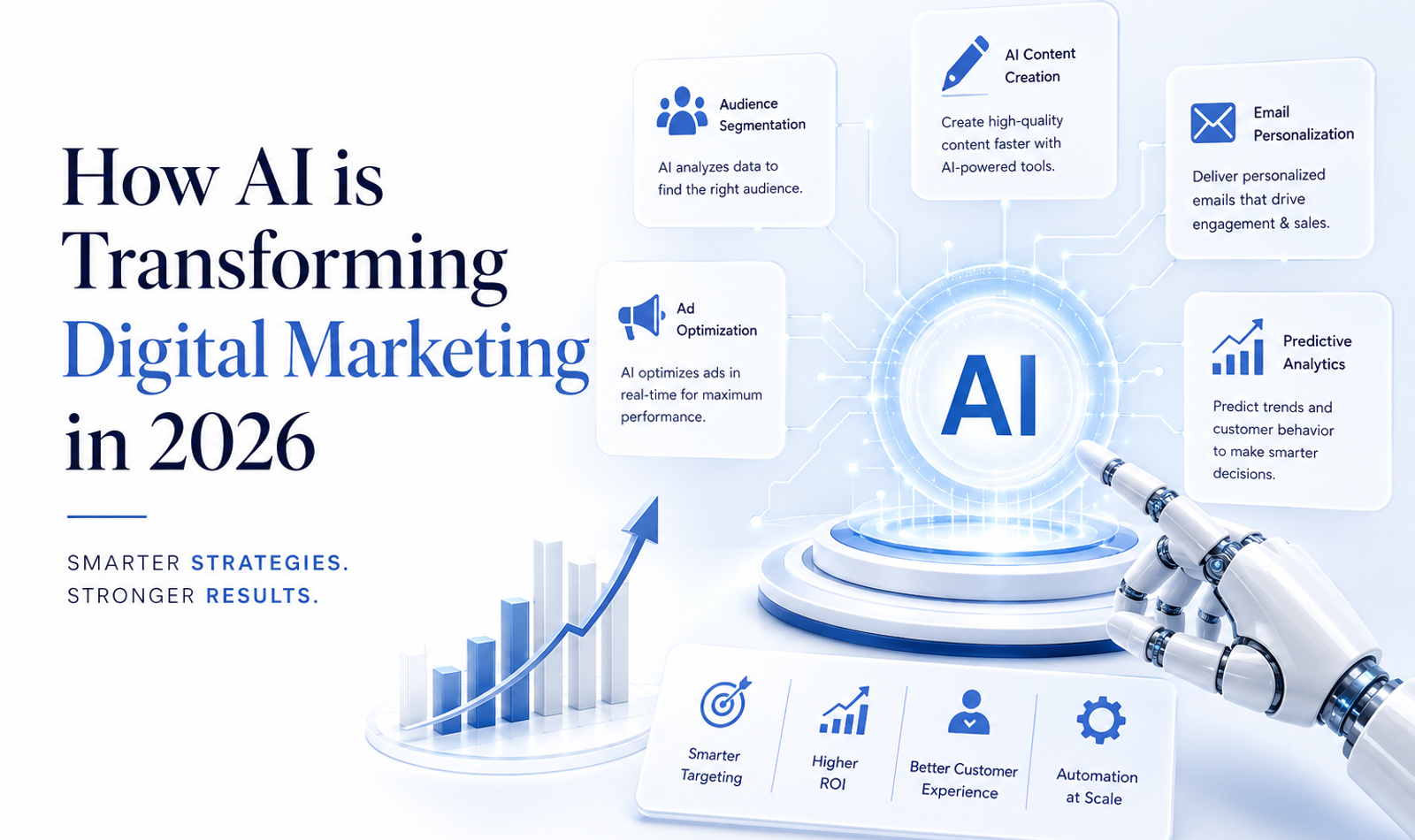
Artificial intelligence has moved from being a future concept to becoming one of the most important forces in digital marketing. In 2026, AI is no longer used only for writing captions, generating images or creating quick content ideas. It is now influencing almost every part of the digital marketing process, from customer research and content planning to advertising, SEO, automation, personalisation, analytics and customer service.
For brands, this shift is changing the way marketing teams work. Earlier, digital marketing depended heavily on manual research, manual content creation, manual campaign setup and delayed performance analysis. Today, AI tools can analyse customer behaviour, suggest campaign ideas, create multiple content variations, personalise communication, automate follow-ups and improve decision-making in real time.
Professional website development and digital marketing services can help businesses connect these AI capabilities with websites, landing pages, SEO, content systems, advertising and lead-generation workflows.
This does not mean that AI has replaced human creativity. In fact, the strongest marketing in 2026 is not created by AI alone. It is created when human strategy and AI-powered execution work together. AI can speed up production, analyse data and reduce repetitive work, but human creativity, brand understanding, emotional intelligence and cultural awareness are still essential.
Digital marketing has always been about reaching the right audience with the right message at the right time. AI is making this process faster, smarter and more precise. It helps brands understand what customers are searching for, what they are engaging with, what problems they are trying to solve and which content formats are most likely to influence them.
AI Is Transforming Content Creation
One of the biggest transformations is happening in content creation. Brands now use AI to generate blog outlines, ad copy, social-media captions, video scripts, email drafts, landing-page content and campaign ideas.
This allows marketing teams to create more content in less time.
However, quantity alone is not enough.
As more brands use AI, generic content is increasing everywhere. This means quality, originality and brand voice are becoming even more important.
AI can write quickly, but it does not automatically understand a brand’s emotional identity, customer promise or market positioning. That is why human editing and strategic direction are necessary.
In 2026, successful brands are not simply using AI to produce more content. They are using AI to produce better content with stronger planning, sharper messaging and greater consistency.
Businesses adopting these tools should follow suitable AI content-creation tools and best practices to maintain originality, factual accuracy, tone and human oversight.
AI Is Changing Video Marketing
AI is also changing video marketing.
Short-form video continues to dominate platforms such as Instagram Reels, YouTube Shorts, Facebook and LinkedIn. AI tools now help brands create video scripts, generate visuals, edit clips, add subtitles, improve voiceovers and create different versions of the same video for different platforms.
This makes video production more accessible for small and medium-sized businesses that may not always have large production budgets.
AI video advertisements are especially useful for:
- Product launches
- Event promotions
- Real-estate walkthroughs
- Restaurant campaigns
- Hospitality marketing
- Fashion storytelling
- Service-based advertising
Instead of creating one video and using it everywhere, brands can now create multiple advertisement variations for different audiences and campaign objectives.
Professional AI video and video-editing services can help brands combine AI-generated elements with strategy, editing, visual consistency, storytelling and platform-specific delivery.
Businesses can also explore the benefits, costs and use cases of AI video advertising before choosing where AI-generated video can add real commercial value.
AI Is Improving Personalisation
Personalisation is another major area where AI is transforming digital marketing.
Customers do not want generic communication. They expect content, offers and recommendations that feel relevant to their needs.
AI helps brands study customer behaviour and create more personalised experiences through:
- Email marketing
- Website recommendations
- Retargeting advertisements
- WhatsApp communication
- CRM workflows
- Product suggestions
- Follow-up sequences
For example, a customer who visits a luxury hotel website may later see content about private stays, destination weddings or weekend experiences based on their browsing behaviour.
A user who checks a product page on an ecommerce website may receive a personalised reminder or relevant offer.
A lead who downloads a brochure may receive an automated follow-up email based on their interest.
This level of personalisation was once difficult for smaller businesses. In 2026, AI-powered tools are making it easier and more affordable.
Brands should still use personalisation carefully. Customers should feel that the business understands their needs, not that they are being monitored excessively.
AI Is Improving Paid Advertising
AI is also improving paid advertising.
Platforms such as Meta, Google, YouTube and LinkedIn already use machine learning to optimise campaigns, but AI is now helping marketers before, during and after campaign execution.
It can support:
- Audience research
- Advertisement-copy creation
- Creative testing
- Campaign segmentation
- Bidding decisions
- Performance analysis
- Landing-page improvement
Earlier, marketers had to create different advertisement versions manually and test them over time. Now AI can help generate multiple creative directions quickly.
It can suggest hooks, headlines, descriptions and call-to-action variations. It can also help identify which audience segments are responding better and which campaign messages need improvement.
This does not remove the need for human media planning.
A campaign still requires clear objectives, correct targeting, strong creative direction, landing-page alignment and proper tracking. AI improves the process, but strategy still decides whether the campaign produces real business results.
Businesses comparing organic and paid acquisition can review SEO versus Google Ads for business growth to understand when each channel may be most useful.
AI Is Transforming SEO
Search-engine optimisation is also changing because of AI.
Traditional SEO focused heavily on ranking pages for keywords. In 2026, search is becoming more answer-driven.
Google AI Overviews and AI-powered search experiences are changing how users discover information. Instead of clicking several links, users may receive a summarised answer directly on the search page.
This means brands need to think beyond keyword rankings.
They need content that is:
- Clear
- Structured
- Trustworthy
- Helpful
- Easy to crawl
- Easy to understand
- Supported by expertise
Authority, source quality, schema markup, direct answers and strong website content are becoming increasingly important.
Brands must create content that helps both users and AI systems understand their value.
A complete technical SEO website optimization guide can help teams improve crawlability, indexing, structured data, internal linking and technical accessibility.
Answer Engine and Generative Engine Optimisation
This is where Answer Engine Optimisation and Generative Engine Optimisation are becoming important.
Businesses now need to optimise not only for conventional search engines but also for AI-driven answer platforms.
Content should answer customer questions clearly, explain topics deeply and show credibility through strong information architecture.
A practical on-page SEO checklist for higher rankings can help brands improve direct answers, headings, metadata, FAQs, internal links and page clarity.
AI search also creates a challenge.
When users receive answers directly on search pages, some websites may receive fewer clicks for informational queries. This makes visibility inside AI answers, strong brand recognition and branded searches more important.
Brands should therefore create content that is useful enough to be referenced while also giving users a reason to visit the website for deeper information, services, proof or tools.
AI Is Transforming Local Marketing
AI can also improve local digital-marketing campaigns.
Local businesses can use AI to study location-based searches, customer reviews, local competition and frequently asked questions.
A restaurant may identify demand for delivery, hygiene, speciality dishes or family dining.
A salon may identify searches related to specific treatments or neighbourhoods.
A clinic may learn which services and appointment questions matter most to nearby patients.
AI can help generate local content, location-based advertisement variations and review-response drafts. However, businesses still need accurate addresses, service areas, opening hours, original local content and genuine customer reviews.
A focused local SEO strategy for Mumbai businesses can help local brands combine AI insights with Google Business Profile optimisation, location pages and regional search intent.
AI Is Transforming Customer Service
AI is transforming customer service and lead management.
Many businesses lose customers because they respond too late or fail to follow up properly.
AI chatbots, automated WhatsApp replies, CRM workflows and intelligent email systems can help businesses capture leads immediately and guide them towards the next step.
For restaurants, this may mean answering questions about:
- Location
- Opening hours
- Reservations
- Delivery
- Menu availability
For real-estate brands, it may mean qualifying leads and sending property details.
For luxury brands, it may mean guiding customers towards private appointments or product enquiries.
For service businesses, it may mean automating consultation bookings and follow-up messages.
In 2026, marketing is not only about attracting attention. It is also about managing that attention properly after the customer shows interest.
AI helps connect marketing with sales by ensuring that leads are not lost between platforms, messages and manual follow-ups.
A connected conversion-focused marketing funnel can help turn advertisement clicks, content visits and brochure downloads into organised lead journeys.
AI Is Improving Marketing Analytics
AI analytics is another powerful transformation.
Earlier, marketers often reviewed campaign reports after a campaign ended. Today, AI tools can help analyse performance while the campaign is still active.
They can identify:
- Which creatives perform better
- Which audiences are more engaged
- Where customers are dropping off
- Which pages are underperforming
- Which leads are more qualified
- Which changes may improve results
This helps brands move from reactive marketing to proactive marketing.
Instead of waiting for a month-end report, teams can adjust campaigns faster.
AI can also summarise large data sets and convert them into understandable insights for business owners who may not have technical marketing knowledge.
For small and medium-sized businesses, this is especially useful. Many business owners do not have time to study complex analytics dashboards.
AI can help explain what requires attention, such as:
- Low click-through rates
- Weak landing-page performance
- Poor lead quality
- High cost per conversion
- Low form-completion rates
- Mobile drop-offs
AI-supported analysis becomes valuable when the business has accurate tracking and clear objectives.
AI Is Improving Email Marketing and Retention
AI is improving email marketing and customer retention.
Instead of sending the same email to every customer, brands can create segmented and personalised campaigns.
AI can help identify:
- Returning customers
- Inactive customers
- Interested leads
- High-value buyers
- New subscribers
- Abandoned enquiries
- Repeat website visitors
It can suggest different messages for each group.
For example, a fashion brand may send styling ideas to one audience, new-collection updates to another and private-preview invitations to premium customers.
A hotel may send destination content to travel planners and wedding-package information to event leads.
A digital-marketing agency may send educational content to business owners who are still in the consideration stage.
This creates a more meaningful customer journey.
AI Is Transforming Social Media Marketing
Social-media marketing is also becoming more AI-driven.
AI tools help brands identify trends, generate content ideas, write captions, analyse engagement and repurpose content across platforms.
A long blog can become:
- Social-media posts
- Video scripts
- Email content
- Advertisement copy
- Carousel content
- Frequently asked questions
- Short-form clips
A customer review can become a testimonial post.
A campaign video can become multiple short-form edits.
However, social media still requires human taste.
AI can suggest what to post, but the brand must decide what is worth saying.
In a market where many brands use similar tools, creativity and originality become even more important.
A connected content strategy for brand websites, blogs, galleries and lead magnets can help businesses repurpose ideas without losing consistency or strategic purpose.
AI Is Improving Creative Testing
AI is helping brands improve creative testing.
Earlier, businesses often selected one campaign idea and invested heavily in it. Now brands can create multiple creative versions and test different hooks, visuals, captions and landing pages.
This reduces guesswork and helps campaigns become more performance-focused.
For example, a restaurant can test whether food close-ups, chef-led storytelling or customer-experience videos perform better.
A real-estate brand can test lifestyle-led advertisements against property-feature advertisements.
A luxury-fashion brand can test craftsmanship storytelling against styling-led content.
AI helps generate and analyse these variations faster.
However, the variations should remain aligned with the same brand positioning.
Testing ten inconsistent creative ideas can confuse the audience even when individual advertisements receive clicks.
AI Is Strengthening Marketing Automation
Another important transformation is marketing automation.
AI-powered automation can connect different parts of the customer journey.
A user may click an advertisement and reach a landing page. Their enquiry can be captured automatically. The CRM can classify the lead. A follow-up message can be sent. The sales team can receive a reminder. If the lead does not respond, another message can be triggered.
This makes digital marketing more structured and less dependent on manual effort.
For businesses that spend money on advertising, automation is essential because missed follow-ups can waste the entire campaign budget.
A strong automation process should still allow human intervention.
High-value enquiries, complaints, unusual questions and sensitive issues should not remain trapped inside automated workflows.
The system should know when to move the conversation to a person.
AI Is Improving Customer Segmentation
AI is improving customer segmentation.
Instead of treating all customers the same, businesses can understand different groups based on behaviour, interest and intent.
Some people are:
- New visitors
- Returning visitors
- Repeat customers
- High-value customers
- Early-stage researchers
- Ready to purchase
- Interested but inactive
Each group needs a different message.
A strong digital-marketing system in 2026 uses AI to identify these differences and communicate accordingly.
This improves conversion and customer experience.
Premium brands should use segmentation carefully so communication remains refined and respectful.
A suitable high-ticket conversion strategy for luxury brands can help businesses combine AI personalisation with premium positioning, qualified enquiries and longer decision cycles.
AI-Assisted Brand Strategy
Another major change is the rise of AI-assisted brand strategy.
AI tools can study competitors, analyse customer reviews, summarise market patterns and identify content gaps.
This helps brands understand where they stand in the market and which opportunities they can target.
For example, a brand may discover that customers are searching for “premium event management in Mumbai” but competitors are not answering specific questions clearly.
A restaurant may discover that customers care more about hygiene and delivery speed than discounts.
A luxury brand may find that customers are asking about craftsmanship, authenticity and personalisation.
These insights can support stronger marketing strategies.
However, AI-generated research should be verified.
The system may summarise patterns, but human teams must determine whether those patterns are commercially relevant, culturally appropriate and consistent with the brand.
A clear luxury brand strategy roadmap can help premium businesses turn market insights into positioning, messaging and content priorities.
AI Is Changing the Role of Digital Marketers
AI is changing the role of digital marketers.
The future digital marketer is not simply a person who posts content or runs advertisements.
The modern marketer must understand:
- Strategy
- Prompting
- Data
- Automation
- Content systems
- Customer journeys
- Creative evaluation
- Brand consistency
- Performance measurement
AI handles many repetitive tasks, but marketers must know how to guide it.
This means digital-marketing teams need new skills.
They need to know how to write better prompts, judge AI-generated content, analyse AI-driven reports, manage automation flows and protect brand voice.
They also need to understand ethics, copyright, disclosure and responsible AI use.
Responsible AI Use in Marketing
Responsible AI use is becoming important.
Brands should not use AI to mislead customers, fake testimonials, create unrealistic claims or hide sponsored communication.
AI-generated content should still be accurate, respectful and aligned with the brand’s real offering.
Trust remains the foundation of marketing.
AI also makes it easier to create content at scale, but brands must avoid becoming generic.
A business that publishes hundreds of AI-written posts without insight or originality may not build trust.
Customers can often sense when content has no real experience behind it.
The best AI marketing combines machine efficiency with human knowledge.
Businesses collecting customer data through forms, personalisation and automation should also follow suitable secure website practices for premium clients.
AI and Website Performance
AI-powered websites and campaigns still require strong technical foundations.
Chatbots, personalisation scripts, analytics tools and third-party platforms can slow down pages when too many are installed without planning.
A slow website can weaken the entire customer journey.
Visitors may leave before interacting with the AI tool or viewing the main content.
Brands should monitor script weight, mobile performance, loading speed and responsiveness regularly.
Strong technical SEO foundations for speed, mobile usability and Core Web Vitals help protect the performance of AI-supported websites and landing pages.
AI Marketing for Small and Medium Businesses
For small and medium-sized businesses, AI creates an opportunity to compete more effectively with larger brands.
They can create better content, respond faster, automate follow-ups and run smarter campaigns without needing very large teams.
A small business can use AI to:
- Research customer questions
- Plan monthly content
- Draft social posts
- Generate advertisement variations
- Summarise reports
- Automate enquiry replies
- Organise leads
- Personalise email communication
However, small businesses should avoid subscribing to too many disconnected tools.
The goal should be to build a manageable system that supports the actual business.
Professional AI marketing services for business growth can help companies decide where automation, content creation, advertising and analytics can provide the greatest value.
AI Marketing for Luxury and Premium Brands
For luxury and premium brands, AI can support personalised experiences, refined storytelling and stronger digital visibility when used carefully.
Luxury brands should not use AI only to increase output.
They should use it to improve relevance and customer service while protecting exclusivity.
AI can support:
- Personalised product recommendations
- Private appointment journeys
- Audience segmentation
- Premium campaign variations
- Customer-service workflows
- Editorial-content planning
- High-value lead qualification
The system should remain discreet.
Luxury customers may value privacy and human interaction more than aggressive automation.
The best use of AI is often invisible. It helps the business respond faster and understand the customer better without making the experience feel mechanical.
AI Is Not a Magic Solution
In 2026, AI is transforming digital marketing in a practical way.
It is helping brands work faster, understand customers better, create more content, improve advertising, strengthen SEO, automate communication and measure performance more clearly.
But AI is not a magic solution.
A weak brand strategy will not become strong simply because AI is used.
Poor customer service will not become premium because a chatbot is installed.
Bad content will not become valuable because it is produced faster.
The businesses that benefit most from AI are those that use it with clear goals.
They know their audience, define their message, build strong systems and use AI to improve execution.
They do not depend on AI blindly.
AI Plus Human Creativity
The future of digital marketing is not AI versus humans.
It is AI plus humans.
AI brings speed, structure and intelligence.
Humans bring creativity, emotion, taste and strategy.
When both work together, brands can create marketing that is faster, smarter and more meaningful.
In 2026, AI is not only transforming digital marketing.
It is transforming the way brands think about growth.
Brands can review Double Trouble Studio’s completed work to explore how strategy, digital content, websites, events and creative execution can work together.
Frequently Asked Questions
How Is AI Transforming Digital Marketing in 2026?
AI is transforming digital marketing in 2026 by improving content creation, paid advertising, SEO, customer service, personalisation, automation and analytics.
It helps brands work faster, understand audiences better and create more targeted marketing campaigns.
Can AI Replace Digital Marketers?
AI cannot completely replace digital marketers.
It can support repetitive tasks such as content drafts, reporting, advertisement variations and automation, but human strategy, creativity, brand understanding and decision-making remain essential.
How Does AI Help in Content Creation?
AI helps in content creation by generating blog ideas, captions, advertisement copy, email drafts, video scripts, product descriptions and campaign concepts.
It speeds up the process, but human editing is important to maintain originality, tone and brand quality.
How Is AI Changing SEO in 2026?
AI is changing SEO by making search more answer-driven.
Brands now need content that is clear, useful, structured and trustworthy so it can perform well in traditional search and AI-powered search experiences.
How Does AI Improve Paid Advertising?
AI improves paid advertising by helping with audience targeting, advertisement-copy creation, creative testing, campaign optimisation and performance analysis.
It helps marketers identify which messages and creatives are performing better.
Is AI Useful for Small Businesses in Digital Marketing?
Yes.
AI is highly useful for small businesses because it helps save time, automate customer replies, manage leads, create content, improve follow-ups and run smarter campaigns with limited resources.
How Does AI Help With Personalisation?
AI helps brands understand customer behaviour and create personalised messages, recommendations, emails, advertisements and website experiences based on customer interest, browsing activity and buying intent.
Can AI Improve Customer Service?
Yes.
AI chatbots and automated-response systems can answer common customer questions, manage enquiries, send updates and support faster communication.
Human support remains important for complex or sensitive issues.
What Are the Risks of Using AI in Digital Marketing?
The main risks include generic content, inaccurate information, weak brand voice, privacy concerns, misleading claims and overdependence on automation.
AI should always be used with human supervision and responsible strategy.
Why Should Brands Adopt AI in Digital Marketing Now?
Brands should adopt AI because customer expectations, competition and digital complexity are increasing.
AI helps businesses respond faster, market more intelligently, improve efficiency and build stronger customer journeys.
Conclusion
AI is transforming digital marketing in 2026 by making campaigns faster, smarter and more connected.
It is changing how brands create content, run advertisements, manage SEO, communicate with customers, analyse performance and automate business workflows.
Marketing is no longer only about publishing content or running campaigns. It is about building intelligent systems that understand customers and support every stage of the journey.
The biggest advantage of AI is efficiency.
It saves time, reduces repetitive work and helps teams produce more ideas, variations and insights.
But the biggest value of AI is not speed alone.
Its real value comes when it is used with strategy, creativity and brand understanding.
Human judgement remains essential.
AI can generate content, but people must decide what is meaningful. AI can analyse data, but people must understand business goals. AI can automate communication, but people must protect trust, tone and customer experience.
In 2026, the brands that grow most strongly will not be the ones using AI blindly.
They will be the ones using AI thoughtfully to improve storytelling, customer experience, performance marketing and long-term brand visibility.
AI is not replacing digital marketing.
It is upgrading it.
When human creativity and AI-powered systems work together, brands can build marketing that is more personalised, measurable and effective.
Build Future-Ready Digital Marketing With AI
If your brand wants to grow in 2026, AI cannot be treated as an optional tool. It needs to become part of your content, advertising, SEO, automation and customer-journey strategy.
At Double Trouble Studio, we help brands use AI-powered digital marketing to create smarter campaigns, stronger content systems, better lead journeys and measurable growth across digital platforms.
Businesses looking for website development and digital marketing services in Mumbai can work with our team across AI strategy, SEO, landing pages, content systems, automation, website development and conversion improvement.
Contact Double Trouble Studio for AI-powered digital marketing, content creation, SEO, video advertising, website development, automation and complete creative-growth strategy.
📩 info@dtsworld.in 📞 +91 80000 06021📍 Andheri West, Mumbai
Need this for your brand?
Let DTS build your next campaign.
From PR, celebrity management and events to websites, social media, SEO and AI video production — Double Trouble Studio helps brands grow with strategy and execution.
Discuss Your Requirement →